Christian Churches of God

No. 203

Start of the Month and the Day

(Edition 1.0 20000930-20030921)
Understanding when the Month and the Day commence is important for correctly keeping all of the weekly Sabbaths, the monthly New Moons and God�s annual Holy Days. The twenty-four hour day starts at the end of evening nautical twilight (EENT), at dark. This paper is written to complement the paper God�s Calendar (No. 156) and should be read with that paper.
Christian Churches of God
PO Box 369, WODEN ACT 2606, AUSTRALIA

(Copyright © 2000, 2003 James Dailley: Ed. Wade Cox)

This paper may be freely copied and distributed provided it is copied in total with no alterations or deletions. The publisher’s name and address and the copyright notice must be included.  No charge may be levied on recipients of distributed copies.  Brief quotations may be embodied in critical articles and reviews without breaching copyright.

This paper is available from the World Wide Web page:
http://www.logon.org and http://www.ccg.org

Start of the Month and the Day

Members and associates of Christian Churches of God follow the natural astronomical cycle for assigning a lunar/solar cyclical annual Holy Day calendar. This is as it was during the Ancient Temple period.

Psalm 104:19-20 19 He made the moon for the seasons; The sun knows the place of its setting. 20 Thou dost appoint darkness and it becomes night, In which all the beasts of the forest prowl about. NASV (cf. Ps 8:3; Ps 89:37)

The annual calendar is set by the alignment of both the monthly lunar cycle and the annual solar cycle. The lunar cycle sets the seasons based on the solar equinoctal cycle. The moon and sun together are governing signs.

Genesis 1:14-19 14 Then God said, “Let there be lights in the expanse of the heavens to separate the day from the night, and let them be for signs, and for seasons, and for days and years; 15 and let them be for lights in the expanse of the heavens to give light on the earth”; and it was so. 16 And God made the two great lights, the greater light to govern the day, and the lesser light to govern the night; He made the stars also. 17 And God placed them in the expanse of the heavens to give light on the earth, 18 and to govern the day and the night, and to separate the light from the darkness; and God saw that it was good. NASV

The seven-day week does not fit evenly into the lunar month of 29.5 days (4 weeks x 7 days =28 days) and neither fit into the solar year of 365 1/4 days (52 weeks x 7 days =364 days) and (12 months x 29.5 days =354 days). These cycles continuously overlap and this feature of the astronomical cycle sets the Holy Days apart.

These days are sanctified or set apart for worship and this is why it is so important that they be correctly identified and observed. The New Moons, Holy Days and Feasts are held at appointed set times for our assembly and for us to make our offerings (Ex. 13:10; Ex 23:14-17; Ex. 34:18-23; Lev. 23; 2Chron. 2:4; Neh. 10:33; Eze. 44:24; 45:17).

SHD 4150 d[eAm or d[emo or hd'[‘Am (moed or moed )

Meaning: appointed time, place, or meeting

We blow the shofar as a call to attend services at these appointed times (Num. 10:7-10) and the natural astronomical cycle cannot be lost, (Jer. 33:20) only neglected. We will keep these Holy Days correctly, even if no one else will (Lam. 1:4) so that God�s anger is turned away from His people (Lam. 2) and so that all may repent (Zep. 3:12-20) and not be rejected (Hos. 9:1-9).

The basic formula for what is termed the “Jewish” calendar is a 19 solar year cycle, which equals 235 lunar months. That is, 19 ordinary solar years having twelve months, with seven of these years having an additional or intercalated lunar month. This additional month keeps the solar year correctly aligned with the spring or vernal equinox. The Greeks called this the Metonic Cycle. This means that every 19 years the civil Gregorian date and the Jewish date coincide either exactly or deviate by one day.

Philo, the Jewish historian and contemporary of Jesus Christ and the apostles, writes in his book, The Works of Philo, On the Life of Moses II, chapter XLI, Part 222 and 224“Moses puts down the beginning of the vernal equinox as the first month of the year…..”

The Start of the Year

Exodus 12:1-5 And Jehovah spake unto Moses and Aaron in the land of Egypt, saying, 2 This month shall be unto you the beginning of months: it shall be the first month of the year to you. Speak ye unto all the congregation of Israel, saying, In the tenth day of this month they shall take to them every man a lamb, according to their fathers’ houses, a lamb for a household: 4 and if the household be too little for a lamb, then shall he and his neighbor next unto his house take one according to the number of the souls; according to every man’s eating ye shall make your count for the lamb. 5 Your lamb shall be without blemish, a male a year old: ye shall take it from the sheep, or from the goats: 6 and ye shall keep it until the fourteenth day of the same month; and the whole assembly of the congregation of Israel shall kill it at even. (Ereb SHD 6153)

Deuteronomy 16:1-6 Observe the month of Abib, and keep the passover unto the LORD thy God: for in the month of Abib the LORD thy God brought thee forth out of Egypt by night. 2 Thou shalt therefore sacrifice the passover unto the LORD thy God, of the flock and the herd, in the place which the LORD shall choose to place his name there. 3 Thou shalt eat no leavened bread with it; seven days shalt thou eat unleavened bread therewith, even the bread of affliction; for thou camest forth out of the land of Egypt in haste: that thou mayest remember the day when thou camest forth out of the land of Egypt all the days of thy life. 4 And there shall be no leavened bread seen with thee in all thy coast seven days; neither shall there any thing of the flesh, which thou sacrificedst the first day at even, remain all night until the morning. 5 Thou mayest not sacrifice the passover within any of thy gates, which the LORD thy God giveth thee: But at the place which the LORD thy God shall choose to place his name in, there thou shalt sacrifice the passover at even, (Ereb SHD 6153) at the going down of the sun, at the season that thou camest forth out of Egypt.

The month of the Passover is the first month, called Nisan or Abib and it is specifically commanded by the Lord as being the beginning of the year from Exodus 12:2 (see also Num. 9:1-3; 33:3; Josh. 4:19; Ezek. 45:18, 21).

“The observation of the autumnal equinox, i.e., �the going out of the year� (see Ex. 23:16), and of the spring or vernal equinox, called �the return of the year� (1 Ki. 20:26; 2 Ch. 36:10 AV), was important for controlling the calendar and consequently the festivals. Thus the year began with the new moon nearest the vernal equinox when the sun was in Aries (Jos., Ant. 3.201 [better to see Ant. (Antiquities of the Jews) III.x.5], and the Passover on the fourteenth day of Nisan coincided with the first full moon (Ex. 12:2-6)”. (The Illustrated Bible Dictionary, J D Douglas & N Hillyer, editors, IVP, 1980; art. Calendar, Vol. 1, p. 223).

From the New Moon at full dark or at the conjunction, there can be a larger number of thirty-day months in a year. This would return to the pre-tradition observations of up to eight thirty-day months. The Passover must always fall after the vernal equinox. The New Moon may be up to thirteen days before the equinox.

The Passover festival, to be celebrated at full moon in the month of Nisan (14 Nisan), should in any case fall after the vernal equinox [metaisemerian earinen] when the sun stood in the sign Aries. This explanation is characterized by Anatolius, in a fragment of decided importance in relation to the history of the Jewish calendar given in Eusebius Hist eccl. vii 32. 16-19, characterizes this as the unanimous view of all the Jewish authorities… With this also agree the statements of Philo and Josephus. If one therefore toward the close of the year noticed that the Passover would fall before the vernal equinox, the intercalation of a month before Nisan would have to be resorted to.

(Schurer, A History of the Jewish People in the Time of Jesus Christ, First Divison, Volume II, Appendix III).

The rule is that the fourteenth day could fall on the day of the equinox but that the fifteenth day, which is the first day of Unleavened Bread or catagorized as the full moon, must fall after the day of the equinox. This is and was calculated months and years in advance. The Samaritans have used this rule for 2500 years and Anatolius says it was the unanimous view of all of the Jewish authorities. This is remarkable (see the Encyclopedia Judaica under Samaritans and John Bowman, Samaritan Documents Relating to Their History, Religion and Life, Pittsburgh Original texts and Translation Series).

Josephus says also that it was while the sun was in Aries and this makes the system more precise. It is important that Schurer notes that the Greeks and the Babylonians (the Egyptians with their solar year were not involved here) had for centuries possessed a fixed calendar based on accurate computation. The Babylonians had such a calendar under the Persians, and the Samaritans and Sadducees determined the calendar long in advance according to the conjunction.

Josephus, Antiquities of the Jews, III, 10 reference is quoted in full:

In the month of Xanthicus, which is called Nisan by us, and is the beginning of the year, on the fourteenth day of the moon, while the sun is in the sign of Aries (the Ram), for during this month we were freed from bondage under the Egyptians, he has also appointed that we should sacrifice each year the sacrifice which, as we went out of Egypt, they commanded us to offer, it being called the Passover.

This places the first day of the first month sometime during the Roman time from March 7th to April 5th.

The New Catholic Encyclopedia comments:

Since the majority of the early Christians were Jewish converts, it is understandable that from the outset the Christian calendar was governed by the fact that the death and Resurrection of Christ had taken place at the time of the chief Jewish feast, the Pasch, or Passover, celebrated on the 14th day of the month of Nisan, i.e., at the full moon following the Spring equinox.

The first month of the year must have the 15th day Passover, the full moon, fall after the vernal equinox. If Passover, being the first Day of Unleavened Bread, falls on the day of or before the equinox, then an extra or intercalary month is added to the year.

This important rule will not be found anywhere in Scripture (see God’s Calendar (No. 156)).

The Start of the Month

Philo of Alexandria [tr. by F H Colson (Harvard University Press, Loeb Classical Library, Cambridge, MA, 1937); The Special Laws, II, XI,41] writes: “The third [feast] is the new moon which follows the conjunction of the moon with the sun”. And in II, XXVI,140: “This is the New Moon, or beginning of the lunar month, namely the period between one conjunction and the next, the length of which has been accurately calculated in the astronomical schools”. It should be noted that the popular Hendrickson Publishers edition (1993) of C D Jonge�s 1854 translation does not have the same information that the Colson translation gives. The indications are that the conjunctions were the determining factors in deciding the first day of the month.

The lunar solar conjunction is the precise alignment of the sun, moon, and planet earth; meaning the meeting of two or more heavenly bodies in the same longitude or the right ascension. At the time of the new moon the sun, moon and earth are in complete alignment.

The lunar solar conjunction can take place at any time during the solar rotation. The time this event takes place at Jerusalem sets the New Moon day apart as a Sabbath and as the day that begins the new month.

The first day of the month begins from the conjunction, or alignment, of the sun and the moon and the planet earth. They would look like three balls having their centres pierced and hung on a taut string. At the time of the full moon the positions would have the sun and the earth in the middle and moon now in alignment on the outside.

The precision with which this event could be predicted allowed all seafaring communities and naval forces to gauge their coming and going. The fact is that we are coming out of a Trinitarian induced dark age that has removed most of the knowledge people had from ancient times (see the papers The New Moons (No. 125)The New Moons of Israel (No. 132)).

The immense structures which were built in North West New Mexico at Chako canyon, show the ability of people over one thousand years ago to build massive building complexes positioned in some cases almost twenty miles apart in precise solar and lunar alignment. Together they are a lunisolar calendar with their walls having precise alignment with the sun and the moon�s courses.

On the canyon walls the builders also show streaks of light filtered through numerous set rock structures. These light streaks shine on many rock engraved or carved graphs appearing at the peak of the equinoxes and solstices. Also, some calendars function with shadows as identification markers.

The Encyclopaedia Britannica, 9th edition, article Calendar, explains some of the controversy:

The [spring] equinox is fixed on the 21st of March, though the sun enters Aries generally on the 20th of that month, sometimes on the 19th. It is accordingly quite possible that a full moon may arrive after the true equinox, and yet precede the 21st of March. This, therefore, would not be the paschal moon of the calendar, though it undoubtedly ought to be so, if the intention of the Council of Nice [Nicea] were rigidly followed. The new moons indicated by the epacts [extra days needed to determine Easter Sunday] also differ from the astronomical new moons, and even from the mean new moons, in general by one or two days…. The epacts are also placed so as to indicate the full moons generally one or two days after the true full moons; but this was done purposely, to avoid the chance of concurring with the Jewish Passover, which the framers of the calendar seem to have considered a greater evil than that of celebrating Easter a week too late (p. 599).

The debate regarding the fourteenth day, the Lord�s Supper and Easter, also had the effect of altering the correct astronomical New Moon and the start of the month for religious purposes. The religious authorities did know when the true new moon at the conjunction was, as did the ancient Chinese and all naval peoples.

Christian Churches of God accept the natural astronomical cycle as governing the calendar. There is no confusion and a calendar may be set years in advance. Care must be taken when the conjunction is close to the start of the day, which is at dark, at the end of evening nautical twilight at Jerusalem.

These monthly New Moon and Holy Day dates are published for the seven-year cycle, the septenante, which concludes in the Roman year 2005. This will be the 28th year of the 40th Jubilee from Messiah�s baptism and the 120th Jubilee from Adam (see the paper The Meaning of Ezekiel�s Vision (No. 108).

Modern Judaism and Islam have not kept the New Moon day as holy, and both have fallen into crescent observation and false worship. Because the sacrifice of Jesus the Christ has not been accepted, they are not permitted to worship on the days set aside in honour of the One True God. The correct observance of these days and the complete Jubilee covenant system will provide humanity with liberty.

The postponement system developed from Hillel II prevents the Jews from keeping Atonement and Passover correctly. Judaism often is one complete month late in determining the start of the year. In 1997 the Catholics kept Easter one week after Christian Churches of God kept the Wave Sheaf, while Judaism was one complete month later.

See Vol. 25, No. 1, 1997 Jewish Bible Quarterly for Saul Leeman, WHY IS PESACH SO LATE THIS YEAR? (Published with permission in the paper Why Is Passover So Late in 1997? (No. 239) (CCG, 1997).

In 1997 they were one month late with the start of the year as their calculators know, and they admit their determinations are incorrect. They feel that it will take Messiah�s return to correct the calendar issues. If Judah knows they are in error, but accommodate the error to retain their traditions they will still once again be facing grave difficulties along with physical Israel. When the Churches of God find they are in error regarding when they worship, they must repent and take corrective action (see the paper The Calendar and the Moon: Postponements or Festivals? (No. 195)).

In Maimonides’ book, “Sanctification of the New Moon“, (Book Three, Treatise 8, page 89, chapter 6) which was written about 1200 CE, states: “the molad is defined as `the moment in which sun and moon, in their uniform motion, become conjoined in a certain part of the sky, which occurs in the same way everywhere – in contrast to the varying times at which the new crescent first becomes visible – in different areas’.” This statement defines the conjunction. At the same time Judaism in general did not keep the New Moon as a Holy Day, and started the month by crescent observation.

Levi�s and Judah�s authority was removed when Christ appointed the new Sanhedrin and re-established the order of Melchisedek (Lk. 10:1-20). This removed the authority of the Levitical priests in Judah.

Luke 10:1-20 1 Now after these things the Lord appointed seventy others, and sent them two and two before his face into every city and place, whither he himself was about to come. And he said unto them, The harvest indeed is plenteous, but the laborers are few: pray ye therefore the Lord of the harvest, that he send forth laborers into his harvest. 3 Go your ways; behold, I send you forth as lambs in the midst of wolves. Carry no purse, no wallet, no shoes; and salute no man on the way. 5 And into whatsoever house ye shall enter, first say, Peace be to this house. 6 And if a son of peace be there, your peace shall rest upon him: but if not, it shall turn to you again. 7 And in that same house remain, eating and drinking such things as they give: for the laborer is worthy of his hire. Go not from house to house. 8 And into whatsoever city ye enter, and they receive you, eat such things as are set before you: and heal the sick that are therein, and say unto them, The kingdom of God is come nigh unto you. 10 But into whatsoever city ye shall enter, and they receive you not, go out into the streets thereof and say, 11 Even the dust from your city, that cleaveth to our feet, we wipe off against you: nevertheless know this, that the kingdom of God is come nigh. 12 I say unto you, it shall be more tolerable in that day for Sodom, than for that city. 13 Woe unto thee, Chorazin! woe unto thee, Bethsaida! for if the mighty works had been done in Tyre and Sidon, which were done in you, they would have repented long ago, sitting in sackcloth and ashes. 14 But it shall be more tolerable for Tyre and Sidon in the judgment, than for you. 15 And thou, Capernaum, shalt thou be exalted unto heaven? thou shalt be brought down unto Hades. 16 He that heareth you heareth me; and he that rejecteth you rejecteth me; and he that rejecteth me rejecteth him that sent me. 17 And the seventy returned with joy, saying, Lord, even the demons are subject unto us in thy name. 18 And he said unto them, I beheld Satan fallen as lightning from heaven. 19 Behold, I have given you authority to tread upon serpents and scorpions, and over all the power of the enemy: and nothing shall in any wise hurt you. 20 Nevertheless in this rejoice not, that the spirits are subject unto you; but rejoice that your names are written in heaven.

The spirits are subject to us and we should have no fear of anything, but desire to live for and love our Father.

The Levites have no authority today as it was transferred to the Churches of God, as the Body of Christ. They are against us and they are only appealed to for authority by the idolatrous Churches, as their rebellion and false calendar will prevent them from keeping the correct days along with Judah.

Acts 19:11-17 11And God wrought special miracles by the hands of Paul: 12 insomuch that unto the sick were carried away from his body handkerchiefs or aprons, and the evil spirits went out. 13 But certain also of the strolling Jews, exorcists, took upon them to name over them that had the evil spirits the name of the Lord Jesus, saying, I adjure you by Jesus whom Paul preacheth. 14 And there were seven sons of one Sceva, a Jew, a chief priest, who did this. 15 And the evil spirit answered and said unto them, Jesus I know, and Paul I know, but who are ye? 16 And the man in whom the evil spirit was leaped on them, and mastered both of them, and prevailed against them, so that they fled out of that house naked and wounded. 17 And this became known to all, both Jews and Greeks, that dwelt at Ephesus; and fear fell upon them all, and the name of the Lord Jesus was magnified.

The sons of Sceva, who was a chief Priest, were no longer recognized by the demons as they had lost their authority. The authority was passed to the Priesthood of Melchesidek, which now included Paul, a Benjamite and all future Gentile converts.

The Churches of God must worship the Father alone on the correct days and in the correct ways. We have been given authority to identify and set apart the date of the second sacrament, the Lord�s Supper, which will establish the first month and the start of the year. There is verifiable historical information for the rule, but this is not to be found identified in Scripture.

The Start of the Day

We do not have a specific clear Scripture to define and explain the start of the year with its intercalation and the start of the month at the conjunction.

We do have Scriptures to define the start of the day. Therefore we can keep the Sabbaths cleared of business, which includes eating out at restaurants, and observe the fasts for the correct time periods.

Timing:

Just before sunset, a low flat, dark blue band rises up from the eastern horizon. This is the earth�s shadow and it stretches for nearly 180�. It is bounded above by the pinkish antitwilight arch and below by the horizon. The earth’s shadow is best seen when the sky is clear and our line of sight is long. As the sun sets, the boundary between the earth�s shadow and the antitwilight arch rises in the sky and becomes progressively less distinct. With the disappearance of the antitwilight arch, the shadow blends smoothly with the deepening blue night sky.

For a shadow to be seen, it must be cast upon something. The earth shadow is cast upon the atmosphere. Eventually the antitwilight arch fades to blue. Its strong color and brightness near sunset originate in backscattering by the relatively thick lower atmosphere, being illuminated by direct (reddened) sunlight. But as the twilight rises, so does the lower bound of the atmosphere, being illuminated by direct sunlight. Being higher and thinner, it scatters less red light and a point is reached where the strong bluish airlight, the same multiply scattered skylight making the earth shadow blue, becomes the dominant source of light reaching our eyes.

http://webexhibits.org/causesofcolor/14E.html#es

This feature of the setting of the sun caused the Jews to use a wound red and blue thread, which was held up to the diminishing light to determine the time of dark. This was the start of the Holy Day, as the time when the colours could no longer be distinguished. This is not an unreasonable method to indicate when they could no longer conduct even verbal business. This is sneered at by some, but if we test this we will find that the colours merge very closely to the end of evening nautical twilight. This will also depend upon atmospheric conditions.

The definition of twilight includes:

1. the soft diffused light occurring when the sun is just below the horizon esp. following sunset;

2. the period in which this light occurs;
3. the period of time during which the sun is a specified angular distance below the horizon (6, 12 and 18 degrees for civil twilight, nautical twilight and astronomical twilight respectively). C15: literally: half-light (between day and night), from old English twi – half + light or two lights;

4. any faint light (Collins English Dictionary).

When the sun first sets on a clear night, we notice that although the light is diminishing, we can generally see perfectly well for up to 28 minutes. This is during the period of civil twilight.

Dusk is twilight or the darker part of the twilight. (Collins English Dictionary)

Elsewhere the term twilight is used to identify a more defined period of time: the period just before it becomes completely dark in the evening. (Cambridge International Dictionary)

Generally in North America, the term �twilight� is used in the sense of the civil more than the nautical time frame. In England, Australia and New Zealand it is used as the nautical time, or for what North Americans would refer to as �dusk�.

There are often words used in one part of the Commonwealth of Israel, the British derived nations, that may have a different usage and meaning in others.

In North America a pub is a bar or tavern, but is a seldom-used term. In Australia and New Zealand it means a hotel. This is from the old British public house. (see Collins English Dictionary)

If people are unaware of different uses of terminology, confusion can ensue. Protest today means to be against but originally it meant for truthPro meaning “for” and teste meaning “truth.”

The �going down of the sun� is a term in this category. To North Americans it is usually understood as speaking about the time the sun is going below the horizon. It was not used solely in that way by Hebrew speakers.

Deuteronomy 16:4-6 And there shall be no leavened bread seen with thee in all thy coast seven days; neither shall there any thing of the flesh, which thou sacrificedst the first day at even, remain all night until the morning. 5 Thou mayest not sacrifice the passover within any of thy gates, which the LORD thy God giveth thee: 6 But at the place which the LORD thy God shall choose to place his name in, there thou shalt sacrifice the passover at even, at the going down of the sun, at the season that thou camest forth out of Egypt.

Exodus 12:6-11 And ye shall keep it up until the fourteenth day of the same month: and the whole assembly of the congregation of Israel shall kill it in the evening (Ereb SHD 6153). 7 And they shall take of the blood, and strike it on the two side posts and on the upper door post of the houses, wherein they shall eat it. 8 And they shall eat the flesh in that night, roast with fire, and unleavened bread; and with bitter herbs they shall eat it. 9 Eat not of it raw, nor sodden at all with water, but roast with fire; his head with his legs, and with the purtenance thereof. 10 And ye shall let nothing of it remain until the morning; and that which remaineth of it until the morning ye shall burn with fire. 11 And thus shall ye eat it; with your loins girded, your shoes on your feet, and your staff in your hand; and ye shall eat it in haste: it is the LORD’S passover.

The above use of ereb in both Scriptures means 3 p.m. in the afternoon, or the Hebrew ninth hour. Elsewhere it refers to different periods of time, this being understood from the context.

Josephus Wars of the Jews (book 6, chapter 9, verse 3)

��� So these High Priests, upon the coming of the feast that is called the Passover, when they slay the sacrifices, from the ninth hour to the eleventh, [Our western three to five p.m.] but so that a company of not less than ten belong to every sacrifice for it is not lawful to eat singly by themselves and many of us are twenty to a company ���.

Strongs 6153 definition is not a specific point in time such as sunset. As we saw earlier the going down of the sun referred to mid afternoon or our 3 p.m. and not when the sun has set below the horizon.

6153 `ereb {eh’-reb}
from 06150TWOT – 1689a; n m
AV – even 72, evening 47, night 4, mingled 2, people 2, eventide 2, eveningtide + 06256 2, Arabia 1, days 1, even + 0996 1, evening + 03117 1, evening + 06256 1, eventide + 06256 1; 137
1) evening, night, sunset

Proverbs 7:9 In the twilight (SHD5399), in the evening (SHD3117 + 6153), {or the day at evening} in the black and dark night:

5399 nesheph {neh’-shef}

Meaning: 1) twilight 1a) evening twilight 1b) morning twilight

Origin: from 05398; TWOT – 1434a; n m

Usage: AV – twilight 6, night 3, dark 1, dawning of the morning, dawning of the day 1; 12

3117 ~Ay yowm {yome}

Meaning: 1) day, time, year 1a) day (as opposed to night) 1b) day (24 hour period) 1b1) as defined by evening and morning in Genesis 1 1b2) as a division of time 1b2a) a working day, a day’s journey 1c) days, lifetime (pl.) 1d) time, period (general) 1e) year 1f) temporal references 1f1) today 1f2) yesterday 1f3) tomorrow

Origin: from an unused root meaning to be hot; TWOT – 852; n m

Job 7:4 When I lie down, I say, When shall I arise, and the night <ereb 06153> be gone? and I am full of tossings to and fro unto the dawning of the day.

Jeremiah 6:4 Prepare ye war against her; arise, and let us go up at noon. Woe unto us! for the day goeth away, for the shadows of the evening <ereb 06153> are stretched out.

Ezekiel 12:7 And I did so as I was commanded: I brought forth my stuff by day, as stuff for captivity, and in the even <ereb 06153> I digged through the wall with mine hand; I brought [it] forth in the twilight (5939), [and] I bare [it] upon [my] shoulder in their sight.

From the above Scriptures it is clear that ereb (SHD 6153) covers a broad period of time from the afternoon to well into the dark and it does not present grounds to assert that days begin at sunset. It could be read that way in some of the numerous texts though.

In Scripture the Hebrew word ereb is frequently used. Evening, between the evenings, twilight, sunset and night are all used in translation. They carry a variety of different time frames in their use and ereb cannot be used to declare that the day begins with the sun setting below the horizon.

Deuteronomy 21:22-23 22 “And if a man has committed a sin worthy of death, and he is put to death, and you hang him on a tree, 23 his corpse shall not hang all night on the tree, but you shall surely bury him on the same day (for he who is hanged is accursed of God), so that you do not defile your land which the LORD your God gives you as an inheritance. NAS

Deuteronomy 2l:23 does not allow a dead body to remain hanging overnight, but is to be taken down the same day which is before dark, so that the land does not become defiled. A new day began at dark and the bodies were to be removed before that time.

This removal carried out by Joshua with the king of Ai and also with the five kings.

Joshua 8:29 And he hanged the king of Ai on a tree until evening [the eventide ASV] <ereb 6153>; and sunset [at the going down of the sun ASV] <SHD8121> Joshua commanded and they took his body down from the tree, and threw [cast ASV] it at the entrance of the city gate, and raised over it a great heap of stones that stands to this day.

Joshua 10:25-27 25 Joshua then said to them, “Do not fear or be dismayed! Be strong and courageous, for thus the LORD will do to all your enemies with whom you fight.” 26 So afterward Joshua struck them and put them to death, and he hanged them on five trees; and they hung on the trees until evening <ereb 6153>. 27 And it came about at sunset [the going down of the sun ASV] <SHD8121> that Joshua commanded, and they took them down from the trees and threw them into the cave where they had hidden themselves, and put large stones over the mouth of the cave, to this very day.

In each case the dead kings were removed from the trees at the going down of the sun. The word rendered sunset SHD 8121 is shemesh meaning the brilliance in verses 8:29 and 10:27, and disposed of. This would have taken some time and makes it clear that it was not the sunset or the going down of the sun that Joshua was concerned about, but the approaching dark. This fulfilled the principle in Deuteronomy that they were to be removed and buried on the same day. Hence the going down of the sun is still construed as being the same day until it becomes dark. This has been the constant view in Ancient Israel, Ancient Judaism and also in the Koran. It is only in the Hadith and late Judaism do we start to comply with the late Roman system.

In Joshua 10:26 we learn that Joshua had the dead kings hung on five trees until evening <ereb 6153>. Verse 27 says that at the going down of the sun [rendered as sunset in some texts] Joshua commanded that they be taken down from the trees and thrown into a cave.

At the very first day of a twenty-hour period on a round rotating planet, there cannot have existed any light reflecting off the atmosphere from a setting sun. How can there have been?

This is made clear at the beginning and from the Scriptural definition for the day, or for one solar rotation, which we are presented with.

Genesis 1:1-5 1 In the beginning God created the heavens and the earth. 2 And the earth was formless and void, and darkness <SHD 02822> was over the surface of the deep; and the Spirit of God was moving over the surface of the waters. 3 Then God said, “Let there be light”; and there was light. And God saw that the light was good; and God separated the light from the darkness. <SHD 2822> 5 And God called the light day, and the darkness <SHD 2822> He called night <SHD 3915>. And there was evening and there was morning, one day.

<02822> (choshek) (365a)

Meaning: darkness, obscurity

Origin: from 2821

Usage: dark(5), darkness(73), obscurity(2).

<03915> (layil or lel or layelah) (538c)

Meaning: night

Origin: of unc. der.

Usage: midnight*(6), night(200), nights(14), nocturnal(1), overnight*(2), tonight(10).

The darkness at the beginning of the first new day was called night. Night and then light or evening and then morning comprised the first complete day. The sky is not dark at the time the sun drops just below the horizon, termed by North Americans as sunset, and not for close to one hour afterwards in the first and seventh months, which are near the spring and the autumn equinox. The sky is dark at the beginning of the new day.

September 16th 2002 was the Day of Atonement. We began the fast the evening before, on the Roman 15th day at the end of evening nautical twilight, at dark.

In central Canada, using Eastern Standard Time close to the 43rd longitude, the sun set at 18:25 or 6:25 p.m. on the 15th and at 18:24 on the 16th. Civil twilight ended at 18:54 on the 15th and 18:52 on the 16th. Nautical twilight ended at 19:27 on the 15th and at 19:26 or 7:26 p.m. on September 16th with daylight saving active.

Moslems must listen; the Koranic definition is the same as is given in Genesis.

Sura [2.187] It is made lawful to you to go into your wives on the night of the fast; they are an apparel for you and you are an apparel for them; Allah knew that you acted unfaithfully to yourselves, so He has turned to you (mercifully) and removed from you (this burden); so now be in contact with them and seek what Allah has ordained for you, and eat and drink until the whiteness of the day becomes distinct from the blackness of the night at dawn, then complete the fast till night, and have not contact with them while you keep to the mosques; these are the limits of Allah, so do not go near them. Thus does Allah make clear His communications for men that they may guard (against evil). M.H. Shakir and published by Tahrike Tarsile Qur’an, Inc

In order to understand the Prophet�s recitals, all of Islam must read and study the Scriptures.

These are termed the Old and New Testaments, but this means the first and the second testimonials. If these Scriptures are not studied, Moslems will not be able to understand the Prophets instructions.

Lines seven to ten are translated by most others as is found on al-islam.com:
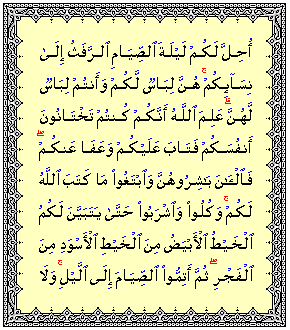


[187] Permitted to you, on the night of the fasts, is the approach to your wives. They are your garments and ye are their garments. Allah knoweth what ye used to do secretly among yourselves; but He turned to you and forgave you; so now associate with them, and seek what Allah hath ordained for you, and eat and drink until the white thread of dawn appear to you distinct from its black thread; then complete your fast till the night appears; but do not associate with your wives while ye are in retreat in the mosques. Those are limits (set by) Allah: approach not nigh thereto. Thus doth Allah make clear His Signs to men: that they may learn self-restraint.


In making this distinction between light and dark Moslems in the sixth century used the ability to discern white and black thread in the morning to commence their fast. They fast for the daylight period. This means they must fast from dark to dark and not until sunset as the Hadithic writers state. This distinction is used in the same way that the Jews used the inability to discern red and blue thread in the evening, to break the fast at dark.

Many Moslems today end the fast five or ten minutes after the sun has set just below the horizon. During this civil twilight period we can readily distinguish black and white thread. Therefore this is incorrect and not according to the Prophet�s instruction. “Till the night appears�, verse 187, does not mean shortly after sunset. The clarification of the Calendar in Islam will deal with the months in their sequence. The modern Islamic calendar is quite incorrect.

This discerning of colours was a method of measuring the end of evening nautical twilight along with seeing three medium size stars.

In North America there is legislation that covers the firing of guns by hunters. It is declared that this activity must cease with the end of the civil twilight or thirty minutes after the sun sets. There is still enough light and time to see for the hunters to get safely out of the field, but all shooting must cease.

On a clear night in the Northern Hemisphere, close to the End of Evening Nautical Twilight (EENT), three medium size stars become visible. If we try viewing this, we will find that with 20/20 vision we will see these stars within minutes of the published EENT times for our locality. With the more complete blackness the smallest stars begin to show themselves.

The viewing of three medium sized stars was used as a measure to end the day and the fast by Judaism and by the Churches of God during the inquisition (see Appendix II, Talmudic Definitions and see Appendix III, Edict of Faith, Agreement concerning the Familiars of the Inquisition, Valencia, 1568, at the end of this paper and also the paper Role of the Fourth Commandment in the Historical Sabbath-keeping Churches of God (No. 170)).

http://aa.usno.navy.mil/data/docs/RS_OneDay.html

The website above will provide us with local data for Sundown, Civil and Nautical twilight in our precise geographic locations. We have also used the definitions in use at the U.S. Naval Observatory, Astronomical Applications Department (see Appendix I).

Monday 16th September 2002 Yom Kippur
What is it all about?

Yom Kippur (the Day of Atonement) falls on the tenth day of Tishrei, in the Jewish calendar, and brings to an end the ‘Ten days of Repentance’ which began on Rosh Hashana. Yom Kippur is a fast day, which lasts for approximately twenty-five hours, from sunset, until the stars come out on the following night.

This modern statement published by the World Union of Jewish Students shows that Judah ends the fast at dark, when the stars come out. They start it at sunset, before the change of the day and end it about twenty-five hours later. They end the fast and start the new day after the Day of Atonement at dark and not at sundown.

http://www.wujs.org.il/activist/yom_kippur/index.shtml

Genesis 15:17-18 17 And it came to pass, that, when the sun went down, and it was dark, behold a smoking furnace, and a burning lamp that passed between those pieces. 18 In the same day the LORD made a covenant with Abram, saying, Unto thy seed have I given this land, from the river of Egypt unto the great river, the river Euphrates

This is another example of the sun went down. Here, the sun going down is tied to dark for the change of the day. It is not tied to the beginning of diminishing light at sunset or the North American term “twilight.”

Let us turn to Nehemiah 13:19

And it came to pass, that when the gates of Jerusalem began to be dark (SHD6751) before (SHD6440) the Sabbath (SHD7676), I commanded that the gates should be shut, and charged that they should not be opened till after the Sabbath: and [some] of my servants set I at the gates, [that] there should no burden be brought in on the Sabbath day.

Clearly this text is dealing with the Sabbath (SHD7676). First we notice that prior to Sabbath the gates were to be shut. Here we see the text stating, it began to be darkThis more than implies that Sabbath would follow this initial period of diminishing light, then proceeding on to twilight and dusk. There is no other conclusion to be reached, but that the Sabbath would start at dark. This is in line with the principle given by the definition in Genesis 1:5.

We often speak of “after sundown a day commences” and we will have to change this to at dark so we are not causing confusion especially in North America.

In today�s society there are specific names for the phases associated with these phases of twilight.

They are referred to as:

1) Civil twilight is defined to begin in the morning, and to end in the evening when the center of the Sun is geometrically 6 degrees below the horizon. This is the limit at which twilight illumination is sufficient, under good weather conditions, for terrestrial objects to be clearly distinguished.

2) Nautical twilight is defined to begin in the morning, and to end in the evening, when the center of the sun is geometrically 12 degrees below the horizon. In the absence of other illumination, detailed outdoor operations are not possible, and the horizon is indistinct.

3) Astronomical twilight is defined to begin in the morning, and to end in the evening when the center of the Sun is geometrically 18 degrees below the horizon. For a considerable interval after the beginning of morning twilight and before the end of evening twilight, sky illumination is so faint that it is practically imperceptible.

Nehemiah 13:19 is describing a period prior to Sabbath when it began to be dark, which we would call dusk. It does not begin to be dark until the end of civil twilight.

The Sabbath would begin at dark, or in today�s terms, at the End of Evening Nautical Twilight (EENT).

All should be able to see that we are speaking about dark, or the end of evening nautical twilight, when operational work would have generally ceased every day. From Joshua we can see that this closing the gates at dark was the standing procedure.

Joshua 2:5 And it came to pass about the time of shutting of the gate, when it was dark (SHD 2822), that the men went out: whither the men went I wot not: pursue after them quickly; for ye shall overtake them.

6751 tsalal {tsaw-lal’}
began to be dark
a primitive root [identical with 06749 through the idea of
hovering over (compare 06754)]; 
TWOT – 1921; v
AV – began to be dark 1, shadowing 1; 2
1) to be or become or grow dark
1a) (Qal) to become or grow dark
1b) (Hiphil) to shadow

Let us turn to Leviticus 23:32

It [shall be] unto you a Sabbath of rest, and ye shall afflict your souls: in the ninth [day] of the month at even (6153), from even (6153) unto even (6153), shall ye celebrate your Sabbath.

During the first and seventh months, which are near the equinoxes, the day begins at dark and is followed by an approximate 12-hour period of the dark and then the approximate 12 daylight hours. This makes up one 24-hour day, or one solar rotation. This is from the evening, or the end of nautical twilight on one day, to the evening, or end of nautical twilight the following day. This period of initial full light at sunset and the developing half-light and on to dark, is close to one hour in length during the first and seventh months.

There are well over one hundred instances of verses containing Strong’s number 6153. From the summary of the usages of 6153 we see the time of day varies greatly in various texts and it is not restricted to a specific point such as sunset in North America, when it is often understood as dropping just below the horizon. Compare the verses to see the different usages of ereb (SHD 6153). The Greek use of ninth hour is the same as the Hebrew.

Matthew 27:45-50 45 Now from the sixth hour there was darkness over all the land unto the ninth hour46 And about the ninth hour Jesus cried with a loud voice, saying, Eli, Eli, lama sabachthani? that is to say, My God, my God, why hast thou forsaken me? 47 Some of them that stood there, when they heard that, said, This man calleth for Elias. 48 And straightway one of them ran, and took a spunge, and filled it with vinegar, and put it on a reed, and gave him to drink. 49 The rest said, Let be, let us see whether Elias will come to save him. 50 Jesus, when he had cried again with a loud voice, yielded up the ghost.

The Hebrew ninth hour is our western 3:00 p.m., which every one should understand.
(Ex. 12:6; Deut. 16:6).

The Hebrew wording translated as the �going down of the sun� does not equate to our western or North American �sundown,� which means to us when the sun drops down below the horizon. Twilight is then produced for a period of time and this is a reflection of the sun�s rays. This is a reflection of or from the previous day, and could not have existed on the first day in Genesis 1. Our new day begins with dark and not with a reflection of light from a previous day.

Most historical evidence will show that most modern Jews keep the days from sunset to sunset. The exception is for Atonement or other fasts, which end on the following day at dark. This is a twenty-five hour day depending on the latitude. Hadithic Moslems generally keep their days from sunset, and they also keep the months from the crescent observation and not from the conjunction. It was not so originally, however, as we see above. The Arab day was from end twilight to end twilight and the moon was from the conjunction to the next conjunction.

They are both wrong and keep incorrect days, because their worship is not accepted by our Father, due to their rejection of Christ�s sacrifice and the adoption of traditions. Hadithic Islam has introduced an interpretation that conflicts with the Koran, as well as with Scripture.

We should all be aware that there also are groups that teach that the day starts at sunup. This has dramatic effects on the timing of the Lord�s Supper and Day of Atonement and it is a gross error.

Acts 27:20-33 20 And since neither sun nor stars appeared for many days, and no small storm was assailing us, from then on all hope of our being saved was gradually abandoned. 21 And when they had gone a long time without food, then Paul stood up in their midst and said, “Men, you ought to have followed my advice and not to have set sail from Crete, and incurred this damage and loss. 22 “And yet now I urge you to keep up your courage, for there shall be no loss of life among you, but only of the ship. 23 “For this very night an angel of the God to whom I belong and whom I serve stood before me, 24 saying, ‘Do not be afraid, Paul; you must stand before Caesar; and behold, God has granted you all those who are sailing with you.’ 25 “Therefore, keep up your courage, men, for I believe God, that it will turn out exactly as I have been told. 26 “But we must run aground on a certain island.” 27 But when the fourteenth night had come, as we were being driven about in the Adriatic Sea, about midnight the sailors began to surmise that they were approaching some land. 28 And they took soundings, and found it to be twenty fathoms; and a little farther on they took another sounding and found it to be fifteen fathoms. 29 And fearing that we might run aground somewhere on the rocks, they cast four anchors from the stern and wished for daybreak. 30 And as the sailors were trying to escape from the ship, and had let down the ship’s boat into the sea, on the pretense of intending to lay out anchors from the bow, 31 Paul said to the centurion and to the soldiers, “Unless these men remain in the ship, you yourselves cannot be saved.” 32 Then the soldiers cut away the ropes of the ship’s boat, and let it fall away. 33 And until the day was about to dawn, Paul was encouraging them all to take some food, saying, “Today is the fourteenth day that you have been constantly watching and going without eating, having taken nothing.

We can understand from the Acts that the Apostle Paul understood that the twenty-four hour day began at the night-time (verse 27) and then carried on through the daytime (verse 33).

Leviticus presents us with the definition for the period of time in which to observe a Sabbatized Sabbath.

Leveticus 23:27-32 27 “On exactly the tenth day of this seventh month is the day of atonement; it shall be a holy convocation for you, and you shall humble your souls and present an offering by fire to the LORD. 28 “Neither shall you do any work on this same day, for it is a day of atonement, to make atonement on your behalf before the LORD your God. 29 “If there is any person who will not humble himself on this same day, he shall be cut off from his people. 30 “As for any person who does any work on this same day, that person I will destroy from among his people. 31 “You shall do no work at all. It is to be a perpetual statute throughout your generations in all your dwelling places. 32 “It is to be a sabbath of complete rest to you, and you shall humble your souls; on the ninth of the month at evening, from evening (ereb) until evening (ereb) you shall keep your sabbath.” NASB

Verse 32 means from dark on the ninth day until dark on the tenth day of the seventh month we must fast. If we do not we may be destroyed and removed from the first resurrection and placed in the second resurrection.

With our preparation we often commence our fast early, without eating and drinking up to the last possible minute. We do not order this but maintain that the fast be kept from dark on the ninth day to dark of the tenth day of the seventh lunar month after the conjunction.

These �day begins at dawn� groups agree that Leviticus 23:27-32 means after the sun has set, which Scripture defines as commencing at dark (Gen. 1:5). They then fast from sundown to the second sunup, which is a thirty-six hour, uncommanded and modified fast. This is adding to Scripture and this is condemned (Deut. 4:2; Deut. 12:32).

These groups are also intending to keep the full moon as the beginning of the month. This will have the effect of damaging some peoples� faith. This will affect their ability to learn by having altered the correct sequence of the Holy Days and subsequently the Feasts.

The western start of the day at midnight is from the Napoleonic era and was introduced from the Roman Catholic Ecclesiastical time frames (see pages 97-100 in John Brady�s Compendious Analysis of the Calendar, third edition, 1815).

Most people are not aware of how recent some of this continuing changing of the times and the seasons for correct worship is. Every attempt has been made to have us not worship the One True God on the days and at the times, which He set apart.

The full determination of the Calendar is covered in the work God�s Calendar (No. 156) and this paper is designed to clarify and supplement these two aspects of that paper.

This recent assault on the calendar should show all covenant-keeping Christians how important these Holy Days and time frames are. We may not postpone the Holy Days, New Moons and Sabbaths. We must correctly keep the Holy time periods sanctified. If we have been making an error, then change and keep the days correctly in the future.

All re-newed covenant-keeping Christians will keep these Sabbaths, New Moons and Holy Days sanctified from dark to the following dark at the end of evening nautical twilight in our specific locality.

Appendix I

Rise, Set and Twilight Definitions

U.S. Naval Observatory

Astronomical Applications Department

Horizon: Wherever one is located on or near the Earth’s surface, the Earth is perceived as essentially flat and, therefore, as a plane. The sky resembles one-half of a sphere or dome centered at the observer. If there are no visual obstructions, the apparent intersection of the sky with the Earth’s (plane) surface is the horizon, which appears as a circle centered at the observer. For rise/set computations, the observer’s eye is considered to be on the surface of the Earth, so that the horizon is geometrically exactly 90 degrees from the local vertical direction.

Rise, Set: During the course of a day the Earth rotates once on its axis causing the phenomena of rising and setting. All celestial bodies, stars and planets included, seem to appear in the sky at the horizon to the East of any particular place, then to cross the sky and again disappear at the horizon to the West. The most noticeable of these events, and the most significant in regard to ordinary affairs, are the rising and setting of the Sun and Moon. Because the Sun and Moon appear as circular disks and not as points of light, a definition of rise or set must be very specific, for not all of either body is seen to rise or set at once.

Sunrise and sunset conventionally refer to the times when the upper edge of the disk of the Sun is on the horizon, considered unobstructed relative to the location of interest. Atmospheric conditions are assumed to be average, and the location is in a level region on the Earth’s surface.

Moonrise and moonset times are computed for exactly the same circumstances as for sunrise and sunset. However, moonrise and moonset may occur at any time during a 24 hour period and, consequently, it is often possible for the Moon to be seen during daylight, and to have moonless nights. It is also possible that a moonrise or moonset does not occur relative to a specific place on a given date.

Transit: The transit time of a celestial body refers to the instant that its center crosses an imaginary line in the sky – the observer’s meridian – running from north to south. For observers in low to middle latitudes, transit is approximately midway between rise and set, and represents the time at which the body is highest in the sky on any given day. At high latitudes, neither of these statements may be true – for example, there may be several transits between rise and set. The transit of the Sun is local solar (sundial) noon. The difference between the transit times of the Sun and Moon is closely related to the Moon’s phase. The New Moon transits at about the same time as the Sun; the First Quarter Moon transits about 6 hours after the Sun; the Full Moon transits about 12 hours after/before the Sun; and the Last Quarter Moon transits about 6 hours before the Sun.

Twilight: Before sunrise and again after sunset there are intervals of time, twilight, during which there is natural light provided by the upper atmosphere, which does receive direct sunlight and reflects part of it toward the Earth’s surface. Some outdoor activities may be conducted without artificial illumination during these intervals, and it is useful to have some means to set limits beyond which a certain activity should be assisted by artificial lighting. The major determinants of the amount of natural light during twilight are the state of the atmosphere generally and local weather conditions in particular. Atmospheric conditions are best determined at the actual time and place of events. Nevertheless, it is possible to establish useful, though necessarily approximate, limits applicable to large classes of activities by considering only the position of the Sun below the local horizon. Reasonable and convenient definitions have evolved.

Civil twilight is defined to begin in the morning, and to end in the evening when the center of the Sun is geometrically 6 degrees below the horizon. This is the limit at which twilight illumination is sufficient, under good weather conditions, for terrestrial objects to be clearly distinguished; at the beginning of morning civil twilight, or end of evening civil twilight, the horizon is clearly defined and the brightest stars are visible under good atmospheric conditions in the absence of moonlight or other illumination. In the morning before the beginning of civil twilight and in the evening after the end of civil twilight, artificial illumination is normally required to carry on ordinary outdoor activities. Complete darkness, however, ends sometime prior to the beginning of morning civil twilight and begins sometime after the end of evening civil twilight.

Nautical twilight is defined to begin in the morning, and to end in the evening, when the center of the sun is geometrically 12 degrees below the horizon. At the beginning or end of nautical twilight, under good atmospheric conditions and in the absence of other illumination, general outlines of ground objects may be distinguishable, but detailed outdoor operations are not possible, and the horizon is indistinct.

Astronomical twilight is defined to begin in the morning, and to end in the evening when the center of the Sun is geometrically 18 degrees below the horizon. Before the beginning of astronomical twilight in the morning and after the end of astronomical twilight in the evening the Sun does not contribute to sky illumination; for a considerable interval after the beginning of morning twilight and before the end of evening twilight, sky illumination is so faint that it is practically imperceptible.

The preceding definitions are agreed upon internationally.

An excellent review, by Rabbi David Bassous, is copied completely here below. It is a review on the Talmudic opinions regarding the start and the end of the day. This is relevant to our discussion.

Keep in mind in reading the study that two twilights are under discussion. Often this has not been made clear in the quotes and the discussion.

The first twilight which develops after the sun has set, is listed as covering some 18 to 24 minutes. This would coincide with our civil twilight which would usually be four to six minutes longer and during which normal work could continue. The second twilight discussed coincides with our evening nautical twilight, which ends at dark. They are also discussing twilight in Judea and also in northern France, which would have a different time frame outside of the first and seventh months.

The time it takes to walk 3/4 of a mile was also utilized but even the 18 or 24 minute time frame is too short for the civil twilight period.

Night and a new day are generally seen as distinct from civil twilight in the review. Also the statement that three medium stars must be seen at the start of the day fits readily with the dark at the end of evening nautical twilight.

Shekia: Twilight, either of the two twilights, which are discussed (our Civil or Nautical).

Minhag: A minhag is a custom that evolved for worthy religious reasons and has continued long enough to become a binding religious practice.

Mitzvot: Are commandments that are based primarily on the list compiled by Rambam, or Maimonides, in the Mishneh Torah. There are other sources used as well.

Appendix II

Talmudic Definitions

Twilight, Sunset and Night
By Rabbi David Bassous
Congregation Etz Ahaim Highland Park NJ

Topics to be discussed:

1. Introduction
2. Sources
3. Contradictions and resolutions
4. The hours of the day
5. The Time Taken to Walk a Mil
6. Tosefet Shabbat
7. The Opinion of Shulhan Arukh
8. The Minhag Today

1.Introduction

As is true about many things Judaism has its own system of measuring time. The Bible in Genesis 1 states “and it was evening and it was morning the first day”, this has been taken to mean that the Jewish day starts the previous evening. Our discussion concerns the start of the Jewish day – nightfall and its preceding twilight. Twilight is the period between sunset and dark. This may seem pretty straightforward however, there are various opinions of what is the definition of sunset and dark. As in many other topics dealt with by the Talmud and its commentators there is a fair amount of discussion and debate.

There are various opinions as to the definition of sunset:

(a) When the sun starts to go below the horizon.
(b) When the orb of the sun is completely below the horizon.

(c) When the sky is dark except for the western extremity which is red.

So too there are various opinions as to the definition of dark:

(a) When the orb of the sun is completely below the horizon.

(b) When three medium stars appear.
(c) When there is no redness left in the western sky after sunset even though the sky may not be totally dark.

(d) When all the stars can be seen even the smallest ones.

Many mitzvot which have to be performed at a set time of the day depend for their veracity on the time of day. The following are just a few examples:
a) The start and end of Shabbat and Haggim (festivals).
b) The time to add to Shabbat and Haggim (festivals).
c) The length of the Jewish day and thus the length of the Jewish hour, which are daylight hours divided by twelve. There are two main opinions regarding the length of the Jewish day they have become known as the opinions of: Magen Avraham from dawn to dark, and Gra (Gaon of Vilna) sunrise to sunset. Both the opinions rely heavily on the either the definition of sunset or the definition of nightfall.
d) All the halakhic times of the day are a consequence of the above, e.g. for the latest time to fulfil the mitzvah of reciting the morning Shema (three hours of the day) the latest time to say the blessings of the Shema and the best time to complete the amidah by (four hours of the day) are all indirectly dependent on the time of shekia.

The Talmud Shabbat 34b offers three possibilities as to the status of twilight:
a) It is day.

b) It is night.

c) It is a combination of day and night.

The Talmud’s conclusion is that its status is doubtful and as such must be treated as a ‘safek’. Generally ‘safek deoraitta lehumra’ and ‘safek derabanan lekula’ – a doubtful Torah law or application is treated strictly and a doubtful rabbinical law or application is treated leniently.

2. Sources

I. Talmud Shabbat 34b-35a

Our Rabbis taught: As to twilight, it is doubtful whether it is partly day and partly night, or the whole of it [belongs to the] day, or the whole of it night: [therefore] it requires the stringency of both days. And what is twilight? From sunset as long as the face of the east has a reddish glow: when the lower [horizon] is dark and no longer red but not the upper, it is twilight; [but] when the upper [horizon] is dark and the same as the lower, it is night: this is the opinion of Rabbi Yehudah.

Rabbi Nehemiah said: For as long as it takes a man to walk half a mil from sunset.
Rabbi Yossi said: Twilight is as the blink of an eye, one entering and the other departing, and it is impossible to determine it…

This is a contradictory statement. You said, ‘What is twilight? From sunset as long as the face of the east has a reddish glow.’ Hence, if the lower horizon is dark but not the upper, it is night. Then it is taught, ‘When the lower [horizon] is dark but not the upper, it is twilight’?

Rabbah answered in the name of Rabbi Yehudah in Shemuel’s name: Combine [them] and learn: What is twilight? From sunset as long as the face of the east has a reddish glow, And if the lower [horizon] is dark but not the upper, that too is twilight. But when the upper horizon is dark and the same as the lower, it is night.

Rabbi Yoseph answered in the name of Rabbi Yehudah in Shemuel’s name, This is what he teaches: From sunset as long as the face of the east has a reddish glow, it is day; if the lower [horizon] is dark but not the upper, it is twilight; when the upper is dark and the same as the lower, it is night.

Now, they follow their views. For it was stated: How long is the period of twilight? Rabbah said in the name of Rabbi Yehudah in Shemuel’s name. (As long as it takes to walk) three…quarters of a mil. While Rabbi Yoseph said in the name of Rabbi Yehudah in Rab’s name: Two…thirds of a mil. What is the difference between them? One half of a sixth. …
Abaye saw Raba gazing at the West. He said to him, but it was taught, ‘As long as the face of the east has a reddish glow?’

‘Do you think that the face of the east is meant literally?’ Raba replied. ‘[It means] the face which casts a red glow upon the east, comparable to a window.’

Rabbi Nehemiah said: For as long as it takes a man to walk half a mil from sunset.’ Rabbi Hanina said: One who wishes to know Rabbi Nehemiah’s period should leave the sun on the top of the Carmel, descend, dip in the sea, and re-ascend, and this is Rabbi Nehemiah’s period…Rabbi Yehudah said in Shemuel’s name: At twilight, as defined by Rabbi Yehudah, unclean priests may perform tevillah. According to whom? Shall we say, according to Rabbi Yehudah [himself]? But it is doubtful! But if it means twilight, as defined by Rabbi Yehudah, according to Rabbi Yossi; [why state] priests may perform tevillah then-it is obvious! I might think that twilight, as defined by Rabbi Yossi, is a continuation of Rabbi Yehudah’s; [therefore] we are told that Rabbi Yehudah’s twilight ends and then Rabbi Yossi’s commences.

Rabbah ben Bar Hanah said in Rabbi Yohanan’s name: The halakhah is as Rabbi Yehudah in respect to the Sabbath, and the halakhah is as Rabbi Yossi in respect to Terumah. Now, as for the halakhah being as Rabbi Yehudah in respect to the Sabbath, it is well: this is in the direction of stringency. But in respect of Terumah, what is it? Shall we say, for tevillah? It is doubtful! (Since he rules that the halakhah is as Rabbi Yehudah in respect to the Sabbath, he must regard Rabbi Yehudah’s view as possibly correct). Rather it is in respect of the eating of Terumah, viz., the priests may not eat Terumah until twilight, as defined by Rabbi Yossi, ends.

Rabbi Yehudah said in Shemuel’s name: When [only] one star [is visible], it is day; when two [appear], it is twilight; three, it is night. It was taught likewise: When one star [is visible], it is day; when two [appear], it is twilight; three, it is night. Rabbi Yossi ben Avin said: Not the large stars, which are visible by day, nor the small ones, which are visible only at night, but the medium sized.

Rabbi Yossi son of Rabbi Zebida said: If one performs work at two twilights, he incurs a sin-offering, whatever view you take.

Raba said to his attendant: You, who are not clear in the Rabbinical standards, light the lamp when the sun is at the top of the palm trees. (i.e. while it is still daylight) How is it on a cloudy day? – In town, observe the fowls; in the field, observe the ravens or Arone.

The conclusion of the Talmud is that the law follows the more stringency of both Rabbi Yehudah and Rabbi Yossi i.e. on Shabbat eve one should follow the earlier opinion of Rabbi Yehudah and on Motzaei Shabbat the opinion of Rabbi Yossi.

II. The Talmud in Pesahim 94a discusses the thickness of the horizon. It was assumed in those days that the sun rotated around the earth and when it disappeared below the horizon would actually go through a hole in the horizon. The sun would actually travel through the hole, around the earth and then back through a hole on the other side at dawn of the next day.

Raba said: The world is six thousand parsaot, and the thickness of the heaven [rakia] is one thousand parsaot the first one [of these statements] is a tradition, while the other is [based on] reason. [Thus:] he agrees with Rabbah ben Bar Hanah’s dictum in Rabbi Yohanan’s name: What is an average man’s journey in a day? Ten parsaot. From daybreak (allot or ammud hashahar) until sunrise (netz hahamah) five mils, and from sunset (shekiah) until the stars appear (or nightfall, ztet hakokhavim) five mils: hence the thickness of the heaven is one sixth of the day’s journey.

An objection is raised: Rabbi Yehudah said: The thickness of the sky is one tenth of the day’s journey. The proof is this: what is an [average] man’s journey in a day? Ten parsaot, and from daybreak until the rising sun four mils, [and] from sunset until the stars appear four mils,: hence the thickness of the sky is one tenth of the day[‘s journey]. This is a refutation of Raba, and a refutation of ‘Ulla…

3. Contradiction and Resolution

A. Rabbenu Tam answers the apparent contradiction between Talmud Pesahim and the Talmud Shabbat by explaining that there are two different shekioth (sunsets) in a day. The first shekia starts as soon as the orb of the sun disappears below the horizon and ends when the sun is totally below the horizon and most of the sky is dark. The amount of time this takes is three and a quarter mil. The second shekia starts when the sky is dark, except for its western extremity which glows red due to the sun below the horizon. This second shekia ends when the whole sky is totally dark (tzet hakokhavim). The period of time between the second shekia and dark is twilight or ‘bein hashemashot’ and is equal to the time taken to walk three quarters of a mil. The Gemara in Pesahim which states that according to Rabbi Yehuda between the shekia and tzet hakokhabim there is four mil, that is going from the first shekia until tzet hakokhabim. The shekia mentioned in Tractate Shabbat that states in the name of Rabbi Yehuda that between shekia and tzet hakokhavim there is a time period of three quarters of a mil refers to the second shekia until tzet hakokhavim.

B. The Gaon of Vilna (Gra) gives another answer to this contradiction. He explains that both Gemarot discuss the same shekia (which is when the orb of the sun totally disappears below the horizon) where the tractates differ is the time of tzet hakokhavim i.e. there are two different tzet hakokhavim being addressed. The opinion of Rabbi Yehudah in tractate Pesahim which gives a measurement of four mil between shekia and tzet hakokhavim is describing the tzet hakokhavim when all the stars come out and even small stars are seen. Tractate Shabbat, however, which gives a measurement of three quarters of a mil between shekia and tzet hakokhavim is describing the tzet hakokhavim when three medium stars are seen. According to Gra there is only one shekia which begins when the west portion of the sky is red and ends when the whole sky is equally dark. This time period is ‘bein hashemashot.’

4. The Three Main Opinions of Shekia.

A. Geonim twilight starts straight after the orb of the sun sets behind the horizon this period lasts for the time it takes to walk three-quarters of a mil (either 131/2 or 18 minutes). This period of uncertainty is followed by night.

B. Rabenu Tam states that there are two sunsets dealt with by the Talmud. The first sunset starts, like the opinion of the geonim, when the orb of the sun sets behind the horizon. This period does not however, signify the start of twilight, rather all the time that it is bright outside, despite the lack of direct sunshine, it is day and on Fridays one may still perform melakhah (work forbidden during Shabbat). This daylight period lasts for the time taken to walk three and a quarter mil, which is followed by the second sunset. This is when the majority of the sky is dark except for the western extremity. This is the onset of twilight, which lasts the time taken to walk three-quarters of a mil. This twilight period is followed by darkness.

C. Re’em, Rabbi Eliezer of Metz holds that shekia starts three quarters of a mil before the orb of the sun totally disappears below the horizon (shekia of the Geonim) and according to him tzet hakokhavim starts when the orb of the sun totally disappears below the horizon (shekia of the Geonim).

5. The Time Taken to Walk a Mil

The time taken to walk a mil is the subject of debate among the Rishonim. There are two basic opinions 18 minutes or 24 minutes, the various opinions follow:

Responsa Terumat Hadeshen states that the time taken to walk a mil is eighteen minutes this is quoted by Bet Yoseph Yoreh Deah 69 and Shulhan Arukh Orah Hayyim 459 and Rema Orah Hayyim 261. This view is shared by Rambam in his Commentary on the Mishnah at the beginning of Tractate Berakhot. This is also the opinion of Rav Saadiah Gaon in his siddur and is the opinion most widely followed by the legal authorities. According to this the time taken to walk 3/4 of a mil is 131/2 minutes.

B. Rambam in his Commentary on the Mishnah in Chapter 3 of Pesahim states that time taken to walk a mil is twenty-four minutes. This opinion is followed by the famous Mishnaic commentator Rabbi Ovadia Bartenura and other poskim. According to this the time taken to walk 3/4 of a mil is 18 minutes.

When dealing with Torah law especially those with severe penalties like Shabbat and Yom Kippur, it is preferable to follow this stricter opinion. When the talmud discusses this length of time for shekia it is talking about the months of Nissan and Tishri when the daylight and night hours are more or less equal, then shekia lasts for the time take to walk 3/4 mil, however in the other months of the year this eighteen minute period is measured by ‘shaot zemaniot’ variable halakhic hours depending on the length of daylight. After these eighteen minutes past sunset it is definitely night according to Rabbi Yehudah and one should then add another minute to account for the stricter opinion of Rabbi Yossi. After these 19 minute (some round it out to twenty) it is definitely ‘tzet hakokhavim’ according to the opinion of the Geonim? Some add another ten or so minutes for the weekday to the Sherbet as ‘Tosefet Shabbat.’ In total adding thirty minutes after shekia of the Geonim to obtain a strict time for dark.

6. Tosefet Shabbat

In Tractate Rosh Hashanah 9a the Talmud states that there is a mitzvah to add from the weekday to Yom Kippur at its commencement and end. The Talmud in Tractate Yoma 81b states that this mitzvah also encompasses Shabbat. Rif and Rosh learn from here that one should add from the weekday to Shabbat at its commencement and end. Rambam Hilkhot Shabbat Chapter 5:3 states that a person should light Shabbat candles before sunset. The Maggid Mishnah (commentator on Rambam) states that Rambam is of the opinion that the addition from the weekday to Yom Kippur only applies to the laws of affliction on Kippur but not to other laws, therefore this addition would not apply to Shabbat. Bet Yoseph, Orah Hayyim 261 states that according to Rambam there is no mitzvah of adding to Shabbat even from Rabbinical edict.

The halakhah however, follows the majority of halakhic decisors. So states Rabbi Yoseph Karo in Shulhan Arukh, Orah Hayyim 261 that there is a mitzvah to add from the weekday to Shabbat, Yom Tov and Yom Kippur at their commencement and end. The prevailing opinion among the halakhic decisors is that there is no set time for this addition and it is sufficient to add even a small quantity of time to fulfill this mitzvah.

7. The Opinion of Shulhan Arukh

Shulhan Arukh addresses this issue in two places:
A. In the laws of Shabbat, Orah Hayyim 261 he states:
“Some are of the opinion that one is obliged to add from a weekday to a holy day. The time that is eligible for this addition is from the beginning of sunset (Shulhan Arukh refers to the first shekia of Rabenu Tam as ‘tehilat hashekia’ or the beginning of shekia. There is only one shekia albeit a long one which ends with the majority of the sky dark.) until when twilight starts. This time period is (the time taken to walk) three and a quarter mil, one may add this whole time period to Shabbat (tosefet Shabbat) or part of this time. The time period of twilight lasts for three-quarters of a mil the time taken to walk 1,500 amot before dark.”

This is obviously the opinion of Rabenu Tam. The Rema who normally comments if he dissents is silent on this issue he must therefore agree.

B. In the laws of Berit Milah Yoreh Deah 266, 8-9 Shulhan Arukh states: A boy born during twilight which is doubtful whether day or night we count (the eight days to his berit) from the night. He is circumcised on the ninth day, which is doubtful eighth day. If he was born on twilight of Shabbat eve his berit is not held on the following Shabbat (but on Sunday). Since we do not perform a berit on Shabbat in doubtful cases. Similarly, we do not perform a berit on Yom Tov, even the second day of Yom Tov (outside of Israel) in doubtful cases�
Shulhan Arukh is also referring in this case to sunset and twilight of Rabenu Tam.

8. The Minhag Today

The minhag among Sephardim today is not like the Shulhan Arukh but like the Geonim in all areas whether in the laws of Shabbat or the laws of Berit Milah.

Therefore the prevailing custom today is to end Shabbat half an hour after sunset (variable hours). This half an hour includes 18 minutes of ‘bein hashemashot’ of the Geonim, the mil being taken as 24 minute plus 2 minutes for the ‘bein hashemashot’ of Rabbi Yossi with an additional ten minutes added for ‘Tosefet Shabbat’, to add to the Shabbat from the weekday.

There are no Sephardim who are lenient and rely on Rabenu Tam’s opinion to start Shabbat and Yom Tov later however, there are those that are strict to follow Rabenu Tam’s opinion to delay the end of Shabbat and Yom. This is the opinion advocated by Rabbi Ovadia Yoseph, who, while acknowledging that the minhag follows the Geonim states that because of the stricture of Shabbat it is fitting not to perform Torah prohibited forms of work (melakhah) until Rabenu Tam’s time has elapsed at the conclusion of Shabbat. This is a stricture since the prevailing minhag is like the geonim.

In the case of a berit the minhag is totally like the geonim even in leniency to perform a berit on Shabbat. For example if a boy was born on Friday night after sunset (the first sunset according to Rabenu Tam) during twilight according to the Geonim the Sephardic custom is to delay the child’s berit to the following Sunday. If the child was born after dark according to the Geonim during the period which Rabenu Tam still considers day the minhag is to perform the berit on the following Shabbat.

Among Ashkenazim there are those that follow Rabenu Tam and Shulhan Arukh’s opinion consistently in both leniency and stricture. While there are those who follow the Geonim, there are also those who are strict on both accounts, following the Geonim at the commencement of Shabbat and Yom Tov, and Rabenu Tam at the conclusion of Shabbat and Yom Tov.

Rabbi Shalom Messas present Sephardic Rabbi of Jerusalem raised the following concerns regarding those that are strict to conclude Shabbat according to the opinion of Rabbenu Tam.
(a) In actuality we see with our own eyes (in Israel) that sunset is reasonably quickly followed by darkness like the opinion of the Geonim.

(b) Rabenu Tam only gave his explanation to apply in Northern France that is why the Hatam Sofer who lived in a Northern Country followed Rabenu Tam.

(c) By following Rabenu Tam’s opinion only at the end of Shabbat while following the stricter opinion of the Geonim at the commencement of Shabbat one is making a mockery of those great Rabbinical leaders throughout the ages. Including Rabbi Joseph Karo who followed the leniency of Rabenu Tam’s opinion both on the commencement of Shabbat and if a male child was born on Shabbat after our sunset according to Rabenu Tam it is still daylight of Shabbat and the baby would be circumcised the following Shabbat, this would be prohibited according to the Geonim and would be transgressing the laws of Shabbat. The baby should be circumcised on the following Sunday instead.

Rabbi Yitzhak Yosef in Yalkut Yoseph answers the above questions as follows:
(a) The Shulhan Arukh himself lived in Israel nevertheless after observing the actual conditions of sunset and nightfall still followed the opinion of Rabenu Tam he must have been of the opinion that Rabenu Tam’s opinion applied equally to the physical conditions of Israel. Rabenu Tam’s time for nightfall could still be accurate in that this would be the time where one could observe three medium stars. But we are not expert in knowing what medium stars are. If one would go out of town into an open area one would be able to observe the fact that one can start seeing medium stars at around the time when Rabenu Ram states that it is dark.

(b) Rabenu Tam did not invent this time he just answers the contradiction between Rabbi Yehudah’s opinion in Talmud Shabbat and Pesahim. Rabbi Yehudah who was a Tanna (a Mishnaic authority) lived in Israel and was discussing nightfall in Israel and not France. Obviously there were messengers who went backward and forward between Israel and France and Rabenu Tam knew the actuality of nightfall in Israel. Furthermore Rabbi Yoseph Karo, the Peri Hadash and many other Sephardic greats who lived in the Middle East followed Rabenu Tam’s opinion and accepted his resolution of the Talmudic contradiction as law.

(c) There are approximately thirty Rishonim who are of the same opinion as Rabenu Tam how can we just ignore their opinions as they apply to the laws of the holy Shabbat. Shulhan Arukh also follows Rabenu Tam. There is no la’az when it comes to following strictures.

Mahari Navon and Hida give testimony that the reason we Sephardim do not follow the Shulhan Arukh’s ruling on this particular halakhah is because the prevailing minhag at that time in Jerusalem and Hevron was like the Geonim. It is interesting that Shulhan Arukh does not even mention that there was a prevailing minhag at all. In fact Bet Yoseph does not even mention the opinion of the Geonim at all!!! He only quotes the Ran and Rabenu Tam. The first one who quotes the opinion of the Geonim is Maharam Elshakar in his responsa 96. Is it possible that Maran was either unaware of this minhag or never had any written sources on which to base himself? The Spanish minhag was most likely like Rabenu Tam as the leaders of Spanish Jewry, Ramban and Rashba follows Rabenu Tam’s opinion.

Rabbi Bension Abba Shaul in his responsa Or Letzion Volume 1, Yoreh Deah 10 states that we clearly see that from the time of sunset till dark is approximately 25 to twenty minutes and not 13 1/2 minutes as mentioned by the Talmud. Therefore we have to decide whether our time for shekia is right and our time for dark is wrong or our time for dark is right and our time for shekia is wrong. Today there is room for doubt as to what the shekia mentioned in the Talmud is. Is it the time when the orb of the sun disappears below the horizon or perhaps while you can see the redness of the sun’s rays in the sky even though its orb is below the horizon it is still day? Therefore even a male baby born after or between thirteen and a half and twenty-seven minutes after sunset on Shabbat eve cannot be circumcised the following Shabbat because of doubt. However, he admits that the minhag is that twenty minutes past shekia is nightfall in Israel. Similarly Rabbi Bension Abba Shaul allows a person to pray Minhah up to twenty-four minutes past shekia.

Rabbi Tukatzinsky author of the widely used calendar states that dark is approximately 27 to 35 minutes after shekia.

Rabbi Ovadia Yoseph forcefully disagrees with these above opinions and states that the opinion of the Geonim and the minhag is quite clearly based on the Talmud that thirteen and a half minutes after the orb of the sun is hidden below the horizon is considered dark (zteit hakokhavim). This is the same time mentioned in Talmud Shabbat that the lower and upper portions of the sky are equally dark which is also the time mentioned by the Talmud Shabbat that three medium stars can be seen.

We are not expert today on the exact timing of these criteria.

**************************************

In 1568 the Churches of God ended the Fast on the Day of Atonement after star rise, meaning when three medium sized stars could be seen. This is at dark, at the end of evening nautical twilight and not at sunset. No stars except Venus, the day star, and another large star can ever be seen at the time of the sun setting.

We were identified by the Office of the Inquisition as those who “cultivated and observed the Law of Moses (as being renewed covenant-keepers) or the Mohammedan sect (as believers in One God alone)”. There are still remnants of the Paulicians, who were of the Churches of God, who hid amongst Moslems and who subsequently converted to Islam in Bosnia.

Appendix III

Edict of Faith

CONCORDIAS: Hechas, y firmadas entre la jurisdicion real, el santo Oficio de la Inquisicion.

DECLARATIONS, Acts and Edicts of the royal Jurisdiction, and the Holy Office of the Inquisition.

Valencia, 1568 (collection of the Author).

“We, Doctor Andres de Palacio, Inquisitor against the heresy and apostolic perversity in the city and kingdom of Valencia, etc.

“To all faithful Christians, both men and women, chaplains, friars and priests of every condition, quality and degree; whose attention to this will result in salvation in our Lord Jesus Christ, the true salvation; who are aware that, by means of other edicts and sentences of the Reverend inquisitors, our predecessors, they were warned to appear before them, within a given period, and declare and manifest the things which they had seen, known, and heard tell of any person or persons, either alive or dead, who had said or done anything against the Holy Catholic Faith; cultivated and observed the law of Moses or the Mohammedan sect, or the rites and ceremonies of the same; or perpetrated diverse crimes of heresy; observing Friday evenings and Saturdays; changing into clean personal linen on Saturdays and wearing better clothes than on other days; preparing on Fridays the food for Saturdays, in stewing pans on a small fire; who do not work on Friday evenings and Saturdays as on other days; who kindle lights in clean lamps with new wicks, on Friday evenings; place clean linen on the beds and clean napkins on the table; celebrate the festival of unleavened bread, eat unleavened bread and celery and bitter herbs; observe the fast of pardon (Day of Atonement) when they do not eat all day until the evening after star-rise, when they pardon one another and break their fast; and in the same manner observe the fasts of Queen Esther, of tissabav, and rosessena; who say prayers according to the law of Moses, standing up before the wall, swaying back and forth, and taking a few steps backwards; who give money for oil for the Jewish temple or other secret place of worship; who slaughter poultry according to the Judaic law, and refrain from eating sheep or any other animal which is trefa; who do not wish to eat salt pork, hares, rabbits, snails, or fish that have not scales; who bathe the bodies of their dead and bury them in virgin soil according to the Jewish custom; who, in the house of mourning do not eat meat but fish and hard-boiled eggs, seated at low tables; who separate a morsel of dough when baking and throw it on the fire; who become, or know of others who become circumcised; who invoke demons, and give to them the honour that is due to God; who say that the law of Moses is good and can bring about their salvation; who perform many other rites and ceremonies of the same; who say that our Lord Jesus Christ was not the true Messiah promised in Scripture, nor the true God nor son of God; who deny that he died to save the human race; deny the resurrection and his ascension to heaven; and say that our Lady the Virgin Mary was not the mother of God or a virgin before the nativity and after; who say and affirm many other heretical errors; who state that what they had confessed before the inquisitors was not the truth; who remove their penitential robes and neither remain in the prison nor observe she penance imposed upon them; who say scandalous things against our holy Catholic Faith and against the officials of the Inquisition; or who influence any infidel who might have been drawn towards Catholicism to refrain from converting; who assert that the Holy Sacrament of the altar is not the true body and blood of Jesus Christ our Redeemer, and that God cannot be omnipresent; or any priest holding this damnable opinion, who recites and celebrates the mass, not saying the holy words of the consecration; saying and believing that the law of Mahomet and its rites and ceremonies are good and can bring about their salvation; who affirm that life is but birth and death, and that there is no paradise and no hell; and state that to practise usury is not a sin; if any man whose wife still lives, marries again, or any woman remarries in the lifetime of her first husband; if any know of those who keep Jewish customs, and name their children on the seventh night after their birth and with silver and gold upon a table, pleasurably observe the Jewish ceremony; and if any know that when somebody dies, they place a cup of water and a lighted candle and some napkins where the deceased died, and for some days, do not enter there; if any know of the effort of a Jew or convert, secretly to preach the law of Moses and convert others to this creed, teaching the ceremonies belonging to the same, giving information as to the dates of festivals and fasts, teaching Jewish prayers; if any know of anyone who attempts to become a Jew, or being Christian walks abroad in the costume of a Jew; if any know of anyone, converted or otherwise, who orders that his dress shall he made of canvas and not of linen, as the good Jews do; if any know of those who, when their children kiss their hands, place their hands on the children�s heads without making the Sign (of the Cross); or who, after dinner or supper, bless the wine and pass is to everyone at the table, which blessing is called the veraha; if any know that in any house, people congregate for the purpose of carrying on religious services, or read out of bibles of the vernacular or perform other Judaic ceremonies, and if any know that when someone is about to set out on a journey, certain words of the law of Moses are spoken to him, and a hand placed on his head without making the Sign (of the Cross). And if any know of anyone who has professed the Mosaic creed, or awaited the coming of the Messiah, saying that our Redeemer and Saviour Jesus Christ was not come and that now Elijah was to come and take them to the promised land; and if any know that any person had pretended to go into a trance and wandered in heaven and that an angel had conducted him over green fields and told him that was the promised land which was being saved for all converts whom Elijah was to redeem from the captivity in which they lived; and if any know that any person or persons be children or grandchildren of the condemned, and being disqualified, should make use of public office, or bear arms or wear silk and fine cloth, or ornament their costumes with gold, silver, pearls or other precious stones or coral, or make use of any other thing which they are forbidden and disqualified to have; and if any know that any persons have or possessed any confiscated goods, furniture, money, gold, silver, or other jewels belonging to those condemned for heresy, which should be brought before the receiver of goods confiscated for the crime of heresy. �All these things, having been seen, heard or known, you, the above-mentioned faithful Christians, have, with obstinate hearts, refused to declare and manifest, greatly to the burden and prejudice of your souls; thinking that you were absolved by the bulls and indulgences issued by our holy father, and by promises and donations which you had made, for which you have incurred the sentence of excommunication and other grave penalties under statutory law; and thus you may be proceeded against as those who have suffered excommunication and as abettors of heretics, in various ways; but, wishing so act with benevolence, and in order that your souls may not be lost, since our Lord does not wish the death of the sinner but his reformation and life; by these presents, we remove and suspend the censure promulgated by the said former inquisitors against you, so long as you observe and comply with the terms of this our edict, by which we require, exhort and order you, in virtue of the holy obedience, and under penalty of complete excommunication, within nine days from the time that the present edict shall have been read to you, or made known to you in whatsoever manner, to state all that you know, have seen, heard, or heard tell in any manner whatsoever, of the things and ceremonies above-mentioned, and to appear before us personally to declare and manifest what you have seen, heard, or heard tell secretly, without having spoken previously with any other person, or borne false witness against anyone. Otherwise, the period having passed, the canonical admonitions having been repeated in accordance with the law, steps will be taken so give out and promulgate sentence of excommunication against you, in and by these documents; and through such excommunication, we order that you be publicly denounced; and if, after a further period of nine days, you should persist in your rebellion and excommunication, you shall be excommunicated, anathematised, cursed, segregated, and separated as an associate of the devil, from union with and inclusion in the holy Mother-Church, and the sacraments of the same. And we order the vicars, rectors, chaplains, and sacristans and any other religious or ecclesiastical persons to regard and treat the above-mentioned as excommunicated and accursed for having incurred the wrath and indignation of Almighty God, and of the glorious Virgin Mary, His Mother, and of the beatified apostles Saint Peter and Saint Paul, and all the saints of the celestial Court; and upon such rebels and disobedient ones who would hide the truth regarding the above-mentioned things, be all the plagues and maledictions which befell and descended upon King Pharaoh and his host for not having obeyed the divine commandments; and the same sentence of divine excommunication encompass them as it encompassed the people of Sodom and Gomorrah who all perished in flames; and of Athan and Abiron who were swallowed up into the earth for the great delinquencies and sins which they committed in disobedience and rebellion against our Lord God; and may they be accursed in eating and drinking, in waking and sleeping, in coming and going. Accursed be they in living and dying, and may they ever be hardened so their sins, and the devil be as their right hand always; may their vocation be sinful, and their days be few and evil; may their substance be enjoyed by others, and their children be orphans, and their wives widows. May their children ever be in need, and may none help them; may they be turned out of their homes and their goods taken by usurers; and may they find nobody to have compassion on them; may their children be ruined and outcast, and their names also; and their wickedness be ever present in the divine memory. May their enemies vanquish them and despoil them of all they possess in the world; and may they wander from door to door without relief. May their prayers be turned to maledictions; and accursed be the bread and wine, the meat and fish, the fruit and other food that they eat; likewise the houses they inhabit and the raiment they wear, the beasts upon which they ride and the beds upon which they sleep, and the tables and napkins upon which they eat. Accursed be they to Satan and to Lucifer and to all the devils in hell, and these be their lords, and accompany them by night and by day. Amen. And if any persons incurring the said excommunications and maledictions, should persist therein for the space of a year, they should be regarded as heretics themselves, and shall be prosecuted by the same process as against heretics or suspects of the crime of heresy.

Given on the _____ March, in the year of our Lord God, one thousand five hundred and twelve.”

Nullus omoveat sub pena excommunicationis.

(Item: Of no avail is the confession made to the confessor for procuring absolution from the sentence of excommunication to which the heretic might be subject, from the time the crime is committed.)

(Item: All who know anything of the things mentioned in this present edict, or of other heresies, and do not come forward to denounce and declare the same, are hereby excommunicated and may not be absolved by their confessors.)

El doctor De Mandato sue Palacio, inquisidor. Reverende paternitatis, Petrus Sorell, notarius.

Contents

One True God:

God exist-Why is God eternal-Many names for God-Which name, which entity-Elohim/Eloah-Elohim plural-How many elohim-Jehovah/Jehovah of Hosts-SHD 3068/3069-Two different beings-God look on sin-God and His Law

Spiritual Creation:

Angel of YHVHIs Christ YHVH-Worship the son-Great Angel OT-Who spoke to Abraham-Who did Moses see-Who talked to Moses and Aaron

Sons of GodHow many sons of God-Difference in heavenly beings-24 Thrones/Elders-4 living creatures-4 rivers/4 Cherubim-Lion headed systems-Who are the host-Cause of rebellion-Cherub rebel-Rebellion-Fallen host repent-Angels male or female Lucifer: Meaning of Lucifer-Satan still has access to God-Satan not always evil- Abaddon/Apollyon Angels: Function of angels-Can we recognise angels-Pray to angels

Physical Creation:

Nephilim: Humans before Adam-Pre/post Adam DNA-Nephilim not resurrected Adam and Eve: Why create man-Mankind’s destiny-Adam rebuke Eve-Life before Adam-Children’s stories-Apple forbidden fruit-Different races-Vegetables or meat first-Physical condition early people Noah: Origin or faces from Noah-Flood worldwide-Noah’s faith Abraham: Blessings for Hagar/Ishmael

The Law:

Two tablets of stone-6 and 4 or 5 and 5-First Commandment-Sabbath-Reading the law Society: Uncleanness until sundown-Not coming near wives-Childbirth-Garments etc-Swearing-Violence on innocent-Death penalty-Tattoos-Owe no man-Gambling Food Laws: Mushrooms-Supplements-Pork and fish-Eating meat-Food and ten commandments Tithes and Offerings: 3 or 7 offerings-Atonement tax-Stealing from God

Israel:

12 Judges-Kings-Numbering of tribes-Order of tribes-Moses: Broken tablets-Wife and children-Hosts of Pharaoh-Red sea-Seven-day march-Fall of Jericho- Red cords-Blood on doorposts-Idols and Images: Golden idol-Why a calf-Worship of images-Golden calf/golden cross-Divisions of Israel

Joshua…Joshua’s life-12 rocks/12 apostles-2 spies

JudgesJudges 9:7-21;Judges 19-Gideon 70 sons-Samson’s hair-Riddle to 30

RuthRuth’s kinsman

1Samuel1Samuel 1:6-17:40-David

1Kings…1Kings chapter 6

2Kings…2Kings chapter 2

EstherEsther 9:13 Nuremburg Trials

Job7 sons 3 daughters-Job of Genesis 46:13

PsalmsPsalm 82-Psalm 187

Proverbs…Proverbs 8 and 9-Proverbs 31

EcclesiastesEcclesiastes 7:1-Birthdays

Prophets:

IsaiahIsaiah 19:23-Isaiah 65:1-6-Isaiah 1:29

Jeremiah…Jeremiah 4:15ff

EzekielEzekiel 46:20;-26:21;-Exekiel’s Temple-Ezekiel 20:37-38

DanielDaniel 12:1-2;-2:43;-7:9-10;-Daniel and 3 in oven-Lion’s den
Hosea…Hosea 2:15

JoelJoel 2:23

MicahMicah 6:4;-5:5

Zechariah…Zecariah 14:16-19

God’s Calendar:

Full moon-Time lost-Number 7-Jubilees: What is a Jubilee-How to count-Blown on Atonement-5 months in 50th or 1st year-End of Jubilee Feasts: Where does he place his name-Assemblies of God-Fat of the Feast-Pentecost: Shavuot-Trumpets: Trumpets blown-Feast of Shofar-New Year-Atonement: Meaning-Tribute tax-Half Shekel

***********************************

FAQ Old Testament

One True God

Why do you believe that God exists? 

A: It is written only a fool says in his heart that there is no God. The entire structure of the creation demands that God exist: From the Laws of Thermodynamics to the phase space volume selection of the universe and Quantum Mechanical theory. The philosophical basis of Causation is singularist and not supervenient. Why would you think that there is no God?

Why do you think God is eternal? The fact that God created us should not mean that God never dies. Maybe your God just had special power to create the whole world and maybe His life has just been very long, of years old.

A: God stands outside of time and space. The Bible is very clear that there is only One True God, whom no man has ever seen or ever can see (John 1:18), and who dwells in unapproachable light and who alone is immortal (1Tim. 6:16).

We know this to be true as the phrase “space volume selection of the universe” is held to be a factor of ten to the tenth, to the 123rd power. It cannot be written in normal denary notation, even if the entire substructure of matter in the universe were to be used. In other words, there is a point of origin, and only one for the entire universe.

We now know from the general theory of relativity and subsequent quantum mechanical theory and its adaptations that a substructure, which we call “quarks”, underpins the basis of matter.

We know from the decay of “K Mesons” that there is directionality to time. We know that the structure of matter in the universe is a directional structure in which Space, Time Mass, Energy and Gravity are equivalent expressions of a single fundamental essence, and that essence we call spirit. The Bible is understood to teach us that God creates it “ex nihilo” or “out of nothing”. This was also the doctrine of the Shepherd of Hermas, the earliest of the writings not now included in the New Testament.

God created the entire spiritual realm, and then he created the physical. This is examined in the papers How God Became a Family (No. 187) and The Purpose of the Creation and the Sacrifice of Christ (No. 160). The structure of the creation and the logical necessity of Singularist Causation and the impossibility of Absolute Creation in the work is shown in Creation: From Anthropomorphic Theology to Theomorphic Anthropology (No. B5). 

I see in my concordance that there are multiple words in Hebrew that are translated as “God.” Do they all mean the same thing? Why do the Hebrews have so many words for God? 

A: No, they don’t all mean the same thing. The various names for God are a function of His activity in the creation. Also, beings carry the name “God” and “Yahovah” when they act for the one true God. The name of God in the singular is “Eloah.” “Elohim” is a plural name, which can be used of singular beings.

In the same way “Yahovah” is used of multiple beings of the angelic host including Christ, but “Yahovih” is not so used. “Yahovih” is “Yahovah of Hosts” who is the “Most High” or the “Elyon.” The term “I am that I am” is a corruption of this idea. The text is “ ‘eyeh ‘asher ‘eyeh” or “I will be what I will become.” The term, “Yahovah” is “He causes to be” as a third person form (see fn. to Exodus 3:14 in the Oxford Annotated RSV). The names of God in the various forms are covered in the texts The Names of God (No. 116) and The Pre-Existence of Jesus Christ (No. 243).

I am confused as to the different names given in the Bible for God. I have read your papers and all makes sense, but it does not tell which name is for which entity. For example, how do you know in Genesis 1:1 that this Elohim is the One True God in the Spirit? In verse 26 it states, “Let us make man in our own image…” That sounds like the plural Elohim and not the One True God. Then I look at 2:4 and on and it states, “YHVH Elohim.” Who is the Elohim in 1:1 and who is YHVH Elohim in 2:4 and how do you know how to distinguish between them? It does say in 2:4 that YHVH Elohim created the Heavens and the Earth. Were they created by YHVH Elohim through His Elohim(s)?

A: Yes, this is a very important question. We have this basic rule. No man has ever seen God, neither heard His voice, nor seen His form (Jn. 1:18). We have this from the mouth of Christ and reinforced by John and Paul. Thus, the beings that are referred to in the Bible as Elohim who were seen or touched were sons of God and not the One True God. This One True God dwells in unapproachable light and no man has seen Him or ever can see Him. All that was experienced by man was delivered by the Great Angel of the Old Testament, who gave the Law to Moses and who became Jesus Christ, or those other sons of God who worked with him and who also bore the name of God. Look at the papers The Names of God (No. 116) and The Pre-Existence of Jesus Christ (No. 243). The One True God, Eloah has created all things by His will and all beings act under His will.

Am I to conclude that we do not know which elohim it is referring to in Genesis 1:1 and it really does not matter because all the Elohim are acting under the direction of Eloah? Do you think it is the sons of Eloah it is referring to because of the plural used in verse 26? So everything was created through the Elohim for Eloah?

A: The word God in Genesis 1:1 refers to Eloah and the first act of creation already completed, which was the extension of Himself as Elohim. Thus, the extended being is Elohim and He creates as Elohim because it involves multiple beings.

Job 38:4-7 shows the concept. He created and the sons of God were gathered together and the Morning Stars sang for joy at the creation of the earth. Thus, all were elohim under the One True God (cf. Jn. 17:3). It is irrelevant who was allocated tasks from the primary creation, which was the generation of the elohim from Eloah. Look at the papers How God Became a Family (No. 187) and The Government of God (No. 174).

Could you explain and define the Hebrew word for God, “Elohim”? Isn’t this a plural word? Are we to understand that it encompasses the Father, Son, and Holy Spirit?

A: The Hebrew word “Elohim” is a plural word meaning both “God;” and “Gods” plural, depending on its use. The singular word for God is “Eloah.” This is “Elahh” in Chaldean. The plural word for God in Chaldean is “Elahhin’” which is the same meaning as Elohim. “The God” is referred to as “Ha Elohim.” The Arabic came from the eastern Aramaic or Chaldean and that is why the Arabic word for God in the singular is “Allah’.” Elohim extends to cover all the sons of God as a council of elohim and a body of spirit beings. The Bible refers to the elohim as a plurality and elohim is rendered as “aggelos” in Greek and “angels” in English. For example, Psalm 8:5 says of Messiah that “Thou hast made him a little lower than the elohim.” This is translated in the English of the KJV as “angels” from the rendering in the Septuagint (LXX) as “aggelos”. The same is true in the Vulgate, and the Syriac. Thus, it was generally understood for three hundred years before and after Christ that the “elohim” were the “sons of God” who were termed “messengers” or “angels.” This text is also rendered “angels” in Hebrews 2:7. The Angel of the Old Testament is also an elohim. Psalm 97:7 also refers to the elohim as a wider council of elohim. It is a very important and interesting point, which is obscured by the Trinitarian system (see the paper Psalm 8 (No. 14)). The Trinity is a pagan system of the Triune God, which was introduced from Rome in the fourth century. Look also at the papers The Elect as Elohim (No. 1); The Angel of YHVH (No. 24); The Pre-Existence of Jesus Christ (No. 243); Creation: From Anthropomorphic Theology to Theomorphic Anthropology (No. B5) and The Soctratic Doctrine of the Soul (No. B6).

In Genesis 1:26 it says man was created in the image of Elohim. In 2:7 it says that YHVH Elohim formed man of the dust. In Revelation 21:17 it refers to the measure of a man, that is, of an angel. It seems to me that it is talking about two different men and maybe two different Gods. Are the words in the ancient text for man in all the places that I referenced the same word? Are we talking about the same beings?

A: The Bible does speak of various elohim. The elohim are a council, as we know from the Psalms and elsewhere. The text in Revelation speaks of the measure of a man as the measure of an angel, and that tells you that we are all brethren and made in the image of God. This aspect also has ramifications about the angelic host. We are all to become brothers and part of the City of God where God is all in all. Look at the paper The City of God (No. 180).

Are Jehovah and Jehovah of Hosts one and the same, or are we talking about different beings? 

A: We are talking about different beings. Yahovah or Jehovah in English (there is no J in Hebrew) was allotted Israel as his possession by the Most High (Deut. 32:8 esp. RSV). The Most High or “Elyon” is Yahovah of Hosts. All beings who act for Yahovah of Hosts have the title, “Yahovah.” Christ was the key figure in the Old Testament as the Great Angel of Yahovah who had this title, but there were others. In Genesis, chapters 18 and 19, we see three Yahovahs who came to see Abraham. The senior remained with Abraham and the other two went on to Lot at Sodom.

They destroyed Sodom by calling down fire from Yahovah in Heaven. Thus there were four there and the One in Heaven who sent the fire down on Sodom. That One is Yahovah of Hosts. He sent Messiah to the world as the giver of the Law and as the protector of Israel. Look also at the papers The Names of God (No. 116); The Pre-Existence of Jesus Christ (No. 243); The Angel of YHVH (No. 24) and Early Theology of the Godhead (No. 127)The creation had a purpose and Christ had a role in the creation given to him by “Yahovah of Hosts” who is “Yahovih” (cf. The Purpose of the Creation and the Sacrifice of Christ (No. 160)).

In your writings you make a distinction between Yahovah (SHD 3068) and Yahovih (SHD 3069). You state that Yahovih (3069) is superior to Yahovah (3068). It is my understanding that the original script is just the Tetragrammaton that is translated YHVH with no vowels. If I am correct, how did the translators come up with 2 different versions of the word and make one superior to the other when they both were YHVH?

A: The Hebrew Text has preserved these distinctions. The alteration by the Sopherim of “Yahovah” to “Adonai” is a basis for the vowel point argument from Adonai. Look at the comments in Strong’s Hebrew Dictionary for 3068 and 3069. You will see there the distinctions. 3068 is read as “Adonai” and 3069 is read as “elohim.”

I was reading the paper Law and the Second Commandment (No. 254) and in Deuteronomy 11:17 ‘Lord’ is referenced both ways in the same verse. Is this a misprint or are we talking about 2 different beings? If so please explain the difference. Also explain 2Corinthians 6:17-18. 

A: The word translated “Lord” in the text is “Yahovah” (SHD 3068) (cf. Green’s Interlinear Bible). The Septuagint makes no distinction in the use of “Kurios,” and it is also translated the same way.

In 2Corinthians 6:17-18, it is speaking of the “Lord Almighty” and there is no distinction. There is a distinction between the entities, as in Zechariah 2:8-11. The “Yahovah” sent to save Israel and Jerusalem is sent by “Yahovah of Hosts.” This is the distinction in Psalm 45:6-7 and seen in Hebrews 1:8-9 as “Messiah.”

Can God look on sin? I heard a sermon where the minister said “God can’t look on sin, that’s why Christ said ‘my God, my God, why have you forsaken me’ as he bore the sins of the world.” Is this true?

A: Yes, God can look on sin but we ask Him not to (Ps. 51:9ff.; Isa. 59:2).

That statement is a myth spread by people who have never read the Psalms properly. The text spoken by Christ was an Aramaic form of the Hebrew in Psalm 22:1. In Psalm 22:24 we read that God did not hide his face from him.

The events in Psalm 22 all refer to Christ and his actual crucifixion. Verse 24 says:

“For He has not despised nor abhorred the affliction of the afflicted; Neither has He hid His face from him; But when he cried unto Him, He heard.”

This fiction is designed to deal with the concept of the reparation for sin without real understanding or acknowledging the Wave Sheaf offering and the true concepts of the Passover. Because they do not obey God’s laws and kept pagan systems, they do not understand Scripture and the Laws of God. The matter of the crucifixion and the aspects of Psalm 22 are examined in the papers on the web at http://www.ccg.org and http://www.logon.org

Ezra 9:15 refers to God being righteous, and Psalm 119:172 refers to God’s Law being righteous. Is there a connection between God and His Law? 

A: God is holy (Ps. 145:17), perfect (Mat. 5:48), righteous (Ps. 145:17), good (Ps. 25:8) and true (Deut. 32:4) and His Law is holy (Rom. 7:12), perfect (Ps. 19:7), righteous (Ps. 119:172), good (Rom. 7:12), and true (Ps. 119:142). This is because the Law proceeds from the nature of God and not from His whim. This is analysed in the papers Distinction in the Law (No. 96) and Love and the Structure of the Law (No. 200).

Spiritual Creation

Angel of YHVH

It was my understanding that “YHVH of Hosts” is the Father and the King is Christ (Zech. 9:9), but in Zechariah 14:16 we are told “all shall even go up from year to year to worship the King, the LORD of Hosts.” Does Christ also have this title “YHVH of Hosts” or is this speaking of “worshipping” both the King and YHVH of Hosts?

A: Christ is given the names he is by the Father and acts for the Father under His delegation. God is King of Kings and Lord of Lords, and yet we see Christ coming as King of Kings and Lord of Lords strapped, as a title, to his thigh (Rev. 19:15-16). Only Yahovah of Hosts is worshipped and as such He is King. The title is given to Christ as it is also given to the elect.

Christ is also given a new name in this process, which will also be written on the elect (Rev. 3:12). We have all been redeemed to be a nation of kings and priests (cf. Rev. chs. 4 and 5 for the council and their statements about the saints and the Messiah).

Because some of these titles given to Christ overlap with titles ascribed to Almighty God, many have misconstrued the intent and believed that Christ is somehow God as God is God, being part of a Trinitarian, Binitarian or Ditheistic Godhead.

This is not the case. These titles given to Christ all convey the concept of delegated authority, even as the Mal’ak of YHVH was termed YHVH and Elohim because he represented YHVH of Hosts (Eloah). See the papers Isaiah 9:6 (No. 224) and The Names of God (No. 116))

In Daniel 2:45 we read about the Stone that was cut out of the Mountain and then in Daniel 7:13-14 we read about the coronation of the Son before the Ancient of Days. It appears the Son came from the Father differently than all the other creation. It almost seems like a type of cloning the Father did on Himself. Could you comment on this? If this is different from the creation of angels and the physical creation, then it would be quite acceptable to “worship” the Son in addition to the Father. He really would be in the Father and the Father in Him.

A: Christ was generated by God in the same way all the sons of God were generated by God. Christ was sent to earth in a different way and was the “only born god,” the “monogenes Theos” of John 1:18. The vision of Daniel 2 is covered in the papers on the nature of God series of the Bible Study Program (No. B1). Look especially at the paper How God Became a Family (No. 187).

No, it would not be acceptable to worship the Son as the Father. The Bible is clear that he who sanctifies and they who are sanctified are of one origin (Heb. 2:11). The doctrine that Father and Son were one God, and the son was worshipped and came to be sacrificed is the doctrine of Attis, and entered Christianity in the Council of the fourth century. “Have we not all one Father? Hath not one God created us?”(Mal. 2:10)

Who was the great Angel who was with Israel in the Old Testament? 

A: The belief of the Church in the first and second centuries was that this was Christ. He gave the Law of God to Moses. Justin Martyr, in writing to the Roman Emperor (ca. 150) in his “First Apology,” states categorically that it was the belief of the Christian Church that the Great Angel of the Old Testament who gave the Law to Moses was Christ. That is the teaching of the Original Catholic Church. See also www.originalcatholicchurch.org. Look at the papers The Angel of YHVH (No. 24)The Early Theology of the Godhead (No. 127) and The Pre-Existence of Jesus Christ (No. 243).

Who was it who spoke to Abraham? Was it Jesus? Who destroyed the cities?

A: It was the angel of Yahovah who became Jesus Christ. He was termed Yahovah, as were the other two angels who came with him to meet Abraham, and then the other two Yahovahs went on to Lot at Sodom and Gomorrah. They (Yahovah) then called fire down on the cities from Yahovah out of Heaven (Gen. 19:24). This Yahovah in Heaven was Yahovah of Hosts or Yahovih. These matters are explained in the papers: The Elect as Elohim (No. 1); The Angel of YHVH (No. 24); The Names of God (No. 116) and The Pre-Existence of Jesus Christ (No. 243).

If no man has seen God as John states, then who was it that Moses saw? Didn’t he see God? 

A: No, Moses did not see the One True God. Christ said no man has seen his form or heard his voice at any time so also repeated by John and Paul (Jn. 1:18; 1Jn. 5:20; 1Tim. 6:16). The belief of the early Church was that the Angel of the Old Testament that gave the Law to Moses was Christ. See the papers The Angel of YHVH (No. 24); The Pre-Existence of Jesus Christ (No. 243) and Early Theology of the Godhead (No. 127).

In Exodus (referring to the 10 plagues) who was giving Aaron and Moses instructions for the pharaoh?

A: The being that was with Israel in the wilderness was the rock that was Christ. He was the Angel of the Old Testament who gave the Law to Moses at Sinai. This was the teaching of the original Church and it is the teaching of the Church today (cf. Justin Martyr, First Apology). Look at the papers: The Angel of YHVH (No. 24); Early Theology of the Godhead (No. 127) and The Pre-Existence of Jesus Christ (No. 243).

Sons of God

How many sons of God does the Bible say there are? 

A: The sons of God are mentioned in the texts in the Old Testament, but no number is given. Deuteronomy 32:8 shows the nations were allocated to the sons of God according to their number (this was altered later in the Masoretic Text but the RSV has the text correct). So we have 70 by tradition for this, but we know it was much more than that from the vision in Elijah. Job 1:6; 2:1; and 38:4-7 just mentions the sons of God and the Morning Stars.

Job 33:23 indicates there are a thousand in the structure capable of ransoming men. We get the term “myriads” used of them and the term “armies” is also applied to them (Rev. 19:14). The book of Revelation gives a number of 200 million horsemen which are marshalled by the four angels bound at the Euphrates for the time appointed to slay a third of mankind (Rev. 9:16). These may well be men and not of the heavenly host.

We have no way of knowing if this reference is an exhaustive number or not. Thus, the number of the sons of God, sometimes termed Messengers, in the texts is perhaps 200 Million, but certainly numbered as armies. Perhaps they are as many as people have been since Adam. We will know when we get to The City of God (No. 180) and are joined with them as a living Temple and residence for God and the Lamb.

Could you explain the differences between all the heavenly beings – sons of God, Angels, Cherubim, Nephilim? Are all sons of God Angels, and all Angels sons of God?

A: All the heavenly host are sons of God. The ones sent to mankind are messengers, termed angels. These are in ranks and positions: Cherubim, Seraphim, and Morning Stars. All are sons of God. Christ is one of them.

The Nephilim are the product of the fallen host. See the paper The Nephilim (No. 154). They have no resurrection. The demons are the sons of God who fell from grace. We will all be Sons of God. Look at the papers How God Became a Family (No. 187); The Government of God (No. 174) and The Elect as Elohim (No. 1).

Can you explain in a nutshell about the 24 thrones and 24 elders?

A: The inner council of the elohim has thirty beings. These thirty are comprised of the twenty-four elders under the High Priest, who is Messiah. The four Living Creatures are the cherubim around the throne of God. They have the elders allocated to them on the basis of two to a system, with three systems making six to a division. God is in the centre at the throne. This makes thirty.

There are others who then make up the council of the seventy. This structure was reflected in the system in Israel, and at the Tabernacle and the Temple. The twenty-four division high priests and the High priest reflected the council of the elders. The seventy plus two reflected the outer council. Israel was divided into four divisions of twelve tribes, three tribes to a division, and with the priesthood of Levi at the tabernacle or throne (see Numbers 10). The divisions of the priesthood were allotted to the division of the tribes. The structure is also covered in the paper The Government of God (No. 174)Look also at How God Became a Family (No. 187).

What are the 4 living creatures and of what importance are they?

A: The Four Living Creatures are the anointed covering Cherubs that stand before the throne of God. The Ark carries two on the Lapporah or cover and another two stand over them. Look at the papers The Ark of the Covenant (No. 196) and The Meaning of Ezekiel’s Vision (No. 108). The paper The Government of God (No. 174) explains their function.

The four living creatures and the Council discharge function within the Host related to administration and judgment. They are in effect quadrant commanders of the universe and cover the throne of God.

The living creatures represent the four stages of the history of the priesthood and Israel. The first stage was the tabernacle of the wilderness and the Judges. The second stage or cherub was as the first Temple from Solomon to the captivity. The third stage was from the reestablishment after the return to the destruction in 70 CE and the fourth stage was as the era of the seven churches until the return of the Messiah.

Each stage is as a covering cherub that protects the throne of God and by human hands (under the wings) accomplishes His purpose on earth. The living creatures have been described elsewhere in the Bible but the symbolism of the form has a much deeper meaning than that of a created oddity with four different faces. In Revelation 4:6-8 we see the same faces but separate as four living creatures each with one of the faces but with six wings.

Do the four rivers flowing from Eden have anything symbolically to do with the four Cherubim around the throne of God? 

A: Yes, symbolically the rivers represent the four divisions of the creation. The creation and the role of the cherubim have been examined in a number of works. These are The Government of God (No. 174); The Purpose of the Creation and the Sacrifice of Christ (No. 160)The Doctrine of Original Sin Part I The Garden of Eden (No. 246) and How God Became a Family (No. 187).

You referred to the man and lion-headed systems; what are the roles or duties of these positions?

A: They are the quadrant commanders of God’s system. They are anointed covering cherubs, and they also appear as such in the Temple in Ezekiel. Revelation shows that they are at the throne of God. They occupy the position senior to the 24 elders, and they are seen in Ezekiel chapter 1 et seq where they are identified as the Cherubim. They have set areas of responsibility as we see from the fact that they do not change their orientation no matter where the throne is headed. Look at the papers: The Meaning of Ezekiel’s Vision (No. 108); How God Became a Family (No. 187); The Government of God (No. 174) and The City of God (No. 180).

Please give me as much information about the Hosts as you can. Who exactly are they, how many, their function and roll? Was Jesus part of the Host?

A: The Host are the sons of God. They are called messengers only from the fact of their mission to man. Angel is a derivation of the Greek word for messenger. “Malak” in the Hebrew has become “Malaikat” in the Arabic, and on into the Indonesian etc.

The Host are centred on the throne of God and serve Him. Christ was one of those sons of God in the beginning. The process is explained in the papers How God Became a Family (No. 187); The Government of God (No. 174) and The Pre-Existence of Jesus Christ (No. 243).

We are to become sons of God and elohim and that is covered in the paper The Elect as Elohim (No. 1). The Meaning of Ezekiel’s Vision (No. 108) also has information of interest regarding the Cherubim. How we all fit together is covered in the paper The City of God (No. 180).

What was the cause of the rebellion of the host?

A: It was always understood as being their objection to our creation. The Koran gives this as the specific reason. That is why Satan is the accuser of the brethren. They accuse us night and day to God. Look at the papers How God Became a Family (No. 187) and The Government of God (No. 174)Lost Sheep and the Prodigal Son (No. 199) is also of interest in this matter as is The Judgment of the Demons (No. 80).

Could a cherub rebel and lose his position? If so what does the future hold for him? 

A: Yes one, Satan, and perhaps two did rebel. They can repent like all of God’s sons. Look at the paper The Judgment of the Demons (No. 80) and also Lost Sheep and the Prodigal Son (No. 199)God’s mercy endures forever.

If one third of the host rebelled and there are 30 in the inner council one could speculate 10 rebelled. Is that why there are 10 components; 7 church eras, 2 witnesses, and Messiah needed to repair the problem/breach created by the hosts rebellion?

A: One might speculate that way and it would seem logical; however, the figures used by the Satanist cells are of the order of twelve/twelve. It seems they actually might have got more from the inner council than a third. However, over all they got a third as it says. Perhaps it was two cherubs and the ten. We will know when we get to Jerusalem and Christ gives us new information.

The ten components of the Temple are not related to individuals, save in the Messiah and the two witnesses. The seven are churches unless we identify the seven angels of the seven churches as potential replacements in the host, and the human elements as the new section. 

If the fallen angelic host (the demons) can repent and still become sons of God, then maybe you believe that the unrepentant demons will be killed forever? What is the difference then, between us and them? Are people just another more creative way of doing the same thing that is done with angels?

A: Yes, that is the answer. The human creation with the family system was another way of giving the angels similar responsibilities of the human family, but with greater oversight. When Satan objected to our creation and the third of the host objected and rebelled with him, they were then given responsibility for us. They became our accusers instead of our spiritual parents. They became an obstruction to the plan and our salvation. After the final rebellion at the end of the Millennium, the demons will be reduced to physical form and die. This is the sense of being brought down to the side of the Pit and to die like any man, as we see in Ezekiel 28 and also the same sense in Isaiah 14. This aspect has been examined in the paper The Fall of Egypt The Prophecy of Pharaoh’s Broken Arms (No 36) and Lucifer: Light Bearer and Morning Star (No. 223). They will then be placed within the physical resurrection at the Second or General Resurrection of the Dead. One can imagine the difficulties they will face when dealt with, in examining their roles over the last 6000 years and the havoc they caused even by simply failing to prevent false action, let alone actually inducing it in the human host.

It was probably to escape this accounting that they developed the theory and doctrine among the mystery cults, especially the Orphic, of the daemon among the humans which was a fallen theos or god, and which had to be purged in order to return to heaven. The inducement of humans in the endeavour was probably a reaction and a desire to be returned to their former estate without enduring the process of the second and physical resurrection under the human elect of the First Resurrection.

The soul doctrine is an invention of Socrates of the “psuche” in reaction to the Orphic doctrines, and from which we get the immortal soul and which later went to the heaven of the Gnostics. The eternal soul is another lie, on the same vein as demons cannot die and they cannot repent. Christ was reduced from one of the elohim to the form of a man and he died on the cross, was resurrected and ascended into heaven. If he could do that, then so can any one of the demons. God has no limitations in the creation. Look at the papers The Pre-Existence of Jesus Christ (No. 243); The Judgment of the Demons (No. 80); The Resurrection of the Dead (No. 143); The Soul (No. 92); Lost Sheep and the Prodigal Son (No. 199)and The Socratic Doctrine of the Soul (No. B6).

I have read up on the paper entitled The Nephilim (No. 154). The angels involved in this sin to create Nephilim were clearly male in origin. So, does that mean that all the spiritual creation is closer to a male type as we understand male and female, or are there also spirit beings that would be closer to the female species? 

A: The sons of God have the capacity to materialise in whatever form. If they can appear as a man, they can also appear as a woman and do appear as women often, hence Fatima etc. They appeared as Balaam’s donkey in one instance. Satan is termed the serpent and may well have literally appeared to Eve in that guise. We make the mistake of thinking that the Spirit world is just another copy of this one. We see through a glass darkly.

The Spirit world has the capacity to move through time and space without the limitations we understand or think within. Mass, space, time, gravity and energy are equivalent expressions of the single fundamental essence we understand as spirit. Some of our scientists have made the error of assuming an immanent God from this basis.

The sons of God were all gathered together here when the world was created. Their leaders, the Morning Stars, sang for joy. Satan was among them as a Morning Star and the anointed Covering Cherub. The function of woman was the capacity by which God would produce more sons of God.

Demons appeared as men to interfere with the creation. They may well have become women but then they would have been tied to the creation and the upbringing of the cuckoos they laid. They were probably emotionally immature for that responsibility without the Holy Spirit of God. Also, the woman was the one they influenced. They lost the Holy Spirit when they finally rebelled and were cast from heaven. They then had to produce the pseudo logon. Thus, they are no longer consubstantial. Look at the paper Consubstantial with the Father (No. 81).

We will all be asexual in the resurrection. The second physical resurrection also seems to demand that asexuality. Look at the paper The Resurrection of the Dead (No. 143) and Outline Timetable of the Age (No. 272).

Are you aware of any scriptures besides Psalm 8:5 that refer to spirit beings (other than the Father and the One that became Christ) as elohim?

A: Yes, there are a few texts. Moses is referred to as an elohim in Exodus 7:1. Abraham is referred to as an elohim in the original Hebrew text in Genesis 23:6, which is termed Mighty Prince in the English.

Satan is referred to as an elohim or theoi in various texts. Paul says there are many theoi (theoi polloi) or elohim in the New Testament. Zechariah 12:8 said that the household of David will become elohim with the Angel of Yahovah (Jehovah) at our head. It is written: “I said ye are gods and Scripture cannot be broken” (Jn. 10:34-35). Look at the paper The Elect as Elohim (No. 1).

Psalm 45:6-7 says that Christ, our elohim, was anointed with the oil of gladness above his partners. Thus, there is a council. Psalm 82 deals with this aspect. The other references are covered in that paper. Also look at the The Angel of YHVH (No. 24).

Are the 1000 sacrifices offered by Solomon in the Tabernacle referring to the council of the 1000 sons of God? Just as Job 33:23-24 talks of one of 1000 and redemption through Messiah; or Genesis 20:16 mentions the 1000 pieces of silver to Abraham for the vindication of Sarah but the entire council needed the appeasement for the offence; or Song of Songs with 1000 shields (Eph. 6:16 shield of faith to quench all the fiery darts of the wicked.) Bottom line, do all these scriptures tie to God’s administrative council of a 1000?

A: Yes, the reference in Genesis 20:16 is in fact an appeasement along the lines we see in Job, where the redemption was from one of the 1000. And the irony of Abimelech, in using the term brother, is because of the sin and damage he suffered.

The notion of being protected by the host is evident as well, as being redeemed by one of the 1000. This is fairly esoteric ground now. Nothing turns on it, other than the view that sin was an offence against God. That was why thirty pieces of silver was paid for Christ. Because it was an offence against the council and it was also deemed the price of a slave

Lucifer

What does the name Lucifer mean?

A: Lucifer means Light bearer. The name comes from his function as the Morning Star of this planet. It is an educative and controlling role which is taken up by Christ and the elect at the end of the age, in the not too distant future, for the millennial reign. The terms are covered in the paper Lucifer: Light Bearer and Morning Star (No. 223).

In remembering that Satan came before God with the angels as told in Job, I am wondering if he still has this access to God and does he still have influence on the angels?

A: Yes, he is the accuser of our brethren and he still has one third of the host under him. Some are held to have repented from the activities of the early Church. He is cast down and knows his time is short. Christ said He saw Satan fall like lightning from heaven. Thus, he must be cast down. Revelation speaks of the short time and his fury against the Church because of that short time. We are in that time. In fact, we are past the 1260 years of the woman in the wilderness. The Fifth Seal is still continuing and the woman that rides the beast, who is drunk on the blood of the saints, is about to be destroyed. Look at the paper Outline Timetable of the Age (No. 272) and also The Role of the Fourth Commandment in the Historical Sabbath-keeping Churches of God (No. 170).

I believe that Lucifer and Satan are one and the same being. This presents a bit of a problem though for this would mean that Satan was not always evil wouldn’t it? This is looking more like it may be true as Ezekiel 28:15 shows him being perfect from the day he was created. So how better can one be than perfection?

A: Lucifer was the anointed covering Cherub of the Throne of God and he was perfect among the sons of God. Lucifer means, “light bearer” and thus he was the educator of the host and Morning Star of the planet. See the paper Lucifer: Light Bearer and Morning Star (No. 223).

He and the fallen host became iniquitous. They sinned and tried to grasp equality with God. They failed in the test of faith. They became accusers of the brethren at the creation of Adam. Christ was not, and did not seek co-equality with God and did not try to grasp what was not His. He preferred to be given and earn the gift of power by obedience, and so He became a man and He humbled himself unto death, even death on the stake (Phil. 2:5-7). See the paper The Purpose of the Creation and the Sacrifice of Christ (No. 160).

He became a son of God in power by His resurrection from the dead (Rom. 1:4). See the paper The Pre-Existence of Jesus Christ (No. 243). All of God’s creation is perfect, but we have the choice to mess it up, and we have done so. The Plan is perfect and includes a safety net, so we will all attain to perfection in God’s time. Look at the paper Outline Timetable of the Age (No. 272).

Some of my friends believe the earth is the place of restraint for the angels that sinned. In Luke 8:31 I read where the demons begged not to be cast into the deep or the Abyss. Also Revelation 9:11, 11:7,17:8, IPeter 3:19, IIPeter 2:4 and Jude 6 leads me to believe there is more to this than just the earth in general. Is Abaddon/Apollyon a king restrained also for a future release or is he the same as Satan? Where might this place be? The ocean possibly?

A: The New Testament term is also “Tartaros” which is reserved specifically for the fallen host. Abbadon or Appollyon is the destroyer and, as such, it is another term for Satan and the system he commands. The fallen host or demons have power over the earth and over mankind for 6000 years. At the return of the Messiah, Satan and the demons are restrained for the thousand years of the Millennium.

The pit is death and the texts indicate that the demons are made to die like any man. They are then dealt with in the Second Resurrection like anyone else. This matter has been examined in the papers The Judgment of the Demons (No. 80) and in Lost Sheep and the Prodigal Son (No. 199)The timing of the activities is seen from the paper Outline Timetable of the Age (No. 272).

Angels

When asked what is the function of angels or what are they, the most common answer heard is that they are simply messengers indicating that they are basically footmen or errand boys. This does not exactly add up. For instance, the 38th chapter of Job is an explanation to Job as to how everything was created. At verse 7, it says that the sons of God, shouted for joy at the creation. I believe sons of God here refers to the angels, so if they were already around at the creation of the earth, and before the creation of man, then what were they doing up to this point?

A: Yes, that is the point. Angel is from the Greek “aggellos” meaning “messenger” which was applied to the heavenly beings. In the Septuagint the word “aggellos” was used to translate various concepts. It was used to translate “Sons of God” in Deuteronomy 32:8. During the post-Temple period, Jewish scribes changed that to read “Sons of Israel” to get away from the concept of there being sons of God in charge of Israel, as Christ was associated with the Angel of Yahovah as a son of God.

The LXX of Isaiah 9:6 says, “Angel of Great Counsel” for the Messiah who was son of God. Job 1:6 and 2:1 use the term “Aggeloi”, “Angels of God” for the “sons of God.” The same is also in Job 38:4-7 where “angels” were used for “sons of God”. The understanding of the meaning of the Hebrew texts is starting to slip by this time. And the concept of the Hebrew Morning Stars is not well understood by the translators in the LXX translation. Nehemiah says they had to explain the Hebrew to the populace during his time because they no longer understood it, speaking only Aramaic.

Basically, an Angel was a messenger. Before the creation there was no one to carry messages to, and so they were simply all sons of God. When men were created they were sent to men as messengers, and so all of them who were in that capacity were angels. Look at the papers The Angel of YHVH (No. 24)The Pre-Existence of Jesus Christ (No. 243) and How God Became a Family (No. 187)For the long-term plan look at the paper The City of God (No. 180).

Were some people able to recognise angels as soon as they saw them and yet others did not? If they appear as humans are we supposed to know they are angels? 

A: The Patriarchs recognised them, as we see by what they did and said in the Bible. It’s the “duck test.” If it walks like a duck and quacks like a duck, it’s a duck. Sometimes they are with us and we are not informed. We entertain angels unawares (Heb. 13:2). God makes His wishes known through His servants the prophets (Amos 3:7).

These people speak for God. So too, the sons of God in the heavenly Host speak for God, and are sent to men as “angels” or messengers. Look at the papers on the sons of God for example The Angel of YHVH (No. 24) and How God Became a Family (No. 187).

I have been presented with Genesis 48:16 as a supporting scripture to pray to angels. What is the correct understanding of this text?

A: This text, and the comment by Stephen, is the only text in the Bible where Christ is addressed in prayer. Moses spoke to him face to face, and stood between him and Israel, as did David. David addresses him is Psalm 45:6-7. When he says: “Therefore God thy God has anointed thee with the oil of gladness above thy partners.” In each of the cases concerned, it is a direct request to Christ in his role as protector of Israel. Look at the paper The Pre-Existence of Jesus Christ (No. 243).

In each case they are used as teaching comments. How would we know that the Angel of Redemption was the elohim of Israel (Zech. 12:8; Heb. 1:8-9), appointed by his God, unless we had the direct testimony of the Patriarchs in the Scriptures to demonstrate this fact? They reflect the direct relationship of the prophets with Christ. We pray to and worship only the One True God.

Physical Creation

Nephilim

Were there human beings alive on this planet before Adam, and when was Adam created? 

A: According to Bishop Ussher’s chronology, Adam was created in 4004 BCE. We know from archaeology that there were beings created on this planet before Homo Sapiens existed.

Thus, there was another creation prior to Adam. The discussion on what the Bible has to say about this is carried on in the works The Nephilim (No. 154) and Doctrine of Original Sin Part 2 The Generations of Adam (No. 248).

The interpretation of Genesis to confine the creation to the sons of Seth and the sons of Cain was an invention by Augustine of Hippo in the early fifth century. It denied the understanding of the ancients and left Christianity entirely unprepared to cope with the modern scientific finds of the last two hundred years. This one single false doctrine of Augustine has made the destruction of Creation theory with the false doctrine of evolution possible.

Are you aware of any information in the comparison of pre-Adam humanoid DNA and post-Adam DNA? Do you see any conflict with Bible scripture and archaeology finds?

A: Yes, recent tests made on the Neanderthals have isolated their DNA structure and it is a 27-strand system whereas a human is an 8-strand. We are trying to isolate the Cro-Magnon to see the exact divergence between it and modern humans. There seems to be a reluctance to discuss this issue of release of any results, if tests have in fact been done. What we have so far is indicative that modern primates are of a totally unrelated creation to the Neanderthals. The humanoids we have so far from Australia, such as the Arunka and Kowe Swamp people, have marked divergences from modern humans. Their mitochondrial DNA differs from modern humans. The Lake Nitchie Male was a giant. These aspects have been covered in the paper The Nephilim (No. 154).

I understand that the pre-Adamic creation was inferior and as stated in Isaiah has no resurrection. The Nephilim are not resurrected because they are not fit physical receptacles able to be acted upon by the Holy Spirit. Is this correct? After 6000 years of misrule of this planet multiple vectors such as viruses, transposons, etc that are able to insert foreign genetic material into our DNA could cause man to become nearly as corrupt as the Nephilim. If the fallen host were given a much longer time period than 6000 years, they could achieve what they tried to achieve with the Nephilim. Do you agree with this?

A: The solution is that the Creation was made in the image of God so that the Holy Spirit could be implanted or superimposed over it. The degradation of the species is certainly happening. It is probable that the limitation of the creation to 6000 years was to limit the degradation of the species by its genetic isolation and other problems. The lessening of the life spans indicates a problem. Also, it appears that there has been a deliberate attempt to interfere with the DNA makeup of humans by the Host through the pre-flood structure of the Nephilim.

There is no doubt that the Neanderthals were of a completely different system but the later structure was not. Neanderthals reportedly have a 27-strand system and the current primates have an 8-strand system. We have more in common with chimpanzee DNA than with the Neanderthals. Our capacity to survive may well be limited if it went any longer than 6000 years unchecked.

I’ve read several responses on resurrection and you state that the Nephilim have no resurrection, but Satan and his demons will have a chance to repent. Can you explain why?

A: The fallen host were all part of God’s Creation and were made in his image and through His will. They can repent and can be used. The Nephilim were not part of God’s Creation. They were made by the fallen host specifically to frustrate the Plan of God, and they are not in the image of God. Thus, they cannot function with the Holy Spirit as the demons are able to do.

God is obliged logically and morally to extend repentance to His Creation, but not to things created by the demons contrary to His Will. Thus, He will extend that capacity to the demons and they will be judged by us according to Scripture (1Cor. 6:3). In like manner, He has said that capacity will not be extended to the Nephilim. They have no resurrection (Isa. 26:14). Look at the papers The Judgment of the Demons (No. 80); The Resurrection of the Dead (No. 143) and Lost Sheep and the Prodigal Son (No. 199).

Noah was chosen to be saved in the Ark because his lineage was perfect. I understand that to mean that his lineage was not corrupted by the Nephilim. All these humans that were corrupted by the Nephilim and died in the flood would be resurrected wouldn’t they? If all of the Nephilim did not perish in the flood, are their descendants subject to resurrection or not?

A: No, the Nephilim/Rephaim have no resurrection as we know from Isaiah 26:13. The whole matter of who they were and what happened before and after the flood is covered in the paper The Nephilim (No. 154).

Adam and Eve

Why would God desire a physical human creation when He had already created spirit angelic beings to be sons of God? Why not just create more angels? What is the difference in the roles of entering His family?

A: This question is perhaps the most fundamental question to the plan of salvation. God could have made spiritual sons as many as He needed or wanted. Why then did he create a weaker physical creation that was then placed under the spiritual creation?

The same question then applies to the physical creation. Why did God create humans in a sequence of breeding animals that would suffer and perhaps die in the process? Why did they eventually die anyway? Why did He not create them all at once and simply educate them?

The answer is both simple and complex. In this way He would have to be obeyed and the entire creation would have to walk by faith. The angelic host would have to see the physical creation destined for some event as sons of God and would have to walk by faith and nurture them as ministering spirits as parents nurture children. The human creation could see even less and that is why faith exhibited in them is greater.

Satan used the creation to bring one third of the host to rebellion. These rebellious sons were then placed in charge of the creation to test both and to judge both.

The church is a group called out to test and judge the demons as they are measured against the standard we set. In the Millennium we will do the job they were set to do now under God’s laws. The demons decided to create another system with another structure of worship that does not work. So we see that the structure was made to ensure that the elect walked by faith and only those who exercise faith and obedience are made sons of God in power from the resurrection of the dead.

The sons of God had to be tested by faith and tested by their duties. Thus the spiritual creation was tested by the physical creation and both come to salvation together. Look at the papers How God Became a Family (No. 187); The Judgment of the Demons (No. 80); The Purpose of the Creation and the Sacrifice of Christ (No. 160) and The City of God (No. 180).

What is mankind’s ultimate destiny?

A: The purpose of the creation of man is to rule as God (Zech. 12:8). The name Israel means literally “he shall rule as God.” We were created to raise ourselves and the sons of God of the Angelic host in a sense of mutual interaction and shared responsibility. We are to get ourselves, and the Host, through the Resurrections to the City of God. Look at the papers The Purpose of the Creation and the Sacrifice of Christ (No. 160) and The City of God (No. 180). We will rule the heavens and we can only guess, at present, at what God has in store for us and the rest of the Host (1Cor. 2:9; Deut. 4:19).

In the Garden of Eden, why didn’t Adam rebuke Eve for eating the fruit of the tree of knowledge of good and evil, instead of following along with her?

  1. It was his responsibility to rebuke her. He did not and the way we are dealt with was changed. However, God knew that he would do it and that it would also become necessary to send Christ to become leader as the slain lamb. We were written in the Book of the Lamb, The Book of Life and of the Resurrection from the foundation of the world.

Thus, God understood the events and they were provided for in the system of Salvation. Look at the papers The Doctrine of Original Sin Part I The Garden of Eden (No. 246) and Doctrine of Original Sin Part 2 The Generations of Adam (No. 248).

The Old Testament says that Adam was created about 5000 years before Jesus Christ, but actually there have been several civilisations like the Pharaohs in year 4200 BCE and the Chinese before that. Scientifically, they found some human bones dated millions of years back. How can we justify this contradiction? 

A: According to Ussher’s chronology, which follows the Bible, Adam was created in 4005/4 BCE. The explanation of the pre-Adamic creation is contained in the paper The Nephilim (No. 154)Look also at the papers The Doctrine of Original Sin Part 1 The Garden of Eden (No. 246) and Doctrine of Original Sin Part 2 The Generations of Adam (No. 248).

Do you have any idea why so many of the children’s stories only represent Adam and Eve sinning and making themselves loin coverings of fig leaves (Gen. 3:7)? Most accounts stop the story there and do not explain the time frame, how Adam and Eve were being taught by God, or how even after their sin God made them garments of skin and clothed Adam and his wife (Gen.3:21).

A: The stopping of the text here is based on a number of false premises. Firstly, the efforts by them were man-made efforts and in contrast to the God-made clothing of animal skins. The emphasis is thus on the human effort and not on God’s effort (cf. Rom. 8:3).

The popular presentations are for a number of reasons. The Gnostics and their doctrines were ascetic vegetarians and wished to conceal the fact of the killing of animals and the consumption of meat. Look at the paper Vegetarianism and the Bible (No. 183).

The leaves also have symbolism among the mystery cults. Thus, they were portrayed more readily. The oak leaves are clearly condemned in the Bible. The priests of Attis in Rome also tattooed themselves with ivy leaves, which were sacred to their god. Thus, the leaf is often used in their symbols, as was the phallus or Asherah, and the kid.

Was the forbidden fruit really an apple? I don’t see that in my Bible, could you tell me where it says that Eve ate an apple? 

A: The notion that Eve gave Adam an apple is not biblical. It comes from the myths and mysteries and is associated with the golden fruit of discord. The full story is contained in the paper The Doctrine of Original Sin Part 1 The Garden of Eden (No. 246).

I believe in God but one thing I have difficulty understanding is if “Adam and Eve” were supposedly the first humans on earth, then where did all the distinct races of man come from? 

A: There is only one race, the human race. We are all brothers. The tongues were confused at Babel. It is a bit like the breeding of animals. The darker skinned people were basically developed, in terms of skin pigmentation, over many years. The fairer ones were in countries where they wore more clothing. However, they are still the same people with the same basic structure. The blood types or categories vary from east to west but they still have the same basic varieties.

In animal terms, we can say that the German Shepherd and the Sheepdog both come from the wolf, and not so long ago. Even though they look different they are both dogs. The creation is dealt with at The Doctrine of Original Sin Part 1 The Garden of Eden (No. 246) and the Doctrine of Original Sin Part 2 The Generations of Adam (No. 248). The pre-Adamic creation destroyed with the flood is covered in the paper The Nephilim (No. 154).

All variations of the human species are explicable in the variations we see occurring from pigmentation and family/tribal likenesses. The finds in the Choukoutien Cave in China indicate the coexistence of families with what we consider vast racial differences within what appears to be the one family group.

These findings by anthropologists are examined in the light of a series of humanoids that existed before modern man but which have no link to them. This matter is examined in the paper The Nephilim (No. 154). The matters have also been examined in the paper The Fall of Egypt (No. 36)This complex matter is too large to be explained here in detail.

God’s word teaches that it is incest to marry a brother or sister, yet how else could the family of Adam and Eve grow? Is it possible He made wives for the sons as He made one for Adam? 

A: This matter is explained in the papers Rachel and the Law (No. 281) and Doctrine of Original Sin Part 2 The Generations of Adam (No. 248)It is also forbidden in other aspects, but Lot produced Ammon and Moab through his daughters contrary to Law. They perceived it as necessity knowing that the world would end by fire and they believed they were in that position then.

‘And Cain knew his wife’. Was she his sister? Why could she live alone before marriage, without being afraid of wild animals?

A: She may have been his sister or she may have been one of the Nephilim. It is likely that she was his sister as that was the only explanation for the sons of Adam keeping their generations pure. Look at the paper The Doctrine of Original Sin Part 1 The Garden of Eden (No. 246)Doctrine of Original Sin Part 2 The Generations of Adam (248) and The Nephilim (No. 154).

Did man eat vegetables or meat first? I say vegetables since they were easier to get than hunting meat.

A: It is believed man had a balanced diet from the beginning (Gen. 1:28-30). The Adamic species has a delineated process from the Bible record. This is covered in the papers The Doctrine of Original Sin Part I The Garden of Eden (No. 246) and Doctrine of Original Sin Part 2 The Generations of Adam (No. 248) and also Vegetarianism and the Bible (No. 183)The paper, The Nephilim (No. 154) might give you some other views of interest regarding the last 140,000 years.

There are divisions to this question. In the case of pre-Adamic man, the answer is both. Man was omnivorous and ate both fruits and also grubs and insects on them and in the trees. The body structure of vegetarians make for significant guts, and this is evidenced by Australopithecines skeletal reconstructions such as Lucy.

What was the physical condition of the early biblical people? Did they exercise? What do you know of their diet? What did they do when struck with an illness? Why were so many struck with leprosy and blindness? Didn’t they have a lot of knowledge of medicinal plants, oils and such?

A: Well, if the ages of the patriarchs are any indication, they were of a vastly superior diet and genetic structure than we are. It appears we have seen a degeneration in the age of man as we have gone from a longevity of 120 years to 70 years, and we are varying downwards on that due to other problems. The diet of the ancients can be seen from the paper The Food Laws (No. 15).

Also they had superior forms of grain then which had the necessary vitamins and minerals. We have developed superior yields, which have in many cases decreased benefit. They did get a lot of exercise because they walked everywhere, or rode horses and camels and donkeys. Their knowledge of drugs was reasonably high. We now have direct evidence that they imported tobacco and cocaine into the Middle East from America at the time of King David (ca. 1000 BCE). They had extensive use of herbs and medicines.

Our evidence also shows advanced surgery such as trepanning in early times. The failure to keep the quarantine laws resulted in the transmission of leprosy. Blindness often resulted from infections carried from birth through immorality, as it does to this day. They had a great capacity for navigation, and there was a sea and trading empire from Israel and Phoenicia from 1000 BCE onwards. There was degeneration in world conditions from the fourth century. In the sixth century there was a series of cataclysms, along with the attitude of the Church, which contributed to the Dark Ages. From this time, the world lost vast levels of knowledge and we are only now putting together what was actually lost.

Noah

In the past some ministers have said one of Noah’s sons was married to a black woman, one married an oriental woman and one married a white woman. This, they explain (or speculate), was to keep the 3 races alive. After the flood they separated by migrating. I have a hard time believing this and wonder if the true reason we have people of different colours is due to the environment and that we are all really the same “race”, the human race, with the same parents Adam and Eve. After all we see a type of evolution within the various “kinds” of animals depending on what part of the world they are from, etc. What do you think about the origin of the various “races”?

A: This view postpones the issue back to Adam (meaning the one who was ruddy or red). Another variation was that Noah had the capacity to throw hybrids, being pure in his generations. This is the real basis of the explanations. Every variety of dog on the planet came from two forms based on the wolf. The capacity to be in various forms was inherent in the early peoples.

Our finds in the Choukoutien Upper Cave in China (discovered 1930 excavated by Pei (1939, 1940) in 1933 show a peculiar group. This one group comprised of two adult males, two adult females, one adolescent, one child, and one baby showed a surprising spread of racial characteristics. The female skulls were a Melanesoid and an Eskimoid. Of the two adult males, one was elderly (estimated at 60), and was relative to the Obercassel skull but was defined as being primitive Mongoloid. Weidenreich (1939) defined these as being of three different racial types, primitive Mongoloid, Melanesoid and Eskimoid type (R.M. and C.H. Berndt, Aboriginal Man in Australia, 1965, p. 30).

Professor Berndt was of the view that current Australians are related to the ancient Egyptians and the Indian Dravidians.  Egyptian relics have allegedly been found in some parts of Australia (cf. notes to I.L. Idriess’ Drums of Mer first edition re the ancient artefacts in the caves of the Zogo Le). There are also numerous boomerangs from the tomb of Tutankhamen now in the Egyptian museum.

The Choukoutien finds were in the one cave in the same strata, all living together so it seems. This indicates that the family groups, who resettled China, all had the diverse genetic capacity to encompass at least three racial groups in the one family system. This matter has not been fully examined from this point of view for obvious reasons.

The Epic of Gilgamesh states that Noah also took the artisans on board with their families as well. If looked at in this light, then the eight people were the heads of families and the women were not counted among the eight. This raises other matters as well. The eruption of the Nephilim is placed in the Midrash at the foot of Og, who allegedly stowed away on the top of the ark and Noah allowed him to remain. Look at the paper The Nephilim (No. 154).

The question of the diversity of current racial types is simply explained as one of pigmentation and localised breeding patterns. For example, one can tell someone from Manx as they have a peculiar line to their ears in relation to the jaw, which is not seen elsewhere in Britain. Pigmentation is simply resistance to the sun’s rays. Modern mapping of the genome and DNA shows we are all from the same ancestors, and not all that far back. The discussion is now merely where and how far.

Was Noah’s flood a worldwide catastrophe or was it limited to the Mediterranean area? If it was worldwide, how was it possible for Noah to gather all the species of plants and animals into the ark? 

A: The Bible indicates it was worldwide. A localised flood scenario has been mooted to resolve the problems seen by geologists and archaeologists working to the current accepted theories of planet age. The Ark was basically a box that God told Noah to build, which Noah did, over a period of one hundred years.

The animals of the earth were the responsibility of God to collect, and he did so collect them. The genetic diversity of the animals was contained in the mother species, and they had the capacity over the following millennia to diversify. Plants did not need to be gathered as they were seed driven and simply germinated when conditions were ready, as they do now. The same is true with spores and others.

Many seeds were taken into the ark as well in the form of food supplies. With, for example, the desert plants and eucalyptus, fire is needed to germinate the seeds. Wood is preserved underwater for a long time, so all the forests were either swept to certain areas, as appears to be the case in the North Pole area with the trees and mammoths etc., or left in areas to generate, first through grass to start the next series off.

We are finding out more and more about the species of the planet. In fact, the procedures for mapping the human genome have shown that the entire creation is based on a similar model. All humans are 99.99 percent exactly the same, and so it is with other species. There is no race other than the human race, and most animals are of the one common species. Mammals are all based on a similar blue print.

We know that this is not so with the DNA of the Neanderthals for example as they are an entirely different structure to our DNA and even chimpanzees, with which we have more in common than the Neanderthals. Look at the paper The Nephilim (No. 154).

During a sermon, our pastor was preaching on faith. He made the statement, “Look at the faith of Noah. God told Noah to build the ark before he even had a family (a wife, three sons, and daughters-in-law).” He said if you will read this chronologically you will see that this is true. Can you explain this to me?

A: The Bible says at Genesis 6:10: “And Noah begat three sons Shem, Ham and Japeth.” He then proceeds to tell Noah (V. 14) that the earth is corrupt and orders him to build the ark. The sons helped to build the ark. Other versions of this flood account all agree in this aspect (cf. The Epic of Gilgamesh).

The genealogies, up to the flood, are covered in the paper Doctrine of Original Sin Part 2 The Generations of Adam (No. 248)The genealogy of Shem, the youngest son of Noah, is covered in the paper Melchisedek (No. 128).


Tower of Babel

What in your opinion was God’s purpose at the Tower of Babel? What do you think He was trying to accomplish? 

A: The dispersion at Babel was to ensure that mankind did not become as elohim of their own accord and destroy the planet under Satan before time.

Satan had been given 6000 years as Morning Star of the planet. As it is Christ is going to have to return so that we are saved. If he did not there would be no flesh left alive. The plan of Salvation can be seen from the papers. Look at the papers Outline Timetable of the Age (No. 272)Lucifer: Light Bearer and Morning Star (No. 223) and The Millennium and the Rapture (No. 95)There are also many other papers dealing with prophecy.

What exactly was happening at the tower of Babel, and why was God so worried about it? Seems to me there must have been a bit more going on there than just building a church with a tall steeple that would reach the heavens. 

A: Yes, there was a lot more to it. The false system at Babel was destroyed and the languages confused so that man would not progress at a rate that was so fast as to endanger the existence of the planet too early within the time frame given to Satan.

They would become as elohim but without the Holy Spirit and thus destroy this planet and hence, the Plan of God. The system you see unfolding now might have happened two or more thousand years ago. The planet would not exist now.

Abraham

Did Hagar or Ishmael receive any blessings for their relationship to Abram? 

A: Indeed, they did receive a blessing. Christ himself said, at the direction of God, He would bless Ishmael and make a mighty nation from him (Gen. 21:17-18).

Look at the various papers that deal with Abraham: Why was Abraham called “the Friend of God” (No. 35); The Angel and Abraham’s Sacrifice (No. 71); Abraham and Sodom (No. 91) and also look at Genesis 22, Judaism, Islam and the Sacrifice of Isaac (No. 244).

The Law

Is there a reason why the commandments were given on two tables of stone? 

A: Yes, there is a reason. The two tablets were small and they were carried by Moses. They appear to have been written on both sides. The tablets appear to be duplicates as a double witness. The tablets of the law were placed within the Ark of the Covenant (See the papers The Ark of the Covenant (No. 196) and Distinction in the Law (No. 96).)

The Law is explained in the series The Law of God (No. L1). The concept of being written on stone was one of God, who is the rock (Ps. 17:31) from which we, and Christ, are all cut (Isa 51:1) and who engraves his Law in our hearts through his power. He becomes all in all.

In Deuteronomy 10 it talks about the covenant (Ex. 34:28) being the Ten Commandments that were written on the 2 tablets. In verse 5 it says he put the tablets IN THE ARK. Is this the LAW that is the New Covenant that is written in the minds and hearts of the elect? Is there more significance to this that you could expound on?

A: Yes, that is the significance both of the Ark and of the tablets being placed inside it. The Law of God was to be placed in the hearts and minds of the elect. This aspect is examined in the papers: Distinction in the Law (No. 96); The Ark of the Covenant (No. 196)The Oracles of God (No. 184) and The Law of God (No. L1).

Are the commandments in two lots of 4 and 6 or 5 and 5? 

A: Assuming you refer to the divisions based on the two great Commandments of the Law; the First Great Commandment is “You shall love the Lord your God with all your mind and with all your heart and with all your strength.” The second is like unto it. “You shall love your neighbour as yourself.” The Commandments fall into two natural divisions of the first four dealing with the love of God and the last six dealing with the love of man. Thus the Fourth Commandment, dealing with the Sabbath day, covers the aspects of the Law and the testimony concerning God’s Calendar and His worship and is the technical end of the First Great Commandment proper.

The Fifth Commandment, concerning the love of father and mother, is the first with a promise. It relates to life on this earth and the formation of the family, which is the building block on which God has chosen to build society. This extends into the heavenly family of the Church and the sons of God. Thus, this Commandment forms a link between the first four and the last six so that, in a sense, both answers are correct.

The Law is divided into two great commandments the first four and the last six linked by the fifth, which joins both the First and the Second Great Commandments. Look at the papers in the series on The Law of God (No. L1) and the associated reference papers as well.

Could you please define and interpret the first commandment?

A: It is written (Ex. 20:2-3):

“I am the Lord thy God Which has brought thee out of the land of Egypt, out of the House of bondage. Thou shalt have no other gods before me.”

Roman Catholics join the second commandment to this commandment and split the tenth commandment into two, which is impossible, based on the text in Deuteronomy 5.

The words for “Lord thy God” here is not simply “Yahovah.” It is “Yahovah Elohim” meaning God in His extended and creative sense. If it were Yahovah, as Bullinger says, it might be argued that the Law was limited to Israel, which it is not.

The first two Commandments are in the first person. The remainder are in the third person. Deuteronomy has the same structure for the first two Commandments. The section in Deuteronomy is argued to be a repeat and definite explanation by Moses of the original ten, which were in Exodus (cf. Soncino Commentary, Chumash p. 458).

“Thou shalt have no other elohim before me” means that no other elohim is to be placed before, or worshipped as, or in place of the One True God, who in the singular is “Eloah” the God of the Temple who placed His name at Jerusalem. See the text in Ezra 4:24-7:26 for the use of Eloah in relation to the Temple and the Law. It is the Law of Eloah.

Eloah has a son from Proverbs 30:4-5. Thus, the Son is not the One True God, Eloah. The First Commandment and the application of the Law and the Prophets have been outlined in the text Law and the First Commandment (No. 253) which was prepared for the Reading of the Law in the Sabbath Year of 1998.

Knowledge of the One True God, and Jesus Christ whom He sent, is eternal life (John 17:3). Explanation of the names of God and of the position of Jesus Christ are contained in the papers The Names of God (No. 116)God Revealed Chapter 1 – Ancient Monotheism (No. G1) and The Pre-Existence of Jesus Christ (No. 243).


Exodus 16 (before the 10 commandments were given) vs. 23 “…then he said to them, This is what the Lord meant: Tomorrow is a Sabbath Rest (how did they know it was the Sabbath since it wasn’t given at Sinai? It must have been through oral transmission from Adam to Moses) a Holy Sabbath to the Lord.” Vs. 28 “Then the Lord said to Moses ‘How long do you refuse to keep my commandments and my instruction? Vs. 29 “The Lord has (past tense) given you the Sabbath…”. When did God give them the Sabbath?

A: The law was given to Adam at the creation. Not only was the Sabbath established then but also the sacrifices and the Calendar were established. Abel’s sacrifice was more acceptable to God than Cain’s because it was a blood sacrifice and he was more righteous.

The SDA doctrine of preflood vegetarianism is quite wrong, as is the notion that the law was not given until Sinai. Look at the paper Vegetarianism and the Bible (No. 183) and also Rachel and the Law (No. 281). The Passover also preceded Sinai and the New Moons, and the sequence of the Calendar was set in place from the first week of the creation. Look also at the paper God’s Calendar (No. 156)Look also at the papers The Doctrine of Original Sin Part I The Garden of Eden (No. 246) and Doctrine of Original Sin Part 2 The Generations of Adam (No. 248)The preflood system was destroyed because it broke the laws of God. See the paper The Nephilim (No. 154).

The commandments were in place and known when Abraham went into Egypt. See the paper Abraham and Sodom (No. 91). Look also at the paper The Doctrine of Balaam and Balaam’s Prophecy (No. 204). Abraham tithed to Melchisedek over four hundred years before Sinai. See the paper Melchisedek (No. 128).

The Fourth Commandment covers a system of God’s order and the system will be enforced when Christ returns. Look at the paper Law and the Fourth Commandment (No. 256). The Sabbaths will be kept with the New Moons (Isa. 66:23). The feasts will be kept and the nations will send their representatives to Jerusalem each year, or they will get no rain in due season and the plagues of Egypt will be brought down on them. This is Scripture and Scripture cannot be broken.

Reading the Law

We are seeing instruction at Deuteronomy 31:9-12 to read the Law every Sabbath year at the Feast of Tabernacles. On which day at the Feast is this to be done? The idea that the law is to be read on one day is a Jewish idea and they do it on the Last Great Day.

A: The Law was read over the entire feast in the seventh year. To read the Law and the testimony correctly, utilising the Law and the Prophets and explaining it correctly as Ezra and Nehemiah did at Jerusalem, takes the entire feast of Tabernacles.

That is why God demands it be done every seventh year, and that it is set aside for the purposes of the reading so that Israel does not forget the Laws of God. Look at the papers Reading the Law with Ezra and Nehemiah (No. 250) and the Law series listed under The Law of God (No. L1) which were read at the commanded Reading of the Law in 1998.

Society

How does the uncleanness until sundown relate to us today as being sanctified? Is there a time now, or a time in the future that He does not want us to sleep with our wives? If so, when and why would this be do you think?

A: The whole process of sanctification for the Seventh of the First month and the Tenth of the Seventh month logically requires fasting from all aspects, including our partners.

The separation from our partners in total will come at the Advent. The High Priests always regarded themselves as being separate when they went into the Temple on the sacred days. They disqualified themselves when ritually unclean. We have to prepare ourselves to enter into a relationship with Christ.

Could you please explain these passages about the days and what is meant about not coming near your wives? I believe this has to do with the second coming of Jesus, but I am not really sure.

  1. The process involves the sanctification of the elect. Under the law a man was ritually unclean if he had an issue of semen until sundown and the aim here was to ensure the host of Israel was sanctified in the day that the Lord was to come to them.

The process of the sanctification of Israel is examined and explained in the papers The Sanctification of the Temple of God (No. 241) and The Sanctification of the Simple and the Erroneous (No. 291)See also Ezekiel 45:18-20.

The entire process of the calendar and the sanctification that takes place in the structure of the plan of God as explained in the calendar and its Sabbaths new Moons and Holy Days all point to Messiah and the restoration of the planet. Look at the papers God’s Calendar (No. 156) and Law and the Fourth Commandment (No. 256).


We are the Temple of God and the Law of God will live in our hearts. We will go from the church to the nations to the world as the Temple of God and will become the City of God. Look at the papers The Oracles of God (No. 184)Measuring the Temple (No. 137) and The City of God (No. 180).

Why was a woman considered unclean for forty days after giving birth to a male child, and eighty days after giving birth to a female child?

A: There are some very difficult issues arising from the laws of female purification (cf. Purification and Circumcision (No. 251)). Science has studied food in many of its aspects, especially its physiology and nutritional value. As a result, we can now understand why certain foods are “clean” and others are not and have been forbidden to us (see the paper The Food Laws (No. 15)). However, for generations we have been following those food laws simply because God told us to. We understand that God gave us His laws in order for us to be able to lead healthy, well balanced, well ordered lives. The laws relating to women have not been studied in the same way; therefore, we must do as we have always done. Rely on the fact that if God has said so, then it is in our best interests to do so. These matters are also qualified in and by their spiritual aspects, as they relate to Messiah.

The term “unclean woman” might bother many people. It seems to be offensive, but it is not. It is simply a time of separation because the woman requires rest and understanding. The term “unclean” is not the equivalent of “sinner.” The purification is scientifically a time of cleansing for seven days. It is a natural and physical act, where the lining of the womb, in not receiving a fertile ovum for the process of impregnation, is rejected during menstruation. Normally, it is a period of seven days in every 28. This process of cleaning permits the continuation of human kind for which this law, in the same manner as all the others, is a blessing from God (Gen. 1:28). The fulfilling of the laws are tied to the daily life of the human being. The Law of God is in force in its totality both physically and spiritually (2Cor. 7:1).

In the text in Leviticus 12:4 we see the term “to touch not what is holy.” In these terms we see the parallel symbolism that goes to setting apart the elect in purification. This distinction was made until Christ. The theory was that the woman in her condition would defile that which was holy. However, that which was holy would also sanctify that which was in a state of purification. For this reason, the woman who was in a state of discharge and in need of cure was made clean by touching Christ’s garment. This did not make Christ unclean but rather the Holy Spirit flowed from Him to her making her clean.

Matthew 9:20-22  And, behold, a woman, which was diseased with an issue of blood twelve years, came behind him, and touched the hem of his garment: 21 For she said within herself, If I may but touch his garment, I shall be whole. 22 But Jesus turned him about, and when he saw her, he said, Daughter, be of good comfort; thy faith hath made thee whole. And the woman was made whole from that hour. (KJV)

This action pointed towards two things. One was that Christ was the new High Priest whose hem was set apart from Exodus 28:33-34; 39:25-26 and whose headband was also Holiness to the Lord (Ex. 28:36; 39:30). The second lesson was that by faith through the Holy Spirit cleanliness and purification are extended to the sick and the infirm. This is repeated again in Matthew, that we might see the importance of the presence of Christ to the impact of the Law and the prophets and the restoration of the sick and the infirm and the unclean.

Thus, from the Law, that which was unholy could not touch that which was holy. This was asked of the priests and the answer was given. Yet from God’s own law and prophecy the same situation pointed towards a time when God would pour out his Spirit on all flesh and make it Holy within His law and He would write it on their hearts. This action was accomplished through Messiah.

Thus all flesh was made holy in the Spirit and was cleansed through Messiah in the Holy Spirit. The Purification legislation pointed towards the cleansing of the human mother as Israel the Church, and Bride of Christ, and mother of the new nation. From this position we see that the mother is cleansed and may partake of the Lord’s Supper and Passover as one of the elect, being cleansed in the Holy Spirit.

If Christians are supposed to keep the Old Testament food laws, what about other Old Testament laws such as not wearing garments mingled of wool and linen? What about the quarantine legislation, and when a woman has an issue of blood? Are Christians to observe these also?

A: Yes, they are supposed to keep those laws. Some matters are covered in the paper Purification and Circumcision (No. 251)Quarantine legislation is very important and badly neglected. TB was eradicated in Australia by concerted effort forty years ago and now, through failure to observe strict quarantine, it is back and some of it is resistant.

When one is asked to testify in a court of law, one is asked to “swear.” But I believe scripture indicates not to swear.

Do you have any suggestions of how to handle the situation?

A: Israel swore oaths before God. The Law says thou “shalt not swear by my name falsely, nor profane the name of thy God. I am the Lord” (Lev. 19:12). There are many references to Israel swearing to truth. David swore an oath to Jonathan (1Sam. 20:12). Israel was made to swear (Ezra 10:5). Isaiah 65:16 prophecies that the earth shall swear by the God of truth and Scripture cannot be broken.

The idea of not swearing in Christianity comes from Matthew 5:34-36 when Christ said: “Swear not at all; neither by heaven; for it is God’s throne: Nor by the earth; for it is His footstool: neither by Jerusalem; for it is the city of the great King. Neither shalt thou swear by thy head, because thou canst not make one hair white or black.”

This was interpreted as meaning you shall not swear an oath at all. For that reason, affirmations were permitted in a court of law. The text by Christ is “let your yes be yes and your no be no.” The sense of this was that pagans were swearing by their mother’s graves, and by all sorts of other strange ideas. The oath is: “Do you swear by almighty God to tell the truth the whole truth and nothing but the truth, so help you God?” This is in accord with the sentiment of the text in Isaiah. The word “swear” has been changed to “affirm” and the term “Almighty God” has been removed. Pressure for the change came from Atheists and Pagans, but it also assisted the truly devout to avoid the possibility that they were in contravention of the dictum of Christ here in Matthew 5:34-37. Thus, he produced a hedge around the sentiment of swearing using the texts in Exodus 20:7; Numbers 30:2; Deuteronomy 23:21. Thus, we can deduce that Judah had introduced practices regarding swearing under the Law which contravened the Law and the Spirit of God. Look at the papers Law and the Ninth Commandment (No. 262)Law and the Third Commandment (No. 255)  and Swearing By God (No. 32)).

What is your view on what the punishment should be for violence on the innocent?

A: The implementation of punishment is contained in the papers on The Law of God (No. L1). Look at the papers: Law and the Sixth Commandment (No. 259); Law and the Seventh Commandment (No. 260); Law and the Eighth Commandment (No. 261) and Law and the Ninth Commandment (No. 262).

In the second resurrection, violence to the innocent is made good by God. All are resurrected and all are retrained in the Holy Spirit. Look at the logic of the release of Satan. At the end of the Millennium, God orders the release of Satan in order to deal with the planet. He also has allowed him to remain in power on this planet for six thousand years when he has the power to restrain him, and does so restrain him for the Millennium.

In this sense God is complicit in the evils of this world and responsible for allowing the evils to take place. Do we then judge God: By no means. This whole creation is a teaching exercise and at the end of it we will lose no one. We will keep the laws of God and love one another because it is clear to us all what will happen when we do not do so. The purpose of all punishment is the rehabilitation and protection of all people concerned.

What is your position on the death penalty? Is it biblical? If so, how should it be accomplished?

A: Yes, every one of the Ten Commandments is backed by the death penalty. The application of the death penalty is covered in the paper Law and the Sixth Commandment (No. 259) and Law and the Fifth Commandment (No. 258).

Leviticus 19:28 and Deuteronomy 14:2 teaches a Bible student what in relation to tattoos?

A: Tattooing and marking or carapacing is an ancient practice that is forbidden under the laws of God. The origins of the system are found in most ancient societies. The word (tat) actually comes from Polynesia and means, “to strike repeatedly.” The history and ancient times in both Egypt and Mesopotamia are in the paper Tattooing (No. 5)The earliest tattoos in ancient Egypt had the form of a fly (associated perhaps or seemingly with the god of Ekron) and also a form of cross like a swastika.

I appreciate the Biblical direction to “Owe no man.” I have been reading how the 7th year of a 7-year cycle should work. It would appear to me that there is provision to “owe” others at least for a time, otherwise why would debt that lingered past the 6th year need to be forgiven in the 7th year? In this day and age there seems no way to purchase land or houses within 6 years. How can we live in current economic conditions and obey this law?

A: The Bible is quite clear that it is improper to charge interest on any loan. Our world system makes slaves of our children and our poor. No debt can be carried on past the Sabbath year. We should owe no man anything. We should pay our debts. This is very difficult in modern society. Our people have virtually been sold into slavery by the system we have. We are all trying to get out of debt and simplify our lifestyles. We all find this very hard, and we have made it harder for our children than it was for us. The Jews get around this by saying that only applies to the Jews but they are only one of twelve tribes. Our houses are over priced. Our people are destroyed for lack of knowledge and those who obey God’s Laws make themselves prey. Look at the papers on The Law of God (No. L1), and especially Law and the Eighth Commandment (No. 261).


Is it okay to gamble? Surely it is simply spending hard-earned money to make more?

A: The Law works on productive increase. The making of money off the losses of another is contrary to the spirit of the Law of God. The Roman Catholic Church condones and in fact uses gambling. That is almost unique in the English speaking system. Gambling in America and Australia has been allowed to increase and the poker machine system has intruded virtually everywhere, such that the results are catastrophic. Gambling can become compulsive addictive behaviour for some as is the case with alcoholics and other drugs users. Compulsive gamblers lie, cheat and even steal to maintain and support their habit. At this point it destroys relationships, marriages and families. Many resort to suicide when things are out of control.

Problem gamblers have a specific mind-set in which the brain operates differently to that of other people. The prospect of gain makes the brain cross transfer impulses and produces larger than normal activity. They can’t help what they do. The pleasure is in the rush of actually risking all and losing. It is only the loss that is the true and full release. The social costs of gambling are horrendous and it will be stamped out in a just society

Food Laws

We are careful to obey Gods food laws. A friend of ours does not eat mushrooms because they have spores to reproduce and he does not consider a spore to be a seed. Have I been wrong in eating mushrooms?

A: No, Mushrooms can be eaten. This idea came from the concept that as we were given seeds to eat and clean animals and spore driven items were not specifically mentioned then anything that grows from spores is unclean in that they are not mentioned among the foods to be eaten or not eaten.

If spore borne items were not to be eaten as unclean then we would be in real trouble. We could not eat Leavened Bread at all as yeast is a spore product. The offerings at Pentecost would be a bizarre contradiction as the two loaves at Pentecost are leavened. God would be ordering us to contradict his own laws.

Beer is leavened by yeast. Wine is yeast fermented. Wild spores are in the air and we eat them all the time. All food has been exposed to some spore activity. Yet God tells us that only for seven days are we not to eat leaven. This is a case of excess zeal not according to knowledge. The people who said this no doubt are trying to be faithful to what they know but have picked up this error from some of the more way out groups keeping the food laws.

One of the academics in the Oxford/Cambridge system published a book a few years ago now about Christ and the mushroom cult. That sort of reasoning is the result of an overactive imagination. The Church of God should be able to see through this error.

We know the food laws are in effect, but if someone needs supplements, i.e. calcium, should it be from a clean animal or plant-based or because it is not being consumed for food, it does not matter? 

A: This is an interesting point. Most food supplements that are required are necessitated by vegetarianism, which is a perversion of Bible laws. If the food laws are obeyed and clean animals are consumed, the necessity for food supplements is considerably reduced. If quality vegetables are consumed in proportion, then the likelihood is reduced. If vitamins were needed, then the manufacturing process would not normally involve unclean animals. In the case of insulin, there are types available from clean animals. The Food laws protect the planet and its environment as well. Look at the papers The Food Laws (No. 15); Vegetarianism and the Bible (No. 183); Wine in the Bible (No. 188) and Balance (No. 209).

Some people I know refuse to eat pork and certain fish. Are they just being fanatical or could there be a valid reason for this in this century with refrigeration available?

A: There is a valid reason for it. The food laws were given in the Bible. God does nothing without good reason. The food laws were dismissed by anthropologists such as Mary Douglas on taboo grounds. Drs. Nanji and French had demonstrated in 1986 that pork was a cause of cirrhosis of the liver. There are a host of other scientific reasons that are covered in the paper The Food Laws (No. 15).


There are sound reasons for not eating all the unclean varieties prohibited in Leviticus 11 and Deuteronomy 14 and the handling legislation. The Foodlaws were not eliminated in the New Testament and Acts 10 concerns the conversion of the Gentiles, and not Peter eating unclean food. Look also at the papers Balance (No. 209)Vegetarianism and the Bible (No. 183) and Wine in the Bible (No. 188).

Do biblical food laws prohibit eating meat? Or just certain meats like pork?

A: The food laws prohibit the eating of certain types of meat such as pork. All animals that chew the cud and have cloven hooves are clean to eat. Thus, one can eat a giraffe but not a pig. The pig, among other things, has been demonstrated to cause cirrhosis of the liver due to a chemical in the soft tissue of its flesh that cannot be removed. There are sound scientific reasons for all the food laws.

Fish that can be eaten must have fins and scales. The reason for this is that fish without scales lack the capacity to isolate heavy metals and toxins making them unavailable for human consumption. For example, one can eat tuna but not shark. The reason is that a tuna has scales and that seems to be indicative of a process whereby the mercury levels, while similar to a shark, are bound up with selenium to make it unavailable for human digestion. The selenium is again bound up with arsenates, which are too small to effect human digestion. Prawns and similar seafood have heavy metals in distributed forms throughout their bodies. Oysters cause various entero-viruses and are reinfective agents. Look at the paper The Food Laws (No. 15).

Leviticus 11 and Deuteronomy 14 seem to indicate we are to eat certain types of food and avoid other types of food. Do these food laws tie to the ten commandments?

A: All of the law and the prophets are subtended from the Two Great Commandments. These are:

  1. You shall love the Lord your God with all your heart and with all your mind and with all your strength.
  2. You shall love your neighbour as yourself.

The Ten Commandments are directly under these. The first four Commandments hang from the First Great and the last six hang from the Second Great Commandment. The Fifth Commandment ties the two together. The responsibility to “make alive” covers a series of aspects both of the environment and of the individual. The well being of the planet depends in part on the food laws. These are explained at the paper The Food Laws (No. 15).

The relationship to the Law is found in the Law series Law of God (No. L1) and particularly Law and the Fifth Commandment (No. 258) and Law and the Sixth Commandment (No. 259).

All of the Laws of God tie into the Ten Commandments and the prophets explain them all. The New Testament is simply commentary on them. That is why it is so absurd to suggest that Messiah would have eliminated them in any way. That is why we are commanded to read the Law every Sabbath year so that we understand how the Law works and interacts. All of the Law proceeds from the nature of God and reflects that nature.

Tithes and Offerings

I once belonged to a church, which had special offerings that were taken up on the Feast day, seven times during the year. I’ve also read in Deuteronomy 16 and in Exodus 23 that there are three feasts to attend and that offerings were made here. Wouldn’t God be more pleased with seven annual offerings than with only three? 

A: If God had wanted seven offerings in a year, He would have said seven and not three times a year. If He had wanted a weekly offering, He would have said that. Instead, He instituted the tithe system and three offerings a year at the three feast seasons. The issue of tithing and offerings is examined in the papers Tithing (No. 161) and Law and the Fourth Commandment (No. 256).

I was studying your paper Tithing (No. 161), when I saw that offerings are to be 3 times a year not 7. I do agree. You also mentioned Atonement is strictly forbidden as an offering. Could you please tell me where I could find the Atonement offering forbidden in these scriptures?

A: The law regarding the Atonement tax is at Exodus 30:15: “The rich shall not give more the poor shall not give less than half a shekel when they give and offering unto the Lord to make an atonement for your souls.” Originally it was a tax without exception in Israel. Now it is a tax without distinction paid for us by Christ, and salvation is open to the Gentiles and they enter Israel by grace and adoption as sons of God.

This concept is developed in Acts 10:34 and Romans 3:22,23; 10:12. The offering is a heave offering. Bullinger also understands this point in his notes to the Companion Bible at Exodus 30:15. When an offering is taken up on Atonement, it is a direct violation of the Law and a rejection of the all-embracing power of the redemption of Christ and the extension of Salvation to the Gentiles.

My pastor says that if a believer does not tithe he is stealing from God and therefore is a thief, and that thieves do not go to heaven. Is he scripturally correct? 

A: Your pastor is referring to the text in Malachi 3:7-12. If you do not tithe, you rob God. This is covered in the paper Tithing (No. 161). It is a sign of the return of the individual to God. However, it is only one sign and your pastor cannot have it both ways. The Law of God has to be kept and so do the commandments regarding the festivals. The Tithes and Offerings are tied up with the Feasts of the Lord. Look at the paper Law and the Fourth Commandment (No. 256). It is all too common for ministers to appeal to the law regarding tithing, and yet ignore it on all the other important aspects. You may find it interesting to look at the series on The Law of God (No. L1).

No one goes to heaven. It was the test of a true Christian in the early church. If anyone said that they were a Christian and that when they died they went to heaven, they were not to be believed. That was the test of a Christian and a Gnostic. Anyone who said that when they died they went to heaven, showed by that statement they were a Gnostic and not a Christian (see Justin Martyr, Second Apology). This is covered in the papers The Soul (No. 92) and The Resurrection of the Dead (No. 143).

ISRAEL

Weren’t there 12 judges in Israel? Does this have anything to do with there being twelve tribes? 

A: The twelve judges of Israel have a relationship to the twelve tribes and were drawn from them. The apostles also head the twelve tribes and the 144,000 are also allocated to them. The twelve apostles and the twelve judges all represent the twenty-four elders of the inner council, and the twenty-four high priests of the division of the Temple also have this symbolism. Look at the papers The City of God (No. 180) and Samson and the Judges (No. 73).

Do you know how many kings there were in Israel from Saul until the deportation by the Assyrians? 

A: There is a list of the kings in the Companion Bible at Appendix 50 but the chronology is completely erroneous. The Kings of the combined kingdom of Israel and Judah were Saul, David and Solomon.

Jeroboam reigned over Israel from the Division, and Rehoboam reigned over Judah. From then on the kings of Israel were: Nadab, Baasha, Elah, Zimri (7days), Omri, Ahab, Ahaziah, Jehoram, Jehu, Jehoahaz, Jehoash, Jeroboam II, Zechariah, Shallum (1 month), Menahem, Pekahiah s. of Menahem, Pekah s. of Remaliah, and Hoshea. In 722 BCE, the fall of Samaria to the Assyrians occurred and Israel was taken into captivity. Total: 22 kings of Israel.

This question involves one of the tribes of Israel. The tribes are numbered as thirteen when the two half-tribes of Ephraim and Manasseh are counted separately but when they are counted as one single tribe they are numbered as twelve. In Genesis 49 Ephraim and Manasseh are counted as one tribe. In Ezekiel 48 the two half-tribes of Ephraim and Manasseh are treated as two separate tribes, making the number of the tribes thirteen. Regardless of how one counts the tribes, the fact is Dan has been left out here. Why has Dan been left out of the 144,000?

A: The birthright is with Joseph because Reuben lost it through fornication with one of the wives. Levi was the priesthood and so became the thirteenth tribe, but not taking part in the physical blessings of Israel directly but through the tithe, which was given to it as the priesthood. Joseph, as the birthright holder, had a double portion under the law. This went to Ephraim firstly and Manasseh secondly. Look at the papers Law and the Fifth Commandment (No. 258) and The Law of God (No. L1) and the Law series generally.

In Numbers 10 we see the battle order of the tribes of Israel. These are East: Judah, Issachar, and Zebulun; South: Reuben, Simeon, and Gad; West: Ephraim, Manasseh and Benjamin; North: Dan, Asher, and Napthali. These differ from Ezekiel 48, which is a prophetic or millennial system. In that system, Joseph goes back to one allocation and Dan resumes their order. Reuben goes to the North with Judah as firstborn, and this is now the reverse of the order of battle of the original tribes. There is also an allocation of the lands according to the tribes as well, which is not being examined here. The lands of Israel will stretch to the Euphrates.

The text in Revelation 7 refers to the priesthood for the inner priests of Christ comprising the 144,000. These were drawn out as living sacrifices comprising a council of 72 per year for the forty Jubilees of the church in the wilderness. 72 x 2000 equals 144,000. This is explained in the paper The Harvests of God, the New Moon Sacrifices, and the 144,000 (No. 120). Levi’s major function is as a priest tribe therefore they resume their normal duties and take a share in the priesthood of the 144,000.

To achieve this Dan who has another major birthright promise to take up yields part of its inheritance as does Ephraim and they share in the 12,000 of Joseph who is always a combined tribe. Manasseh takes 12,000 in its own right, which is very interesting. Dan then takes its birthright and becomes judge in Israel as promised in Genesis 49:16. This is the reason for the verse: “I have waited for thy salvation O Lord.” Only on the return does Dan take up his inheritance as Judge in Israel. This is Scripture and cannot be broken.

Dan then takes its position at the East gate in Ezekiel’s system with Joseph and Benjamin, the children of Rachel. This is the place of entry of the Messiah and hence the seat of Judgment. There is another point also in the birthright promises that has not been taken up as yet, and that is the calling of the people to Jerusalem. That birthright is taken up by Issachar and Zebulun (Deut. 33:18-19). Look at the paper Calling the Peoples to Jerusalem (No. 238). None of these three tribes has exercised these birthright promises as yet and Scripture cannot be broken. God’s word does not come back void or empty.

Does God give any indication as to the criterion for the order of the tribes for battle (as referenced in your answer citing Numbers 10) and for the order of the tribes at the gates (cited in Ezekiel 48)? Levi is not in the battle order (with Ephraim and Manasseh counted as sons of Israel) but Levi is in the gate order (with Ephraim and Manasseh represented by Joseph)?

A: Levi is in the battle order in Numbers 10 carrying the Ark of the Covenant and the Temple, but is broken up for these purposes. Look at the paper The Ark of the Covenant (No. 196). They carried the physical structure and thus, were an order of priests set apart for that purpose.

We are the Temple of God now and we are the Oracles of God. We are the Ark of the Covenant and that is why Jeremiah was told to hide it where he did. If they found it again where it is hidden, we would have to send a team to re-bury it. There is a new order of priests after the order of Melchisedek, and which comprises Levi who paid tithes in the loins of Abraham to Melchisedek and is thus a lesser priesthood. Hence, Levi is one of the priesthood for the millennial system and thus appears in the gate order as the apostles of the twelve tribes are over each one. Look also at the papers Melchisedek (No. 128) and The Oracles of God (No. 184). This gate order in Ezekiel tells you the gate order of the City of God. Thus, we can also be given an indication of the foundations of the apostles over the tribes from their placement and dispersion. This is another matter. Look at the paper The City of God (No. 180).

It is also our view that the order of the tribes in the Gates is indicative of the order of March. As you are aware, Messiah enters always via the east gate and that is why it is bricked up at the moment in the wall at the Temple Mount in Jerusalem. The witnesses will probably shatter that gate when they arrive, in preparation for or at the arrival of Messiah, when the Mount of Olives cleaves and the First Resurrection occurs. Look at the paper The Witnesses (including the Two Witnesses) (No. 135). As Dan is judge, it is also in the East gate with the birthright tribes, but Dan leads the sons of Rachel, the birthright tribe of Joseph (i.e. Ephraim, Manasseh and the son of the promise, Benjamin). Dan thus becomes first and not last. Judah is the rearguard, instead of Dan, as Messiah is our rearward or rearguard protection. This will take place during the Millennium also. It is written: Manasseh shall feed off Ephraim then Ephraim shall feed off Manasseh (which is where we are now) and then both shall feed off Judah. Again, Scripture cannot be broken. Look also at the paper Rachel and the Law (No. 281). This may also give an indication of the birthright shift from west to east.

Three tribes were also given an inheritance over Jordan, these were half Manasseh, Reuben and Gad and some Ephraim and Dan also joined them in Gilead. Dan split into two as well in the occupation. Israel and Assyria will come out of Europe in the north, hand in hand, to reoccupy the Middle East also. We moved into Europe in the second century CE when the Parthian Empire fell and joined the rest of the Israelite-Hittite-Phoenician alliance in Britain and West Europe in the fourth century. The Bar Kochba rebels of Judah had gone on to America after the failure of the revolt in the second century. Look at the paper The Unitarian/Trinitarian Wars (No. 268).

Allen’s work of Judah’s Sceptre and Joseph’s Birthright misidentified the tribal movements and trivialised the issue. The US and BC in Prophecy, published by the  Worldwide Church of God, merely reinforced the historical errors by plagiarising Allen’s work. The movement from Europe will be after the wars of the Fifth and Sixth trumpets. The last wars of the kings of the North and South are about to begin. Look also at The Seven Seals (No. 140) and The Seven Trumpets (No. 141). The movement will commence with the flooding of the Netherlands and the low countries in the not too distant future (See the paper Global Warming and Bible Prophecy (No. 218).


This is in reference to the allocation of the 24 elders. I realise there are 4 cherubim around God’s throne. I thought this would make 4 quadrants or areas of responsibility; therefore I would divide 24 by 4 and get 6 elders given responsibility under each cherub. The division might continue with the 12 judges and 12 apostles each also being allocated responsibility under a cherub, with 3 judges and 3 apostles to each quadrant. Would this be correct?

A: Yes, your idea is correct. Israel was divided as two divisions to a tribe. There were three tribes to a quadrant. The zodiac is a corruption of the divisions of the government which the tribes represent.

The East, and first, quadrant under the Lion which is of Judah is: Judah, Issachar and Zebulun. They are first in the order of march. Second is the South, or man system, of Reuben Simeon and Gad. Third is the Western, or Bull-headed system, which is Ephraim, Manasseh and Benjamin. Fourth, or last, is the Northern or Eagle system, which is also represented by a Scorpion and balances in judgment. These tribes are Dan, Asher and Napthali.

These are the rearguard of Israel, hence the sting in the tail and also the symbol of the serpents path. The Tabernacles and the priesthood move between the First and Second Quadrants. The position of the Ark is examined in the paper The Ark of the Covenant (No. 196). Look also at the papers The Meaning of Ezekiel’s Vision (No. 108) and The Government of God (No. 174). This structure will become the City of God. Look at the paper The City of God (No. 180).

Moses

In this verse (Ex. 32:19) it states that Moses broke the 2 tablets. Then he had to go back up to get them written again. Does this have any significant meaning? Is there more to this than Moses just getting mad?

A: Yes, this has great significance. The symbolism was that Israel would break the law and be unable to keep it in a state of sin, being divorced from God. The second time represented the new Moses who was to come as Jesus Christ, who would ascend to the Mountain of God and return with the Holy Spirit, which would lock the law of God in all our hearts.

That is why, when Christ ascended to the throne of God on the Wave Sheaf at 9 a.m. following his resurrection, he returned that day and breathed the Holy Spirit on the disciples and said, “Receive the Holy Spirit” (Jn. 20:22).

Would you please explain if Moses’ wife and 2 children went with Moses when he returned to Egypt to lead God’s people to freedom? Exodus 4:20 seems to indicate they were along on part of the trip; yet, Exodus 18:1-5 indicates that Jethro brought Moses’ wife and children.

A: Zipporah went down to Egypt with Moses and the two boys as we see in Exodus 4. She appears to have tried to prevent the circumcision of Eliezar and nearly had him killed because of that fact. She then did it herself to save his life and accused Moses because of it. The language in the texts is accusative. She was herself a descendent of Abraham, through the sons of Keturah, and should have known better.

Exodus 18:2 says that Moses sent her back. It was probably at this point in Ex. 4:26 that he sent her back to her father Jethro from the inn, thus she did not make it to Egypt. The meeting of Aaron and Moses in the next verse (Ex. 4:27) makes no mention of her or the boys. Nothing short of wholehearted spiritual strength would bring Israel out of this Exodus with their minds set on God.

In Exodus 14 it speaks of the hosts of Pharaoh. Who were these and do they have symbolic meaning? 

A: The entire story of Moses and the Exodus is dealing with the nation, and also the fallen host that it worshipped and by which it was governed. The significance of this is covered in a paper on the Exodus called Moses and the Gods of Egypt (No. 105).

The entire structure of the Bible is allegory and parables dealing with the structure of the Plan of Salvation. You will also enjoy the paper Pentecost at Sinai (No. 115), which takes the Exodus on to Sinai and the giving of the Law. The next paper in that aspect is The Golden Calf (No. 222). Thus, we have both a physical host and spiritual host, which God dealt with through Christ. Look also at the paper The Pre-Existence of Jesus Christ (No. 243).

I need some information on the Red Sea parting. I once saw something about a scientific reason for this. Any biblical reference will be of great importance for what I am looking for.

A: For a long time scientists and people in general have been trying to explain away the miracle of Israel and the Exodus in the crossing of the Red Sea. Some linguists try to make it read the Reed Sea and place it as a marsh in the area of the canal. The Israelites allegedly marched over the marsh of the reed sea and the Egyptian chariots sank. However, that is not what the Bible says happened.

There is another version which places Pi ha Hiroth on the Gulf of Aqaba. It is asserted that the gaps in the mountains either side allowed the deluge to wash down massive amounts of soil and that there is a bridge under the water, some few hundred feet down. Thus, the sea was piled up on the sides of the underwater bridge and the Israelites crossed into Midian near Jebel el Laws in Saudi Arabia. The name means, “The Mountain of the Law” in Arabic. There is a video purporting to have been made at this site. We have no evidence of its authenticity. When we can send a team there, we will look for the crossing.

Which day of the First month did Israel start the seven-day march around the walls of Jericho?

A: Israel, under Joshua, crossed into the Promised Land on the tenth day of the First month, and was set aside to the Lord in circumcision on that day. They abode four days and on the Fourteenth day of the First month, they killed the Passover and ate of the old corn of Canaan on the First Holy Day of Unleavened Bread (Josh. 5:11). This act enabled Rahab to be counted by the scarlet thread on her lintels, and salvation was again extended to the Gentiles as part of Israel.

Joshua 5:13 says that “it came to pass that when Joshua was by Jericho that he lifted his eyes and there stood a man against him with a drawn sword.”

This is held to be between the 15th and 21st of the First month. We can assume that they kept the 15th as a holy day as commanded. We can make one of two deductions. The command of Christ as the Captain of the Host of God came to him when he was near Jericho. We might assume that the story is conjoint and that he spoke with Christ on the 14th day, and that the activities of the host took place from 15th Nisan and went for seven days. The Seventh Days were the Holy Days, and the walls went flat and the children of Israel entered on the last Holy Day of Unleavened Bread. This has merit in that the symbolism of the feast of Unleavened Bread is to remove sin, as malice and wickedness, from among us. The fall of Jericho is symbolised by this activity. The difficulty with this is that the major activity of the battle took place on a Holy Day.

We might conclude that this was done to show the victory of the host was enabled by the right conduct of Israel as the Church keeping the feasts of God. In this light, the case has merit. In the other view, we might say that the story is continuing; that the events took place over the Feast and the Last day’s activities took place on the day after the Holy Day. In which case, we overcome the objection but we lose the full power of the symbolism of the Battle and the purpose of the feast of Unleavened Bread.

The story is covered in the paper The Fall of Jericho (No. 142) but this aspect is not properly developed there. The seven days were most probably the seven days of Unleavened Bread from 15 to 21 Abib. The battle and victory took place at the end of the Feast. The end result is that the first day was 15 Abib, but it may possibly have been 16 Abib. It is discounted as being after the 21st, as the full symbolism of Abib is lost.

Christ probably appeared to Joshua as the prototype on 14 Abib.

The fall of Jericho sounds a little like the book of Revelation with the marching around the city for seven days, and going around seven times on the seventh day. Is this coincidence, or is there a link here? 

A: The actions of the Old Testament were a reflection of the New Testament and the Church. The entire story of the forty years in the wilderness and the taking of the Promised Land were a reflection of the forty Jubilees in the wilderness of the church.

Christ met Joshua, son of Nun of Ephraim, at the plain of Jericho as the captain of the Army of God, and he will come again to Israel to save them and place them again in their inheritance. The paper The Fall of Jericho (No. 142) deals with the similarities of which you speak.

Was there any significance to the red cords that Rahab was told to put in the window of her house so that the Israelite army would not kill anyone in her house? 

A: The red cords were a symbol of the blood of the lamb that was on the doorposts and lintels of Israel in Egypt. Rahab had made a deliberate decision to affix herself to the body of Israel. She was the symbol of the salvation of the Gentiles. There was a mixed multitude that also joined Israel when they went out of Egypt.

The Lamb was her protection here, as it was in Egypt. Here he came as the captain of the Army of the Lord. He also gave the Law to Moses. The same thing was said to Joshua as was said to Moses: “Take off your shoes for the place where you are standing is Holy Ground.” Look at the paper The Fall of Jericho (No. 142).

Rahab was told to put red cords in the window of her house so that the Israelite army would not kill her or her family. Is this the same concept as the blood put on the doorposts of the Israelites’ houses on the first Passover?

A: Yes, but not many people make that connection. If Judah understood that, then they would all be converted. This is why we have to keep the Lord’s Supper on 14 Abib and the Night of Watchings on 15 Abib. That is why the first thing the pagans eliminated from the Church was the Passover, and substituted Easter using the bishops in Rome from Anicetus in 152 to Victor in 190-192. Once they did that, the Church in Rome was cut off from Christ and the rest was easy. Look at the paper The Quartodeciman Disputes (No. 277) and also the papers The Lord’s Supper (No. 103)The Passover (No. 98) and Sanctification of the Temple of God (No. 241).

Idols and Images

There seems to be a contradiction in the story of the golden idol or idols that Aaron either made or allowed to be made while Moses was upon the Mount. After the completion of the molten calf or calves, he said at Exodus 32:4 “These be thy gods, O Israel, which brought thee up out of the land of Egypt.” Then Nehemiah 9:18 says they had made for themselves a molten calf, indicating a singular idolCould you please clarify the difference?

A: Yes, this is another contradiction in the Bible, which serves to illustrate a lesson. Aaron is recorded as saying: “These be thy gods, O Israel” and Nehemiah says Aaron said, “This is thy god, O Israel.” Aaron is speaking of the earrings that were used in the construction, which were themselves amulets which were collected, and from which the calf was made.

Nehemiah’s reference is in the singular to illustrate it was only one idol made up from many individual amulets. The calf was allowed because it served as a teaching lesson and cleaned idolaters out of the priesthood. The nation was also cleaned of the amulets. The idolatrous purpose behind these protections for the orifices of the head is explained in the paper The Origin of the Wearing of Earrings and Jewellery in Ancient Times (No. 197)The story of the Calf and the theology behind it is found in the paper The Golden Calf (No. 222).

In reading further about the account of Israel making an idol while Moses was away, I am wondering why they chose to make a calf instead of say a lion or a bear or some other creature. Was there some particular reason why they chose to make a calf?

A: The calf was a symbol of the moon god, Sin. The horns, symbolised by the crescent moon, were also associated with the finger of Ashirat, which was another name for the deity associated with the feminine aspects, as Istar. The horns in Egypt were also associated with Hathor who was a symbol of fertility as a pregnant horned female. As the mother goddess she was associated with Isis and also Nut. Isis was the consort of Osiris and the mother lover of Horus, as was Easter (or Istar or Ashtoreth) of the Baal-Easter system. They are all part of the mystery sun cults.

The Trinity stems from this system as the Triune God and appears in Egypt as Osiris, Isis and Horus; in Palestine as Baal, Ashtoreth and the Morning star as the third element; and in Rome it was as Jupiter, Juno, and Minerva who was the virgin of the Immaculate Conception. These elements were transferred into Christianity in total by the fifth and sixth centuries. The term “Easter” comes from “Istar,” as does “Ostar” or “Ostara.”

The Minotaur of the Cretans is the same as the god Chemosh and Milcom (hence Malcolm) of the Moabites and Ammonites. The human sacrifices were offered to the god and sometimes cooked alive inside it. This is the origin of passing your children through the fire to Moloch. This Golden Calf was worshipped among the Irish Celts until the 5th century and cannibalism is noted among the Scots in France during the same century. The details are found in the papers The Golden Calf (No. 222) and The Origins of Christmas and Easter (No. 235).

I heard that images were authorized based on John 3:14 “And as Moses lifted up the serpent in the wilderness, even so must the Son of Man be lifted up.” The reasoning was that Christ approved the making and exalting of the brazen serpent, by which the Israelites were healed in the desert. I know Christ would never support worshipping an image but what is the correct understanding of the text?

A: Moses used the brazen serpent as a symbol to Israel that they had power over the serpents and it acted as a psychological prop for people who were bitten (cf. Num. 21:9). No one prayed to it or worshipped it. Moses was dealing with the problem of getting an uneducated people to a point where God could work with them. It was also a prophecy that referred back to the position in Genesis where the heel of the seed of the woman would bruise the head of the serpent and he would bruise his heel. This referred to the battle between Christ, as head of Israel and the Church, and Satan. It looked forward to the redemption of man by the elevated Christ who was to die for our sins. These papers are relevant: Moses and the God’s of Egypt (No. 105); Pentecost at Sinai (No. 115) and The Cross: Its Origin and Significance (No. 39).

Joshua

I am doing a report on the man Joshua in the Bible. I have several questions, but a lack of resources. I need a basic bibliography of Joshua’s life and how he did things. Can you help?

A: You can get an idea of the life of Joshua, and the symbolism of what he did and his environment, from looking at five papers for the background to the Exodus and the significance of what he did: The Passover (No. 98); Moses and the Gods of Egypt (No. 105); Pentecost at Sinai (No. 115); The Golden Calf (No. 222) and The Fall of Jericho (No. 142).

He was the son of Nun of the tribe of Ephraim. The concept of his name here means, “the Salvation of God (Yahoshua) comes through Endurance (Nun).” These were names of the Messiah. “Jesus” is a rendering in English of the Greek form of writing “Joshua.” It is correctly translated Joshua in English (see the paper Joshua, the Messiah, the Son of God (No. 134)).

He was a young man in Egypt who came out with Moses. He was one of the twelve spies and the only one of the twelve, along with Caleb of Judah, to enter the Promised Land. He rose to war leader of Israel and was chosen as Judge of Israel to enter the Promised Land. He took Jericho and then the cities mentioned in the Bible text in progression. He lived to 110 years of age. He was buried in his inheritance on the North side of the hill of Gaash on the border of his inheritance, which was the city of Timnath Serah in Mount Ephraim. The Septuagint adds to Joshua 24:30 that they buried the knives of stone with him that he used to circumcise Israel at Gilgal.

Look at the Book of Joshua for the details of the conquest and his life, as that is the most comprehensive account. You will find sketches of his life in the Bible dictionaries at your library. Interpreter’s Dictionary of the Bible is a good one and so too is ISBE.

I was reading the book of Joshua and saw a few things that were of interest. One was that when he was to take the people over the Jordan to the land God had promised them, he had a priest step into the Jordan and it was divided just like the red sea and the people went across on dry land. Does this prefigure baptism? Also they had to circumcise all the males again because they had wandered in the wilderness for forty years. Why weren’t they circumcised 8 days after birth? Joshua was instructed to take 12 rocks and make a memorial. Do the 12 rocks represent the 12 apostles?

A: Joshua is a very interesting text. The symbolism of entering the Promised Land was like that of Israel in the Exodus. The Passover brought them out of Egypt. This was a type of Christ, who was the Passover Lamb. They could have gone into the Promised Land when the twelve were sent to spy out the land but only two, Joshua and Caleb, were dedicated enough. These two symbolised Israel and Judah.

They then had to spend forty years in the wilderness before they were allowed to enter. That is the same as the Forty Jubilees of the Church in the wilderness. They were not circumcised so as to make a difference between the old generation, which refused to take up their inheritance, and the ones not part of the decision that were born in the wilderness. That represented the Church.

The Church has to be prepared once again for the coming of the Messiah, and so does Israel. The priest standing in the Jordan was symbolic of baptism. These people were brought through the Jordan and then circumcised into Israel and the Covenant. The circumcision here represents the rolling of sin from the Gentiles and from the nation of Israel. There were twelve stones left in the middle thread of the river. This is a boundary marker and the division of Israel and the world. There were twelve stones also taken as an altar at Gilgal.

There are thus two lots of twelve as twenty-four stones. These in two divisions represent the two aspects of the priesthood and the apostles and judges. The symbolism of what happened there and its relationship to the Plan of Salvation and the Return of Messiah is explained in the paper The Fall of Jericho (No. 142).


What is the meaning of the 2 spies hiding in the hill country for 3 days (Joshua 2:1-24)? There are many references to 3 days, i.e. sign of Jonah, etc.

A: It is another example of the two witnesses’ concept. We saw it with John and Messiah, and we will see it again when the witnesses get here. The two spies act as witnesses against the civilisation they are sent to spy out. In the last days, the two will stand for 1,260 days and then they will be killed by the world systems. They will lie in the streets for 3 ½ days and then be resurrected. Look at the papers The Fall of Jericho (No. 142) and The Witnesses (including the Two Witnesses) (No. 135).


Judges

What is the meaning of this passage (Jud 9:7-21) in reference to 4 different types of trees and other components of the text?

A: The trees of Judges 9:7-21 represent the trees of Israel’s power and the fourth false system of the Antichrist that is allowed to rule over it, and in the end destroys it.

Trees went forth, in the emphatic sense in the Hebrew, with great earnestness of purpose. (cf. Companion Bible n. to v. 8). The first is the olive, which represented Israel’s religious privileges and power (cf. Rom. 11 and Zechariah 4 re the olive trees). The Olive Trees are the power of witness of the nation of Israel. By the oil of its fatness, the nation honours God. In other words, the power of its witness was used to glorify God. But the spirit, who represented the trees, wanted it to participate in a false system of self-aggrandisement.

They asked the fig tree, which was the symbol of Israel’s national privileges (Mat. 21:19-20; Mk. 11:13, 20, 21; Lk. 13:6-9). This was its birthright promise. The fig held to its birthright under temptation of the host, who wanted to tempt it to defeat its birthright promise.

The vine was Israel’s spiritual privilege. For the vineyard of the Lord is the whole house of Israel (cf. Isaiah chap 5 and John chap 15). The word “leave” in v. 13 is “forsake” as in v. 11, and the concept is that of forsaking the power of the Holy Spirit through this temptation of the host and its false system. The wine here is “tirosh” or “new wine” which cheers both God and man. This is the wine of the Lord’s Supper and the Passover of the saints of God.

The bramble is the false tree of the Antichrist system and the false system of worship, which devours Israel through the fallen host and the Babylonian Mystery and sun cults. This is seen as devouring the false nation under the Antichrist system. This also can be seen from the concept of the story of Gideon. Look at Gideon’s Force and the Last Days (No. 22).

In Judges 19 we read about a situation where a Levite has a concubine that has been gone 4 months and he goes after her to reconcile after she has been unfaithful. It is quite similar to the time of Lot. The woman is raped to death by the sons of Belial then her man dismembers her and distributes the 12 body parts into all the coasts of Israel. Is there some symbolism here for us today and why did they not hesitate to turn the women over to these men as Lot was also willing to give his daughters?

A: Yes, there are some striking parallels in this story. The tempting conclusion is that the symbolism of the Levite is Christ, as elohim of Israel. The concubine from Bethlehem-Judah (a Jewess of Messiah’s clan) who was unfaithful was Israel that was taken in and repented as the church. Bethlehem-Judah was also of the Gentiles in Tamar and Ruth.

There are two periods of four whole months, which are two lots of 120 prophetic days. This was allowed to happen so that the message to the tribes would be understood. The tribe of Benjamin was the youngest and the “son of the promise.” Saul was also from Gibeah. The tribe was almost wiped out and then was allowed to be rebuilt by the stealing of the daughters of the tribes.

The Church was abused and murdered by the sons of Israel. Israel decided to rebuke Benjamin, but lost 40,000 men in two days. But Benjamin was destroyed except for 600 who formed a nucleus of the new tribe. The real message is that Israel paid a price for the treatment of the Church and the sons of the promise were also wiped out and then had to be built up at the expense of all.

Gideon

Would you please explain if Gideon had 70 sons (Jdg. 8:30) or 72 because Abimelech and Jotham were his sons and not accounted for in the dead of Jdg. 9:5? What is the significance of these numbers and systems?

A: Yes, the seventy represent the elders of Israel and the council of the Church. The Sanhedrin were always referred to as the seventy, but were always understood as seventy plus two. They represented the Council of God and were understood as having the two. This was depicted by the seventy with Eldad and Medad outside the tabernacle under Moses. Moses and Aaron also depicted the positions of Christ and God over the seventy.

This position was also seen in the Sanhedrin at the time of Christ, where the Seventy were supervised by the High Priest and his deputy (Annas and Caiaphas at the time of Christ). This later became the Nasi or prince and the High priest. Luke 10:1,17 shows that the seventy were ordained by Christ and sent out but the text in the Greek reads “hebdomekonta”[duo] or seventy[two]. Gideon represents the story of the church in the last days. Look at the paper Gideon’s Force and the Last Days (No. 22).

Samson

Was Samson’s power really derived from his hair, or did he just think so? 

A: His hair was a symbol of the power of the Holy Spirit. Until the Messiah, the closest one could get to the elect was as a Nazirite under vow, and their hair was not cut.

Other than that, God conferred his power on individuals according to their selection as prophets or kings, such as David, or the elders of Israel, and the Judges. Now all men can approach God through Christ and be given the Holy Spirit. What they do with it determines their entry to the First Resurrection.

God also calls whom He chooses and predestines. These are the called and chosen of Romans 8:29-30 and they are thus justified and glorified. Many are called but few are chosen. Look at the paper Samson and the Judges (No. 73) for a fuller explanation of the operation of the Holy Spirit in the cycles and the explanation of some important parables.

Samson gave a riddle to thirty companions (Jdg. 14:12-14). Later Samson’s wife told them the answer, after which he got mad and went into town and slayed 30 men and took their festal garments and gave them to the companions. My question is this: Is there some kind of symbolism to this story?

A: The story points to the structure of the inner council of God and also to the salvation of the Gentiles. The council is comprised of seventy plus two. But the inner council is comprised of twenty-four divisional commanders or elders allotted to the four covering cherubim, in divisions and structures of two to a unit of twelve as were the high priests symbolising them; and then into quadrants of six in three units as were the tribes of Israel divided into quadrants of three making up twelve tribes (see Num. 10).

The Lamb and the Ancient of Days make up the inner throne council of the thirty. Satan was also removed from this council and will be replaced. The thirty garments are representative of the allocation of the Holy Spirit in power and the opportunity of salvation going to the Gentiles. If they had gone to God, He would have told them that out of the dead carcasses of the lion came the fruit or honey of the Holy Spirit.

The word “Essene” means “Bees” and this was the ancient religion of Assyria right up until the time of Christ, and was seen in the Celibate priests of the Baal-Easter system. Instead they ploughed with Samson’s heifer and he killed them and took the garments they already had. This was a warning to the demonic host as well. Look at the paper Samson and the Judges (No. 73); The Judgment of the Demons (No. 80); David and Goliath (No. 126) and The Pinata (No. 276).

Ruth

In the book of Ruth, Boaz represents Christ and Ruth the Church. Who does Ruth’s kinsman, who does not fulfil his obligation to marry her, represent? Is it Satan or someone or something else? 

A: It is symbolic of Levi and Judah as a whole who failed the Gentiles because of their xenophobia, and also of Satan and the fallen Host who were given the responsibility for the Gentiles but failed to take them into the Kingdom of God as brides.

The elder kinsman is both Levi and Judah, and the Anointed Covering Cherub that was Lucifer. Look at the paper Ruth (No. 27) and also look at Lucifer: Light Bearer and Morning Star (No. 223) and Lost Sheep and The Prodigal Son (No. 199).

1Samuel

Would you comment on 1Samuel 6. Once again I noticed it contained the number 5. How did the Philistines have a concept of the guilt offering? Is there any significance regarding the cities and their religions? Also was the ark returned around Pentecost since they were harvesting wheat?

A: In this text in 1Samuel 6 we see the Ark receives its own divine title as “The Ark of Yahovah.” The Law was placed within the Ark, as the Law proceeded from Yahovah of Hosts to the entire Host through the Holy Spirit.

The Ark was captured after the Feasts of the Seventh month and was with the Philistines for seven months. The symbolism is this. Israel was to live by the law of God and protect the Law as Holy, Perfect, Righteous and Good Truth, which thing also is God.

The Ark was given to the Gentiles and they had it but did not live according to the laws of God and so the curses or the plagues of Egypt came upon them. In this way, they attracted the emerods and the mice, which were the plagues of Egypt. They got piles, in other words, and no doubt boils and other things, as well as the mice plague.

However, we know that the five cities of the Lords of the Philistines were all struck by the plagues and they were given until the Passover, and then the second Passover experienced during the Omer count and the fifty days to Pentecost, which is the Wheat Harvest.

So, the Philistines were given a chance at salvation. They were given the five months of grace, from the Last Great Day to the Preparation for the Sanctification of the Temple and the Passover, which they did not observe and so they were under judgment and the curses of Deuteronomy 28 came on them being under judgment. Look at the paper The Blessings and the Curses (No. 75).

They did not repent and take the First Passover, and then failing that the second Passover, as is provided by Law. Look at the paper Law and the Fourth Commandment (No. 256). This was to look forward to the opportunity, which was to be given to the Gentiles for the Law of God to come upon them as the Philistines were given charge of the Ark.

The five Lords had as witness against them the two plagues, which they symbolised in their votive offerings of emerods (haemorrhoids) and mice. These five cities of the Philistines were similar to the five nations that were later given the area of Samaria and Galilee. The five are a symbol of grace. By grace God conferred salvation on the Gentiles.

The Philistines failed to live by the laws of God and so incurred the penalties. They had literally to give up the Law of God and the Ark, symbolising the Holy Spirit that proceeded from God. They had to hand it back to those whose right it was. In this way, any Gentile who comes into the Church and does not live by the commandments of God is removed and cannot enter the Kingdom of God. If they do not speak according to the Law and the Testimony (Prophets), there is no light in them (Isa 8:20).

The Holy Spirit gave command to the priests of the Philistines as it commanded Balaam. Look at the paper The Doctrine of Balaam and Balaam’s Prophecy (No. 204). The Philistines knew what the religion of Israel was and had observed it first hand for centuries.

The result was also to stand as a witness to Israel. They asked for a sign that they might tell that it was the God of Israel that smote them with the plagues. It was to have gone up by the way of the House of the Sun, which stood on the border of Judah and Dan.

This is another reprimand for Israel, as they have been backsliders into the worship of the sun cults and Baal-Easter for millennia. They will not learn, even to this very day, for they are a stubborn and rebellious people, the whole house of Israel.

The cart came into the field of Joshua, which is the name of the Messiah, and the cart was used as fuel and the oxen were offered up as a sacrifice to the Lord God in that place called the House of the Sun Beth-Shemesh.

The Ark was set down on the Great Stone of Abel at Beth Shemesh. This is a reference to the Church that was begun with Adam, and the first sacrifices that were accepted as those of righteous Abel. The Holy Spirit had been given to the patriarchs, and the Church had been founded on the Rock that was God with the Ark representing the Holy Spirit. On this stone God would build His church through the Holy Spirit and on the foundation of the apostles with the chief corner stone who was Joshua, the Messiah, the Son of God. Look at the papers The Ark of the Covenant (No. 196); Doctrine of Original Sin Part 2 The Generations of Adam (No. 248) and Joshua, the Messiah, the Son of God (No. 134).

When David slew Goliath we are told that he picked up 5 rocks from the stream, one of which killed Goliath (1Sam. 17:40). Do you think there’s any symbolism to there being 5 rocks and not say 4 or 6 or 7 rocks?

  1. Yes, there is a symbolism. The five rocks represent the five churches that make it into the Kingdom of God in Revelation, chapters 2 and 3. Two churches do not make it. These are Sardis and Laodicea, with only individuals of these organisations who triumph.

One of these churches is used by Messiah, here represented by David, to strike the giant of the world’s systems in the forehead, where is found the mark of its system. In the last days, truth and the well-aimed stone of David as the anointed King of Israel, who is yet to take up his crown, overcome this system. The symbolism of the religious structures of the world and the Philistine’s relationship to them is seen in the paper David and Goliath (No. 126).

What did King David achieve in his life? Why is his story important? How did God touch his life? 

A: David was chosen by God to be King of Israel, and David was given the Holy Spirit to achieve that end. He was also placed in various positions and tests to provide lessons for all of us, as to the conduct of a man after God’s own heart.

He was used to make all preparations for the Temple of God. David prepared and then Solomon built the Temple. This was to serve as an illustration of the lessons of creation and the Plan of Salvation. The story of his battle with Goliath and the theological significance of that event are covered in the paper David and Goliath (No. 126).

The place of David in the Plan of God will be dealt with in the paper Rule of the Kings Part II: David (No. 282B)His time in history and the entry into Jerusalem is discussed in the paper Outline Timetable of the Age (No. 272)He is to be the king of Israel under Messiah as elohim, as are the elect from Zechariah 12:8.

1Kings

In Exodus 20:3 God commanded us not to make any carved images of anything. When I was studying 1Kings 6, especially verse 23 and on I see that Solomon made 2 cherubim of olivewood and carved others. Why is this? Also what is the significance of the cherubim, palm trees and the open flowers that were carved?

A: The Second Commandment is read in two ways. One is that no image of anything is to be made at all. The second way is that no image on anything that is to be worshipped is to be made. It is “thou shalt not bow down to it or worship it” that is conditional to the making of the image itself.

This is obviously the meaning, otherwise the instructions for the building of the Ark of the Covenant were in direct contradiction to the Second Commandment and Solomon’s actions here, and in the subsequent temple, are all in breach of the Commandment. So too, we see Ezekiel’s Temple is in breach of the Law.

Israel never worshipped any graven image or object, and the cherubim were no exception. It is from Ezekiel that we see the identity and purpose of the anointed Covering Cherubim. There were four of them. They are represented as the Bull-headed, Lion-headed, Eagle-headed, and Man-headed cherubim. They surround the throne of God. Look at the papers The Meaning of Ezekiel’s Vision (No. 108); The Government of God (No. 174) and Pentecost at Sinai (No. 115).

2Kings

From 2Kings chapter 2 is there any significance to the fact that just before Elijah gave his mantle to Elisha and was taken by God, that they went from Gilgal to Bethel, to Jericho, and finally to Jordan, each time Elijah telling Elisha to wait for him?

A: The Gilgal here is not the well known Gilgal near Jericho, but the one between Tibneh and Shiloh (cf. 4:38). In this case, it was a circle. The instructions were a test for devotion and the passage of the power. He had been foreordained, from his anointing, to follow Elijah and to slay those that Jehu did not slay. His devotion shows his progression and identification, and then his receipt of power after the taking of Elijah in the chariot of God. At each point, Elisha was met by prophets and told that his master was to go that day. The effect of all this was to establish Elijah in the eyes of the prophets, and as the key prophet of God.

Would you please explain why 2Kings 25:8 and Jeremiah 52:12 both seem to be describing the same event but have different dates listed? The same question follows with Jehioachin’s release from prison in 2Kings 25:27 and Jer. 52:31.

A: The word in Kings is that he came “to” Jerusalem on the seventh day of the month. He set fire to the city. Jeremiah says he came “into” Jerusalem. This is a bit like the fall of Jerusalem to the Australians and British in December 1917. The attack went in on the seventh, and it was taken by the eighth, but Allenby did not enter until the Australians had secured it and the contingents were in place on the eleventh of the month. This aspect has been examined in the paper The Oracles of God (No. 184).

In the case of the release of Jehoiachin the order appears to have been given on the twenty-fifth day but not carried out until the twenty-seventh. The texts of 2Kings 25:27 in the Septuagint and the Syriac say “and brought him forth out of his prison”. The text in Jeremiah does not say that. Thus, we must deduce that he was ordered released and that he did not take his place at the king’s table for two days. This was probably to rehabilitate him.

Esther

Do you think Esther 9:13 is a prophecy of the 10 men being hung after the Nuremburg trials?

A: This is an interesting parallel but not necessarily prophecy. The Book of Esther is certainly not just a story about Judah 2,500 years ago. Haman was an Amalekite. Agag was killed by Samuel in front of Saul because Saul had let him live. That activity looked forward in prophecy.

The wars of the Amalekites look forward to the days of the end at the end of the forty Jubilees in the wilderness. They were carried out just before Israel went into the Promised Land. Israel was forty years in the Exodus and then fought the wars of the Amalekites. Israel was forty Jubilees in the wilderness and then fought the wars of the 20th century. The wars of the Fifth and Sixth Trumpets have still to be fought. Look at the papers The Seven Seals (No. 140) and The Seven Trumpets (No. 141).

Over that last period, from 1914 to the present, we have seen a drive for the defeat and extermination of Judah, and also of Israel. The Jews are not the Israelites. Judah is only one Tribe of Israel, and Levi is another while not all Levi is in Judah. The Holocaust was involved in the story of Esther and the hanging at Nuremburg was part of that story, but it has gone on for decades.

The Arab wars are also part of the process. Messiah will come to save those who eagerly await him. Judah will be converted in the last days at the very end. The explanation of the Story of Esther is in the paper Commentary on Esther (No. 63).

Job

Could you explain the significance of the fact that Job had 7 sons and three daughters? These numbers are repeated in that he had 7000 sheep and 3000 camels, 5000 oxen and 5000 she asses. These numbers must have important significance?

A: The round numbers 7, 3 and 5 are held to denote perfection and sufficiency according to Daath Mikra (cf. Soncino fn. to Job). This aspect also carried over into the function of the numbers in relation to the church. The seven spirits of God and the seven angels of the seven churches are accompanied by the three other candlesticks of Messiah and the two witnesses making the ten.

The seven churches have five only that are accounted worthy, and hence five is also the number of grace. The entire structure is one of plenty and sufficiency according to the purpose of God, yet these were allowed to be destroyed by Satan because they sinned. Look at the papers Symbolism of Numbers (No. 7) and Birthdays (No. 287).

The point is that of perfection removed through sin. Children are sanctified in their parents, but are killed through sin. God allows actions to be undertaken to test and deal with people in the faith. Job could not save his children because they were of age and they had taken up with a foreign religious system in the practices they were undertaking as Job knew, and hence the sacrifices.

This lesson is to the church and the nation. The nation is not protected in the birthright promises through idolatry. The Church is not protected in sin. Loss is made good also through faith and faithfulness. The break-up of the 5000 is through grace. The five and the five, wise and foolish virgins also are a consideration in the concept of the retention and loss of salvation.

Can you give me some insight on the book of Job? Was this Job also the Job mentioned in Genesis 46:13?

A: Yes, it is commonly accepted that Job is the son of Issachar mentioned in Genesis 46:13. It seems most probable that Job was in Midian and the friends seem to be Midianites. The work was most likely given to and written by Moses while he was in Midian, and formed the preparation for the Exodus and the writing of the Pentateuch. It may well have been the first book of the Bible written.

Psalms

Can you explain Psalm 82? Is the Psalm referring to the angelic host or the human elect?

A: The text refers to all the sons of God, both heavenly and human. He said he was a son of God and He quoted this Psalm in John 10:34-35 and said that Scripture cannot be broken. We are to all become elohim (cf. also Zech. 12:8). We are all to be sons of God and as elohim or gods. The text also speaks of the fallen host as judging unjustly (the poor here are the oppressed) as well because in 82:7 it says: “But you shall die like men and fall like one of the princes.” Thus, the unjust ones of the elohim are brought down to the pit and die like men and fall as any human prince. This theme is also taken up in Ezekiel 28 ff., and Isaiah 14.

In this text we are speaking of Messiah who stands as judge among the congregation of the elohim. 82:8 says, “Arise o elohim, judge thou the earth for thou shall inherit the nations.” This is Messiah, and the true version of Deuteronomy 32:8 (RSV) has Israel allotted to Yahovah as his inheritance when the nations were allotted to the sons of God. However, here all nations are part of the inheritance and so we see that all nations are to come into Israel and under Messiah. Thus, the entire host will come under Messiah as judge and king. Look also at the paper The City of God (No. 180).

Psalm 137 indicates that Israel’s captors required them to sing “one of the songs of Zion.” This seems like a strange request if you are conquering a people to ask them to remember their songs and the meanings of the song. Any ideas why this request of their captors?

A: The captives of Judah had been taken away, just as Israel had been taken away by the Assyrians under Shalmaneser in 722 BCE. The Babylonians were mocking them. The songs of Zion are the Psalms of the Lord. They were effectively saying, “Well, you were not protected by your God. Where is He now? Sing us a song to Him.” The purpose of captivity is to bring us to repentance and to a knowledge of the Lord God of Hosts. Each time we have fallen into the ways of the heathen we have been sent into captivity and that may well occur again very soon.

Proverbs

I have a question regarding the book of Proverbs, chapters 8 and 9. I’ve heard from people, that the wisdom in that book is Christ. Is that true? I always believed that it was talking about the Holy Spirit or one aspect of that Spirit. Some try to prove the eternal existence of Christ with that text. What is the correct answer? 

A: Wisdom is rendered here in the feminine and was understood as the “Sophia,” Greek for “wisdom.” The Holy Spirit is the function or power of God, which confers wisdom. Kings (and princes) reign in wisdom through it, as the text says in verses 15 and 16. The Lord possessed wisdom in the beginning, before His works of Old. The text says: “I was set up from everlasting from the beginning before ever the earth was.”

The Trinitarians cannot use this as a text for the co-eternality of Christ, as it clearly says that wisdom was set up from everlasting: from the beginning. Thus, wisdom is a creation of God, whether it was referring to Christ or the Holy Spirit.

The text that refers to Christ is in verse 30:

“Then I was by Him as one brought up with Him and I was daily His delight; Rejoicing always before Him. Rejoicing in the habitable parts of His world” (Heb: tebel ‘arez and tr. earth in the KJV: See Bullinger fn. to v. 31 Companion Bible).

Whosoever finds wisdom finds life and favour from the Lord. This is the Holy Spirit, which is being spoken of, as the cosmology of the Bible depends on this force of God tying all the sons of God together from their generation.

Thus, for Christ to be one with God, he needed the Holy Spirit to achieve that and thus, the Holy Spirit is logically prior to the unity of the Host. The fact that it was removed from the sons of God who rebelled reinforces that fact.

The comments in chapter 9 place wisdom as a female building her house. She has hewn out the seven pillars. She has killed her beasts, she has mingled her wine and she has sent forth her maidens. She is the Church. The Holy Spirit is the Church because without it, the Temple of God cannot exist. We are that Temple. We are the house of living stones that is the Temple of God. She is the bride of Christ. Her maidens are the elect of the marriage supper. The seven pillars are the angels of the Seven Churches and are the seven spirits of God.

One could say that the invitation to come eat my bread and the wine, which I have mingled, refers to Christ. But remember that John says clearly that Christ had to go to the Father who was his Father and our Father and his God and our God. When he returned to the Apostles he was able then to blow the spirit on them and say, “Receive the Holy Spirit” (Jn. 20:22). The text explains itself.

The Fear of the Lord is the beginning of wisdom, and the knowledge of the Holy Spirit is understanding. “For by me your days shall be multiplied and the years of your life shall be increased.” From Proverbs 9:13, we are given the example of the foolish woman, which is the false church under the false spirit set up by the fallen Host under Satan. It is referred to in the New Testament (cf. 1Tim 4:1-2).

There is no doubt we are speaking of two women here and one was with God from everlasting and is the woman that is the Church. The concepts are explained in the papers The Holy Spirit (No. 117); Consubstantial with the Father (No. 81)The Development of the Neo-Platonist Model (No. 17)How God Became a Family (No. 187) and The City of God (No. 180).

I once belonged to a church, which taught that the main message of Proverbs 31 is that women should be subservient to their husbands. While I do agree that the head of the woman is her husband, I am beginning to think that there is more to Proverbs 31. What would you say is the main message in that text? 

A: The king is Christ and the woman is the Church, and the Church is then comprised of men as heads of families, and women as the woman. The main message is that the church has to perform as a proverbs 31 woman at all times. The explanation of this text is given in the paper Proverbs 31 (No. 114). Too often the text is used by churches to silence women and deny their own responsibilities.

Ecclesiastes

Ecclesiastes 7:1 states “A good name is better than precious ointment; and the day of death than the day of one’s birth.” Could you explain why the day of death is better than the day of birth? This would seem to be the opposite of what most people would believe?

A: The celebration of birthdays is a pagan custom that came from the Babylonians. Look at the paper Birthdays (No. 287). The idea is carried on by the Satanists and the Stargazers, who use it as a fate determination and to elevate the individual above God and as a god. The Bible position forbids this view. Our destiny is to become sons of God. We await the resurrection of the dead so we can become sons of God in power through the Holy Spirit so God can become all in all (Eph. 4:6). Look at the papers The Soul (No. 92) and The Resurrection of the Dead (No. 143).

So, you’re saying that the day of one’s death is better than that of their birth because we are that much closer to the final destiny of mankind which is to be a son of God in power, as God becomes all in all? Interesting how Satan has deceived most of the world into celebrating their birthday while confusing them as to their destiny after the resurrection from the dead.

A: Yes, the Soul Doctrine and the invention of the great lies of Heaven and Hell are part of the deception of the false religious system he established.

PROPHETS

Isaiah

Does Pharaoh have symbolic meaning for the future exodus that is coming?

A: Sodom and Egypt are names for the nations under the demons. In this sense Pharaoh is a name for Satan, as is Tyre and Babylon. In the coming Exodus the demons under Satan will be bound. The Bible shows that Israel will march out of the north, hand in hand with Assyria, and a highway will be built from the north to Jerusalem and also from Egypt to Assyria (Isa 19:23). They shall all serve together, and Israel will be a third with them. They will all be blessed together by God and they will serve the Lord together from Jerusalem.

Isaiah walked naked and barefoot for three years as a sign to Egypt and Ethiopia that they would be taken captive, and the coast land would also be taken captive, naked and barefoot by the Assyrians (Isa. 20:3-6). In the final phase the breach will be healed and they will serve the Lord together at Jerusalem. Look at the paper Outline Timetable of the Age (No. 272)Trumpets (No. 136)The Day of the Lord and the Last Days (No. 192); The Seven Trumpets (No 141) and The Millennium and the Rapture (No. 95).

Who is being spoken of here in Isaiah?

Isaiah 65:1-6  I am sought of them that asked not for me; I am found of them that sought me not: I said, Behold me, behold me, unto a nation that was not called by my name. 2 I have spread out my hands all the day unto a rebellious people, which walketh in a way that was not good, after their own thoughts; 3 A people that provoketh me to anger continually to my face; that sacrificeth in gardens, and burneth incense upon altars of brick; 4 Which remain among the graves, and lodge in the monuments, which eat swine’s flesh, and broth of abominable things is in their vessels; 5 Which say, Stand by thyself, come not near to me; for I am holier than thou. These are a smoke in my nose, a fire that burneth all the day. 6 Behold, it is written before me: I will not keep silence, but will recompense, even recompense into their bosom,

A: There are two groups here. One group represents the gentiles of the church who seek God and obey His commandments. The other represents the nation of Israel, and those who associate themselves with it – those who know God but eat swine flesh and other abominations and burn incense on their hewn and constructed altars contrary to God’s Law.

These are the false priests of the false religious system who destroy the commandments of God and lead the people astray. They set themselves apart as holy from the people they lead. God says these people are an abomination in His sight, a smoke in His nostrils. To fully understand the ramifications of the text, you have to know where the ten tribes of Israel are found. Israel is not the Jewish people, but Judah is one of the twelve tribes of Israel. There are elements of Judah, which also fall into this self-righteous mentality. It stems from the Pharisees and entered rabbinical Judaism from that source.

The movement of the Tribes and their location is discussed in the paper The Unitarian/Trinitarian Wars (No. 268)The identity of these false priests and what happens to them is also discussed in the paper The Messages of Revelation 14 (No. 270).

Isaiah 26:14; 43:17 and Jeremiah 51:57 are used by some to claim that there are many that will not be awakened from the dead. To whom are these verses referring? Was it from a certain time frame only?

A: The text in Isaiah 26:13-14 refers to the Rephaim, who have no resurrection. They are the Nephilim of Genesis 6:4. Their identities are examined in the paper The Nephilim (No. 154). Jeremiah 51:57 refers to the fall of Babylon and the death of the host who are with them. This is not the same as the Rephaim in Isaiah. These people are put to sleep and are dead. However, the matters are examined in the papers The Judgment of the Demons (No. 80) and The Resurrection of the Dead (No. 143).

What is meant by purifying themselves in the gardens behind one tree? Why the reference again to eating swine flesh? What’s the significance of the mouse? (Isa 66:17)

A: The structure of the Mystery cults was around the Asherah, which was often an oak tree. Isaiah 1:29 commences this sequence and we see it in the texts in 57:5; 65:3; and 66:17. It runs oaks, gardens, oak, garden in the sequence. These are the places of worship in the Mystery cults. The oak leaf is also condemned in 1:30. The Asherah was a phallus and it was often used with a phallic implement.

The cutting of mistletoe and the other items associated with the solstice are part of this festival. It is the basis of Christmas and Easter. In the depictions of the mystery cults in the Roman frescoes there was also a kid. This appears to be the origin of the Bible prohibition of the kid seethed in the milk of its mother. A phallic implement was also depicted and that is why the mysteries were also popular with the women. The fertility rites associated with these systems came in as the Christmas and Janus festivals. They then went on through the Carnival and Shrove to Ash Wednesday, and then Lent, and on into the Easter festivities. None of it is Christian, and that is what God is condemning here. Look at the paper The Origins of Christmas and Easter (No. 235).

The mouse is ‘akbar (SHD 5909 pr. ‘akbawr) as attacking and hence a mouse as nibbling. There are twenty-three members of the family Muridae in Palestine, and we are unsure of the exact species. There was a cultic practice of sacrificing and eating field mice, and Maimonedes preserves the tradition that it was carried out by the Harranians. Haran was the centre of the Babylonian Moon cult from 2000 BCE, and hence the centre of the mystery cults. It was a centre of Lunar paganism down until Christian Times. (cf. Interpreter’s Dictionary of the Bible, vol. 2, p. 524). They worshipped the Moon God, Sin, and the Triune system of the Mother goddess, and the Easter and sun system. This same system penetrated Christianity. Look also at the paper The Golden Calf (No. 222).

The real problem is that Israel will not repent of this evil. The English speaking people, and the European Aryans, are wedded to their iniquity and to these pagan festivals.

The entire civil calendar of the USA is based on the pagan days of Human Sacrifice. It is impossible for it to be a coincidence. The administration has to be influenced by paganism and witchcraft at their decision making levels. God will deal with these people very soon.

Jeremiah

Jeremiah 4:15ff. seems to infer a prophet in the end times warning the nations and condemning false religions etc. How will we know when this prophet is among us? Is there a time sequence for this prophet?

A: The text refers to the voice from Dan that publishes affliction from the mountains of Ephraim. Warn the nations that “He” is coming and beseigers or watchers come from a distant land. The term in this text is not the same as the Watchers elsewhere and thus may not refer to the heavenly host.

The text is corrupted in some Bibles because of its implications. The fact of the voice does not mean it is a single prophet but rather it is a warning issued in the last days concerning the coming of the Messiah and may be a work of many people of the church. It is however a specific warning. The question has been examined in the paper The Warning of the Last Days (No. 44).

Ezekiel

Ezekiel 46:20 seems to say that animal sacrifices will be performed again in the Kingdom? Could this be possible?

A: Yes, it does and they will be performed. The killing of animals will be for the festivals and systems of worship on the Sabbaths and New Moons. Zechariah 14:16-21 shows clearly also that there will be meat killed and eaten in Jerusalem and the pots shall be holy to the Lord. Look at the papers: The Millennium and the Rapture (No. 95); Vegetarianism and the Bible (No. 183); God’s Calendar (No. 156) and Law and the Fourth Commandment (No. 256).


We read in Ezekiel chapter 26 about the destruction of Tyre by Nebuchadnezzar. In verse 21 it says that Tyre shall be no more and never found again. Yet, in Matthew 15:21, we find Jesus going to Tyre. How can this be?

A: Tyre was taken by Nebuchadnezzar after a thirteen year siege (Isa. 23:1; Josephus. A of J, x, 11, 1; Contr. Apion, i, 20). The prophecy began to be fulfilled then. The prophecy covers a period of time and deals with it as a declaration.

The fate of Sidon was different. Tyre was destroyed and was a promontory in the sea and she was made as a bare rock. The garrisons or pillars are visible even today in the sea. The area was known at the time of Christ and the text of which you speak says he went into the parts or regions of Tyre and Sidon. It is rendered “coasts” in the KJV. The text in Ezekiel is concerned with the fallen host as well, and Tyre typifies Satan and we see that develop over the texts in Ezekiel 28. The text in chapter 29 then goes on to deal with Egypt and its fall. See the paper The Fall of Egypt The Prophecy of Pharaoh’s Broken Arms (No. 36).

Is there a reason in Ezekial’s Temple that there are carvings of a young lion’s face toward a palm tree and a man’s face toward the palm tree on the other side? 

A: Yes, there is a reason. The lion-headed and man-headed beings are the two living creatures around the throne of God. The palm tree represents Messiah, who was the tree Moses used to cleanse the waters at Meribah on the way to Sinai. In other words, we could not take of the Holy Spirit without Messiah.

The rebellion involved a third of the Host, but one area is only a quadrant thus, there had to be two quadrants involved in the rebellion. These are the manheaded and aeon systems. These two beings are to be replaced and the elohim, with Messiah, are listed in the Bible. They are Moses (Ex 7:1) and Abraham. The text that makes Abraham an elohim has been mistranslated so it is impossible to find except in the original Hebrew. Look at the papers The Government of God (No. 174)How God Became a Family (No. 187) and The Covenant of God (No. 152).

Most of the people that have entered Israel since the war do not keep God’s Law. How do you understand the following scripture?

Ezekiel 20:37-38  “I will make you pass under the rod, and I will let you go in by number. 38 I will purge out the rebels from among you, and those who transgress against me; I will bring them out of the land where they sojourn, but they shall not enter the land of Israel. Then you will know that I am the LORD.” (RSV)

A: The Jews are only a part of Israel. There are nations of the ten tribes still out there who are greater and mightier than the Jews. In the last days there will be a second Exodus. This Exodus will make the first one pale into insignificance. It is mentioned in Isaiah (66:18-23).

This period sees the First Resurrection and then the breaking of the nations at Armageddon. After that event, the nations will be required to give up their Israelites from among them and they will be returned under the rod, as was Israel in the first Exodus.

Some that have already returned will be sent away into captivity. These rebellious will also die in the wilderness. The only people who will return will be those who keep God’s Law either physically or spiritually. All others will be allowed to die in the wilderness. Each will pass under the rod of judgment.

Those nations, which do not obey and send their representatives to Jerusalem each year at the feast of Tabernacles, will be given no rain in due season. Those that attempt to get around the law by irrigation, such as in Egypt, will be destroyed by plagues (Zech. 14:16-19). Eventually everyone will keep the Commandments of God and the Feasts, New Moons and Sabbaths.

The people who argue that the Law was nailed to the “stauros” in Colossians 2:14 will simply die. There will be no further discussion. That is Scripture, and Scripture cannot be broken. Look also at the papers Measuring the Temple (No. 137) and Law and the Fourth Commandment (No. 256).

Daniel

Could you explain to me Daniel 7:23-27?

A: The fourth kingdom is the “legs of iron” of chapter 2. This empire was the Roman Empire. It followed the gold of Babylon and the silver of the Medes and Persians and the brass of the Greeks and the Hellenised system. It went on into the feet of iron and clay.

The feet referred to the Holy Roman Empire formed in 590 CE and which lasted until the revolutions in 1848 ending in 1850 and being confined in 1870. The ten kings did arise and form part of this system. They persecuted the saints over the 1260 years of the empire. They first subdued the ten tribes by intrigue and treason after the fall of the Parthian Empire and the move into Europe (see the paper The Unitarian/Trinitarian Wars (No. 268)).

The feet also had ten toes, which formed the structure of the Alcvin twins or the “Thing” of Europe: The Parliament of the Aryans. In the last days this union forms a beast. This entire structure is the system of Antichrist, yet it claims for itself the power of God and uses that charge against others. This system wore out the Saints of the Most High over the 1,260 years, and in the 20th century from WWI and the Holocaust to the end of WWII and the death of Stalin.

The system changed times and laws for its followers. The “three and a half times” of the 1,260 years is the same time as that in Revelation 12. The Church is pursued by the dragon, which tries to kill the seed of the woman. But the earth helped her and swallowed the Church so that it could not be identified and destroyed by this false religious system and the power of the dragon.

This system will establish a final empire for one hour, which will rule the world and then disaster will descend upon it. The kingdom will be given to the Saints in the final wars of the end. Soon Christ will come to save those who eagerly await him.

In Daniel 12:1-2 God tells us of a time when Michael stands up and there shall be a time of trouble unlike ever before. Then the Bible says: ‘at that time many that sleep in the dust of the earth will awake, some to everlasting life and some to everlasting contempt’. Which resurrection is this and what exactly does it mean to be raised to “everlasting contempt”?

A: This period is referring to the Day of the Lord and to the entire structure of the resurrection. The concept here of everlasting life means the restoration to the spiritual fold as sons of God. The words “everlasting” here are “owlam” (SHD 5769) meaning time out of mind or to the vanishing point from the concept of concealed.

The Hebrew word rendered “contempt” is actually two words, neither of which is confined to what we understand as contempt. The first one is SHD 2781 “cherpah,” meaning reproaches or shame. The second is “dera’own,” (SHD 1860)  meaning abhorring, and in this sense it is contempt.

The view is that individuals will face judgment. The shame and abhorrence one feels when sin is made known is a very serious matter. We are healed by grace and the love of God. That does not mean we do not face shame for what we have done ourselves, and many will endure that knowledge as spirit beings and know that other spirit beings also know their sin.

That is why forgiveness is so central to the love of God. If we cannot forgive others, how can we expect forgiveness and, most importantly, how can we deal with shame that comes from perfect knowledge as a spirit being? The details of these processes are explained in the papers: The Soul (No. 92); The Resurrection of the Dead (No. 143) and The City of God (No. 180).

In Daniel 2:43 there is a statement about the toes of the image that says that “they shall mingle themselves with the seed of men: but they shall not cleave one to another, even as iron is not mixed with clay.” My question is who are the “they” being spoken of here, and what is meant by not mingling themselves with the seed of men?

A: These ten kings are also spiritual powers as the sons of God from Deuteronomy 32:8 who were allocated the nations according to the number of the sons of God. There were two cherubim, Satan and the Aeon and ten others making the inner twelve elohim of the fallen host. This was then also extended to seventy in the original.

This is a reason why Deuteronomy 32:8 was changed after the fall of the temple and the Jewish Hebrew MT is incorrect. One of the few Bibles that has it right is the RSV. Another is the Roman Catholic New American Bible. Thus, the government is that of the Antichrist over the entire period of its existence. It is the image of the beast of the Holy Roman Empire and then the union of Europe in the last days. This union is given dominion over the whole world and Christ returns to destroy it.

The demons are not allowed to mingle with the seed of men as they did prior to the flood. That happens within the Sign of Jonah and the fortieth Jubilee. “Their days” means the end of the time of the fifth and sixth power. Look at the paper Outline Timetable of the Age (No. 272).

Daniel 7:9-10 seems to refer to fire being at the throne of God. What is the symbolism of fire? There are so many items that come to mind: the burning bush, pillar of fire, walking on coals of fire, etc.

A: The fire is the spiritual power that issues from the Throne of God. As the Ancient of Days, He dwells in unapproachable light. No man has ever seen him, or can see Him. He alone is immortal (1Tim. 6:16). It is in this aspect, as the One True God and Creator, that He is seen as Judge of the Universe. He has given this power to Christ in judgment.

Fire is used to portray the spirits, and power of God, and also the demons that fell from grace before this throne. That is why the flame is so important in demonology, especially in the seats of its power, for example at Rome in the Temple of Vesta and among the curia.

In the book of Daniel, we read of the three friends of Daniel being thrown into the oven. Is there some kind of symbolism here, and if so what is it? Also, why three men and not say seven, or twelve?

A: The three friends were chosen with Daniel to show the captivity of Israel and its deliverance under persecution.

The Triune system is represented also in these three. They were taken by Babylon and given names of the Babylonian system and these three represent in their own way the elect called out under God’s protection. The Son of Man was sent to protect them. As Christ walks with these three in the furnace he walks with us now. The heat of the furnace has been raised and as it killed the guards there so it will kill the system in the last days.

There are so many references to lions in scripture. Do you have any idea why Daniel was thrown into a lion’s den versus some other kind of animal or other test?

A: Lions were the largest predators available to them in Mesopotamia. They used them for disciplinary reasons as far down as the Roman Empire. They did not feed them well so that they would tear their victims to death and eat them.

Many of God’s people were tested in this way and were torn apart by wild animals. Daniel had no way of knowing if God would protect him or not. The same was true in the furnace of fire. They said, “We do not know if God will save us or not, but we will not worship you.” In this case, the king pronounced his own judgment as he said, “Your God whom you continually serve, He will deliver you.” In this case, God did this as an example to the king.

The king was caught in his own laws. His decree could not be altered even though he knew he had been tricked into the plan to kill Daniel. The fact that King Astyages spent the night fasting for Daniel showed his respect, and God heard the prayers of the king. The people who sought to kill Daniel set the test.

The Bible position is this: “He who digs a pit for another, falls into it himself and catches himself in his own snare getting out” (Prov 26:27). These people were then killed and eaten by the same lions they sought to use to kill Daniel, as were their wives and children. This is a powerful lesson on the laws of God (see The Law of God (No. L1)).

Hosea

What is the meaning of the Door of Hope and valley of Achor in Hosea 2:15? 

A: “Achor” means, “trouble.” The Door of Hope is Christ who is the door of salvation. The valley of trouble becomes the door of hope. This text must be compared with Joshua 7:24-26. Israel was burdened through the idolatry of some among it and one, Achan was stoned to death. The Lord’s wrath was stilled in that day and the valley of Achor also became a valley of hope to those who trusted in God through the Messiah. Look also at the paper The Fall of Jericho (No. 142).

Hosea takes the story of Joshua onward to the end days, and the idolatry that has permeated Israel through the Baal-Easter system will be removed. Israel shall be restored and they will call Yahovah, “Ishi” and “Baali” no more. For He will remove the names of these idolatrous gods from among us.

Joel

Could you explain Joel 2:23 for me? Some Bibles translate “early rain” as “teacher of righteousness”. Does this refer to Jesus and/or someone else?

A: Joel 2:23 is a prophecy that concerns Messiah and the Holy Spirit. The rainfall system in Israel was sparse and they were placed there in Canaan so that they were in direct relationship with God. The blessing of the rain was indicative of that relationship. That was in direct contrast to Egypt that relied on flood irrigation. The crops of Barley and wheat are reliant on the rains to develop their root system and then to branch correctly. The latter rain is necessary to fill out the corn for harvest. But it must not be too late other wise the crop is blackened.

Thus, the latter rain falls early in the first month to enable the Wave Sheaf and the subsequent harvest to be fully developed. Christ was the Passover lamb, but He was also the Wave Sheaf offering at 9 a.m. on the Sunday Morning. This also began the count to Pentecost of fifty days occurring on the Sunday at 9 a.m. fifty days later.

When Christ was presented as the Wave Sheaf, on the Sunday morning after the resurrection the previous evening (see John 20:17), He told Mary Magdalene to go and tell the disciples that he was going to His Father and their Father, and His God and their God.

Later that same day before dark, He returned and spoke to the disciples and breathed on them the Holy Spirit. This was the sign that He had returned with the rain of the Holy Spirit. Now this latter rain aspect has a twofold meaning. He was the Messiah of two advents. This was the former rain of the planting as well as the Passover of the harvest. The Omer count had begun to the wheat harvest, which harvest we are.

The latter rain will come with the Restoration of all things spoken of by Malachi. That process is commencing to be implemented now. In a few years, the witnesses will be with us and then the nexus of the law will be restored. Then the Messiah will come. Thus the latter rain is the final pouring out of the Holy Spirit on all mankind. It will take a lot of hard knocks to get there however, as most of humanity seems dedicated to destroying itself and ignoring God.

Micah

What is the meaning of: I set before you Moses, Aaron, Miriam? What symbolism do these individuals have when we read scripture? (Mic. 6:4)

A: Moses, Aaron and Miriam were sent before Israel when they were brought up out of the land of Egypt. The symbolism here in Micah 6:4 is that The Lord is expressing His controversy with Israel. He asks where has He wearied Israel? What has He done to us? He asks us to testify against Him. He brought us out of Egypt and He gave us leaders, priests, and prophets as represented by these three. He does nothing except that he warns His people through His servants the prophets first.

He reminds Israel of what the Moabites under Balak wanted to do and how they wanted to use Balaam, son of Beor. However, God was righteous. He also says that He requires us to do justly, to love mercy, and to walk humbly with our God. The rich among us use wrong measures and rob from the poor. The rich are full of violence and the inhabitants of our cities speak lies and are full of deceit.

He will smite Israel for the statues of Omri and all the works of the house of Ahab who served Baal-Easter. For this He will make us a desolation and a reproach. Israel still worships the Easter goddess to this very day. They are filled with the servants of Baal-Easter and the Khemarim, or black cassocked priests, who worship the sun cults and Easter. Their laws are not based on the law of God and they are changing them daily to this false European system. The inhabitants of the city are being spoken to in rebuke.

Chapter 5 speaks of the Messiah and His establishment of Israel. Chapter 6 deals with his rebuke of Israel. In this entire process, we see a span of 2000 years or forty jubilees. Messiah came, and Judah was given 40 years to repent but did not, and they were destroyed. The church was sent into the wilderness for forty jubilees, and a new order of Melchisedek was established. Messiah was at its head. In this period of time, Israel was given its birthright and will be brought to subjection before its God, and then the nations will be brought into it.

This period is covered in the paper Outline Timetable of the Age (No. 272)The papers Measuring the Temple (No. 137) and The Messages of Revelation 14 (No. 270) are also important to understanding what is happening.

Would you please explain the meaning of Micah 5:5. Who are the 7 shepherds and 8 leaders of men?

A: Micah 5:2-3 refers to Messiah and the meaning of that text is covered in the paper Micah 5:2-3 (No. 121)The text in Micah 5:5 refers to the invasion of the nation of Israel in the last days by Assyria.  Isaiah 5:3 refers to the Church, which Christ has given up to the world until she has brought forth those of the elect who were predestined. Then, the remnant of Christ’s brethren shall be returned unto the children of Israel, which is also the Church.

At that time of the end, there will be a great tribulation and Messiah shall return to save those who eagerly await him. He shall stand in Israel as the great shepherd of Israel. The term feed means to tend as the flock.

Compare the following verses with this verse. Psalm 80:1; Jeremiah 31:10; Ezekiel 34:23; and importantly Genesis 49:24. He shall be great refers also to Psalm. 22:27; 72:8; 98:1; Isaiah 49:5,7; 52:13; Zechariah 9:10. The Hebrew regarding the Assyrian is emphatic. The terms regarding “When he shall tread in our palaces” can be compared with Isaiah 7:20; 8:7-10; 37:31-36;

The sequence as to what follows can also be compared with Isaiah 44:28; 59:19; Zechariah 1:18-21; 9:13; 10:3; 12:6. In the last days, the Israelite nations will be so weakened by treason from within and apostasy, that the Assyrian people will enter Israel. They will then turn to Messiah in repentance.

In the sequence that follows, there will be raised seven shepherds and eight principal men. This sequence is yet to be fulfilled. The concept of seven shepherds is akin to the seven angels of the seven churches. The eight principal men are akin to the judges in Israel as war leaders. The exact nature of this prophecy has not yet been revealed.

The time frame would indicate that this will occur probably in the next ten years. Seven nations under Ephraim will be galvanised with the eighth of Manasseh. The European system will again commence the war — WWIII. This time the English-speaking people will be destroyed by treason from within, through the agency of this European system. They will fight on their own soil for their very survival.

Messiah will return and the nations will be brought to repentance through their own almost total annihilation. Zechariah 2:8-13 shows that Yahovah of Hosts sends Yahovah to Jerusalem in the last days, and Messiah shall stand there to protect it. Judah will be restored in the last days, as will Jerusalem.

Isaiah shows that after this, Assyria and Israel will come hand in hand out of the north. In other words, Assyria will be brought to repentance as well. Have a look at the process in the papers Measuring the Temple (No. 137) and Outline Timetable of the Age (No. 272).

The text in Micah 5:7-8 shows that the remnant of Jacob shall be mighty as a young lion among the Gentiles at that time. There is a distinction between the land of Assyria and the Land of Nimrod in this text (cf. Gen. 10:8-10). The entrances mean the passes of the land of Nimrod.

In other words, we will be cleaned of apostasy and weakness through our tribulation and the saving strength of Messiah. In the last days, we will have gone through the process of weakening and strengthening. Manasseh fed of Ephraim, and now Ephraim must feed of Manasseh, but at the end time both will feed of Judah under Messiah.

Zechariah

When do you think this prophecy of Zechariah 14 will come to pass?

Zechariah 14:16-19  And it shall come to pass, that every one that is left of all the nations which came against Jerusalem shall even go up from year to year to worship the King, the LORD of hosts, and to keep the feast of tabernacles.17 And it shall be, that whoso will not come up of all the families of the earth unto Jerusalem to worship the King, the LORD of hosts, even upon them shall be no rain. 18 And if the family of Egypt go not up, and come not, that have no rain; there shall be the plague, wherewith the LORD will smite the heathen that come not up to keep the feast of tabernacles.19 This shall be the punishment of Egypt, and the punishment of all nations that come not up to keep the feast of tabernacles.

A: After the return of the Messiah, the armies of the nations will be brought down to Armageddon and subjugated. Then the Second Great Exodus will occur. The system of the millennial structure will be set up at Jerusalem and the Law of God will emanate from there. All nations will be required to keep the Holy Days of the Bible (cf. Isa. 66:23) and send their representatives to Jerusalem for the Feast of Tabernacles and especially for the Reading of the Law in the seventh year. If they do not go up to Jerusalem every year, that nation will receive no rain and suffer the plagues of Egypt. This will take effect from the 121st Jubilee, which is the 41st since Messiah, and the 50th since the Restoration under Ezra and Nehemiah and the issue of what became the finalisation of the canon of Scripture, which we term the Old Testament. Look at the papers Outline Timetable of the Age (No. 272and Reading the Law with Ezra and Nehemiah (No. 250). This is Scripture and Scripture cannot be broken. The cosmology of the Roman Catholic Church is borrowed from the pagans and Gnostics and has completely negated the doctrines of the original Church through their introduced traditions.

God’s Calendar

In some literature, there is reference to blowing a trumpet on the full moon. In searching the Strong’s Concordance, I cannot find the term “Full Moon” mentioned even one time. Do we ever need to determine when the full moon happens?

A: No, it is not mentioned but some try to make Psalm 81:3 say “full moon” when it is the “new moon” of Abib or the new year in Abib or Nisan that is meant as the solemn New Year feast of the First Moon. It is a New Moon. If the New Moon is correctly determined according to the conjunction, then the feasts will fall correctly anyway.

The Feasts are centred on and determined from the New Moons according to the conjunction. These aspects are discussed in the papers: The Moon and the New Year (No. 213) and God’s Calendar (No. 156)Some fall on the full moon but all are determined from the New Moon. The full moon has significance for paganism and non-biblical cults.

Due to the passage at Joshua 10:13 where it is said that the moon stood still for about a day, some have said that time has been lost and that we cannot determine the exact days that God set aside for worship. Does this fact cause any calendar concerns for us today?

A: There are a number of miracles in connection with the sun and the moon. 2Kings 20:11 and Isaiah 38:8 also show that the sun went backwards. Amos 8:9 says it went down at noon. Isaiah 60:20 mentions “no more going down.” It is darkened in Isaiah 13:10; Ezekiel 32:7; Joel 2:10:31; 3:15 and Matthew 24:29; Revelation 6:12; 8:12; 9:2; 16:8.

This miracle is to be performed again (Luke 23:44,45). Psalm 19:4-6 deals with the motion. The important thing to note is that at no time was it ever suggested by any of God prophets that the times had been lost or the days misplaced. The entire Temple period was regulated according to the Calendar and there was never any suggestion, from Joshua to the close of the Temple, that the Sabbath and other days had been misplaced. Christ was silent on the matter and kept the entire Temple calendar.

If a day had been lost, then He was presented as the Wave Sheaf on the wrong day and there are no firstfruits. There has never been any suggestion that the Sabbath is misplaced except for a few uninformed Protestants who try to make Sunday the Sabbath. An equally uninformed group in Islam are trying to make the sixth day of the week the Sabbath using exactly the same arguments as the Protestants do for Sunday.

You have commented on the number seven being significant. Is there any correlation of the 7 days of the week to God’s plan?

A: Yes, the number 7 is the symbol of perfect spiritual completion and it relates to the entire creation. The seven days of the week are also of that complete creation. The Seventh Day Sabbath is part of the Plan of God, as a perfect “Sabbaton” or week made complete by the reconciliation to God in the last day, which is the Sabbath. The Hebrews and Arabs always had the week ending on the Sabbath.

The seven-day week came into the Roman system from the Egyptians. The Babylonians began the corruption of the week with the seventh day being determined from the New Moon instead of being independent from it (cf. ERE, vol. 3, p. 63). Look also at the paper God’s Calendar (No. 156).

Jubilee

What is a Jubilee, and what if anything is its significance? 

A: The Jubilee is the key cycle of fifty years in the calendar and the Law of God. The Jubilee determines the cycles of the tithe and of land ownership and control. It ensures freedom from oppression and slavery.

The Jubilee is a cycle of fifty years with the Jubilee year as the fiftieth year, but starting in the forty-ninth year with Atonement and lasting until Atonement in the Fiftieth. The Jubilee is blown at Atonement. The Law is read in the seventh year of the cycle and also with the Jubilee when all lands are returned to the lines of owners in the tribes. From the day after the Last Great Day at the end of Tabernacles the lands are then worked. That is so the harvest is ready again for the barley harvest at Passover and the Wave Sheaf Ceremony in Unleavened Bread. Look at the papers Law and the Fourth Commandment (No. 256); God’s Calendar (No. 156); Reading the Law with Ezra and Nehemiah (No. 250) and Tithing (No. 161).


We’ve learned that there are 7-year time cycles similar to the 7-day week and that the 7th year of each cycle is like the 7th day Sabbath where there is a rest. Then after 7 of these cycles, or at 7 X 7 (49) there is a special rest year called a Jubilee. How is the Jubilee year counted then? It would not start the next cycle as year 1 would it?

A: The Jubilee is counted as an eighth year of the cycle. It runs from Atonement of the Sabbath year to Atonement of the Jubilee year unlike normal years. This is so the restoration of lands can be made and the new holders can commence ploughing and sowing for the harvest at the Passover of the next and first year of the new Sabbath and Jubilee cycle. The cycle of the Jubilee is covered in the papers: God’s Calendar (No. 156); Tithing (No. 161) and Law and the Fourth Commandment (No. 256).

The Jubilee seems to be “blown” on Atonement (Lev. 25:9) and I assume this is a special observance during that particular 8th year. If it actually begins with Atonement then into which year do the first 7 months fall that occur just after the last day of the previous 7th year? Is it an extension of the 7th year or is this space of time not counted at all until Atonement? Could it be that the Jubilee functions start at Atonement and then extend partly into this New First Year?

A: In the 48th year of the jubilee cycle, which is the Sixth year of the Seventh Sabbath cycle, God gives a treble harvest. The next year in which this occurs will be 2025. The Sabbath year of the cycle starts at 1 Abib, like all normal years. From Trumpets the reading of the law is prepared, as we saw in the restoration of Ezra and Nehemiah. The Jubilee year commences from Atonement in the Sabbath year and continues until Atonement in the Jubilee year. At Tabernacles of that Sabbath year, the Law is read and the Jubilee festivities and the rest accorded to the lands and trees occurs.

From the blowing of Atonement in the jubilee year, all lands revert to their owners. Only the houses in towns can be sold in perpetuity. After the Last Great Day following Tabernacles all the restoration is put in place. This is termed the eighth year for the purposes of calculation. This period of five months is used for ploughing and sowing so that the first harvest can occur in the month of Abib of the first year of the new cycle. Look at the papers: Tithing (No. 161)Law and the Fourth Commandment (No. 256); Reading the Law with Ezra and Nehemiah (No. 250) and God’s Calendar (No. 156).

In a previous question it was said the Jubilee year is from Atonement to the next Atonement or in the fall of the year. Stored crops are eaten and there is no planting or tithe paying. What happens to the next five months and are they in the 50th or the 1st year of the next cycle?

A: The Bible says that they were in the eighth year of the cycle, which is the Jubilee year. However, the actual Jubilee itself is blown from Atonement to Atonement, which is why there is a treble harvest year in the 48th year of the Jubilee cycle, to enable this extended period of rest. The preparation for the harvests must be undertaken after the Last Great Day of the Feast cycle in the Seventh month, and so that period is normal for agricultural purposes. The structure is examined in the papers Law and the Fourth Commandment (No. 256) and Tithing (No. 161).

When does the Jubilee end? Are there different jubilees for different kinds of people?

A: There is only one true jubilee–the jubilee of the Bible. It is fifty years in duration and consists of seven seven-year cycles with the fiftieth year as the jubilee. The jubilee is also called the Acceptable Year of the Lord and was declared by Christ in 27 CE, the year he was baptised by John. The determination of the jubilee year is made from a number of Bible references. Look at the paper Law and the Fourth Commandment (No. 256).

The jubilees occur in the years 27 and 77 of each century of the current era, and the years 24 and 74 BCE. The reading of the Law occurs at each Sabbath year and in each jubilee. The jubilee is declared or blown from Atonement of the Sabbath to Atonement of the Jubilee year. Look at the paper Reading the Law with Ezra and Nehemiah (No. 250).

In that year, all lands are to be restored and the jubilee acts as an eighth year of the cycle. From the end of the Last Great Day of the Feasts of Tabernacles, the lands are ploughed and sown for the Harvests of the next year in Abib and through to the Wheat Harvest at Pentecost.

New Years day begins on 1 Abib approximating March of the Pagan Roman Calendar. This is explained in the paper The Moon and the New Year (No. 213). The calendar is set by God from Creation and is essential for the correct system of worship. Look at God’s Calendar (No. 156)The year 2000 is an invention of man and is not a jubilee year. Look at the paper The Significance of the Year 2000 (No. 286).

Feasts

We are told to keep the holy days of YHVH-where He places His Name. In this world today with all the confusion in the churches how can we really know where He places His name for His feasts?

A: Finding a place where Yahovah has placed His name is the same commandment to discern the body of Christ for the Passover. We are all commanded to discern the body of Christ in order to take the Lord’s Supper and Passover sequence with that body. To do that we normally examine which church is faithfully adhering to the doctrines of the Original Church of God. In the past, that has been fairly easy as we have normally been underground and persecuted but faithful to the truth.

The Doctrine of the nature of God was readily understood, and Christ was understood to be the Great Angel of the Old Testament who gave the Law to Moses and was never confused with the One True God. This century the Hillel Calendar was introduced from Judaism in some branches, which has made it even more diverse.

The task is fairly simple on the face of it. You have to find the people on the planet doing what the Church has done for two thousand years; keeping the original Calendar with all the Sabbaths and Feasts (including the Wave Sheaf service and New Moons) and worshipping the one True God in the name of His Son, Jesus Christ.

Once you have found them, you have found the place where God has placed his hand and where Christ will be for the Feast. Nothing has changed — there are just more errors and confusion in the last days. The work by Samuel Kohn, Sabbatarians in Transylvania will show you what the church was doing at the Reformation in Europe. We are still doing the same thing.

If the men of Israel were to go to Judea at least 3 times a year, on Passover, Tabernacles, and First Fruits, and now Jesus is our Passover and Pentecost is our First Fruits, that leaves Tabernacles as the required Feast right? Why do we have a weekly Service to hear the word? What did the men of Israel do the rest of the year? We should only have to go to services 2 or 3 times a year.

A: The commanded assemblies of God are in Leviticus 23 and the New Moons in Numbers 10. The Sabbath is the first commanded assembly and feast of the Lord. Thus, it precedes the others and all the commanded assemblies of God flow from this text and the Fourth commandment. The New Testament church had to keep Pentecost at the right place and time together otherwise the Holy Spirit would not have come upon them. The weekly Sabbath was kept by the New Testament church; and so were the New Moons. They also kept Passover and Unleavened Bread, the Wave Sheaf, which is the first of the First Fruits, Pentecost, Trumpets, Atonement, Tabernacles and the Last Great Day. Acts shows they kept the feasts. Colossians 2:16 shows they kept the Sabbath, New Moons and Feasts and were not to let anyone judge them in how they kept them.

The Bible is quite clear, Christ will enforce the Sabbaths, New Moons and Feasts when He returns, and if you do not keep them you will die of starvation or the plagues of Egypt (Isa. 66:23; Zech. 14:16-19). The Witnesses will be the first to address this issue when they get here and Elijah restores the Nexus of the Law and restores all things. Then all debates are over.

What exactly is the ‘fat of the feast’ mentioned in Exodus 23:18?

A: The fat of the feast in this context is the same as that used for the command to eat the fat and drink the sweet in the Restoration of Ezra and Nehemiah (Neh. 8:10). It has nothing to do with the consumption of, or usage of animal fat. It is the concept of the fat and sweet of the feast being distributed, and the offerings taken as soon as the feast is commenced. Thus, the Levites and the poor can eat.

That is why there are only three offerings, one at the beginning of each feast season. The Second Tithe is also used for this activity as we see by Nehemiah’s command on the Day of Trumpets. The fat of the feast, the offerings, are not to remain until the morning. In other words, they are to be collected and used, being distributed to the poor so that they may also enjoy the feast in a timely manner.

Pentecost

What day is Pentecost?

Many Christian churches, that observe God’s holy days, calculate the day of Pentecost by counting fifty days from the day after the weekly Sabbath that falls within the days of Unleavened Bread. This is the Wave Sheaf Offering (Sunday) which commences the countdown to Pentecost (Lev 23:15-17).

The early church kept Pentecost on a Sunday. Only the Jews kept a Sivan 6 and only after the Temple was destroyed. See the paper The Wave Sheaf Offering (No. 106b).

What is the meaning of Shavuot?

A: Note: Shavuot = Feast of Weeks or Pentecost.

“Unlike all the other Holidays in the Tanach [Hebrew Scriptures], the Feast of Weeks is not given a fixed calendar date but instead we are commanded to celebrate it at the end of a 50-day period known as “The Counting of the Omer” (Shavuot being the 50th day). The commencement of this 50-day period is marked by the bringing of the Omer Offering in the Temple as we read, “And you shall count from the morrow after the Sabbath from the day you bring the Omer [Sheaf] of Waving; seven complete Sabbaths shall you count… until the morrow of the seventh Sabbath you will count fifty days… and you shall proclaim on this very day, it shall be a holy convocation for you ” (Lev 23,15-16.21).”

In late Second Temple times a debate arose between the Boethusians and the Pharisees about whether the “morrow after the Sabbath” [Heb. Mimohorat Ha-Shabbat] refers to the Sunday during Hag HaMatzot [Feast of Unleavened Bread] or the second day of Hag HaMatzot (i.e. the 16th of Nissan). Like the Boethusians and Ancient Israelites before them, the Karaites count the 50 days of the Omer from the Sunday during Hag HaMatzot [Unleavened Bread] and consequently always celebrate Shavuot on a Sunday.”

The quotation above is taken from the Karaite Jews:

www.karaite-korner.org/shavuot.shtml

The Karaite Jews follow the Judaism of the Sadducees. It doesn’t matter that Paul was a Pharisee; it was the Sadducees who were in control of the Temple. The explanation of the Karaites also follows the Church and the Ancient Temple system as well as the Samaritans.

Trumpets

I read the paper Trumpets (No. 136). I see that trumpets were blown at this commanded assembly. Were trumpets blown at other times as well?

A: Yes, they were. The trumpets were blown on New Moons and feasts in various forms. It is a good exercise to look up “trumpets” in Strongs and then look at when they were commanded. Also look at the papers God’s Calendar (No. 156); The Holy Days of God (No. 97) and The Moon and the New Year (No. 213).

Should the Feast of Trumpets be called the Feast of Shofar or Yom Teruah, Day of Blowing? Using The Interlinear Bible (Hebrew, Greek, English)

A: Leviticus 23:24 (Hebrew) In the month seventh, on the first of the month (2320) shall be to you a Sabbath (7677) (Sabbathown) reminder (2146) SIGNALLED (8643) a gathering (4744) holy (6944)

Leviticus 23:24 (English) In the seventh month, on the first of the month, you shall have a Sabbath, a Memorable Acclamation, a holy gathering.

Numbers 29:1(Hebrew) And in month the seventh, on the first of the month, a convocation holy shall be to you any work of service not shall you do; A DAY (yom) OF BLOWING (8643) [the trumpet] (included, but no Hebrew word or number for it) it shall be to you. 8643 Teruah (Teruwah) a type of blowing. 8643 comes from 7321, split the ear, blow an alarm, shout. Cry (alarm, aloud, out) destroy, make a joyful noise, smart, shout sound an alarm, triumph.

I am finding the use of the word Trumpet is mostly translated as Ram’s Horn in the Interlinear Bible…the shofar. Trumpets…. 2689 Shofar…7782. Is the Shofar as well as the Silver Trumpet to be blown? Is the blowing…..the sounding of the alarm to awaken us to the coming events of Atonement and Tabernacles?

A: Trumpets is a New Moon. The sound of the ram’s horn is heard by those keeping the New Moons. The Day of Trumpets is a traditional term applied to the festival. It is also a New Moon and so the double sacrifices were applied to this day and also the New Moon instruction. 3117 is prior to 8643 in Numbers 29:1 and Green translates this as “a day of blowing of the trumpets.” We say Day of Atonement or Yom Kippur but, as we are English speakers, we say Day of Atonement more often and it conveys meaning to us. The word “teruwah” means a “clamour” or “acclamation” or “battle cry” and especially of the clangour of trumpets as an alarm. The word carries with it the implicit meaning of raising an alarm as a battle sound of trumpets. The use of trumpets occurs elsewhere in Numbers.

In dealing with Trumpets we must always bear in mind that it is a double Holy Day and the New Moon activities are also carried out. Look at the papers God’s Calendar (No. 156); The New Moons (No. 125); The Holy Days of God (No. 97) and Trumpets (No. 136).

Many times I’ve heard of Trumpets or the beginning of the 7th month as being celebrated as the Jewish New Year. I am wondering if this could be true and whether the Jews have always had this for their New Year?

A: The Day of Trumpets has always been celebrated in the Temple Calendar, but it was not the New Year under the Temple system. According to the Mishnah, we see it intruding in as a New Year, beside the New Year of 1 Abib or the First Month. The festival of Rosh Hashanah, which modern Jews keep, did not enter Judaism until the Third century of the current era. Rabbi Samuel Kohn makes this comment as proof of Jewish influence on a Sabbatarian sect in Europe after the Reformation. This is contained in the work Sabbatarians in Transylvania, CCG Publishing, 1998 which is available from the CCG offices in USA and Australia.

The effect of the Hillel Calendar of 358 was calculated to enshrine the postponement system in the Jewish calendar. It effectively made the Babylonian New Year the means of determining the beginning of the year and effectively moved the New Year, and hence all the Holy Days, out by one or two days. Consequently, Judaism rarely keeps the true calendar. Look at the papers God’s Calendar (No. 156)The Moon and the New Year (No. 213) and The Calendar and the Moon: Postponements or Festivals? (No. 195).

Atonement

Since every word of God is given for a reason what is the meaning of the Day of Atonement from Leviticus 23:27 and following?

A: Atonement points toward the reconciliation of the Nation and the planet to God in Messiah. The Azazel goat, being placed in the wilderness, is the symbol of binding Satan for the millennial system. This aspect is covered in the paper Azazel and Atonement (No. 214). The High Priest firstly performs his duties in linen symbolising the priest Messiah of the First Advent. After the atonement is undertaken, the High Priest then changes into the royal garments of the High Priest symbolising the King Messiah at the return of the Messiah and in the Second Advent. Look also at the paper Atonement (No. 138).

It appears that Messiah paid the tribute tax on Atonement from this text (Ex 30:11-16). If that is correct is it because he kept the entire law, which required it to be paid even though he was to be the ransom, atonement, kaphar?

A: Yes, this was the didrachma or half shekel tax of Exodus 30:11-16. It is shown here that we are free but, so as not to cause offence and break the law before his death and atonement, the tax was collected in this way to show us that he paid it for us. This text shows we are forbidden to take up a collection on Atonement as it is an affront to the atoning sacrifice of Messiah. Only three offerings a year are authorised under the law.

Regarding Exodus 30:13 “This is what everyone who is numbered shall give: half a shekel according to the shekel of the sanctuary (the shekel is twenty gerahs), half a shekel as a contribution to the Lord.” Does this mean the person gave a full shekel and 1/2 shekel went to maintaining the sanctuary and the other 1/2 shekel was a heave offering to the Lord?

A: No, only one half shekel was given in this tax. It was reduced to a third of a shekel under the Babylonian captivity as the shekel then was thirty gerahs according to their system of weights and measures. This tax pointed towards the Salvation of Messiah who paid our tax for us as an atoning sacrifice. That is why it is forbidden to take up a collection on Atonement in any Church. It is a census tax under ancient Israel and hence, forbidden to Judah as well and it was paid by Christ and hence forbidden to Christians as well. The early Church kept this day as we see from Acts 27:9.